Showing posts with label Paintings. Show all posts

Friday, January 3, 2025

15 works, Today, January 3rd, is Saint Genevieve's day, her story, illustrated #003

Puvis de Chavannes
L'Enfance de Sainte Geneviève" (detailles), 1876 - 1878
Oil on canvas
Norton Simon Museum

St. Genevieve (422-512), was born at Nanterre, a village on the outskirts of Paris, during the time of Attila the Hun. She was a shepherdess, the only child of Severus and Gerontia, hardworking peasants. She was seven years old when Saint Germanus, bishop of Auxerre, was visiting the village with Saint Lupus, on their way to great Britain to combat the heresy of Pelagius. Seeing Genevieve in the crowd, Bishop St. Germain laid his hands on her head, and asked if she wanted to give herself to the Lord. Genevieve said “Yes!” Her mother opposed her decision, which angered Genevieve tremendously. Genevieve’s mother was struck blind until she was forgiven by her daughter. Taking a gold coin from his purse, Saint Germanus gave it to her, telling her to keep it always as a reminder of that day and of God to whom her life belonged.

Pierre Puvis de Chavannes (14 December 1824 – 24 October 1898) was a French painter best known for his mural painting, who came to be known as 'the painter for France'. He became the co-founder and president of the Société Nationale des Beaux-Arts, and his work influenced many other artists, notably Robert Genin. Puvis de Chavannes was a prominent painter in the early Third Republic. Émile Zola described his work as "an art made of reason, passion, and will" More on Pierre Puvis de Chavannes

Flemish School, late 16th century
Saint Genevieve keeping her sheep, from 1575 until 1600
Carnavalet Museum, Paris

Sainte Genevieve watching over her flock protected by a stone circle. When she did not destroy these prehistoric megaliths, the Church tried to Christianize the symbols "diabolic"

Flemish School painting flourished from the early 15th century until the 17th century. Flanders delivered the leading painters in Northern Europe and attracted many promising young painters from neighbouring countries. These painters were invited to work at foreign courts and had a Europe-wide influence. Since the end of the Napoleonic era, Flemish painters had again been contributing to a reputation that had been set by the Old Masters. More FLEMISH SCHOOL

Charles Sprague Pearce (1851-1914)
Sainte Genevieve, c. 1887
Oil on canvas
82 x 66 in
Frye Art Museum, Seattle, Washington, USA

On the deaths of her parents, she went to live with her godmother Lutetia in Paris, where she became a nun and dedicated herself to a Christian life. (Coincidentally, "Lutetia" was the former name of the city of Paris). She experienced visions and prophecies, which initially evoked hostility from Parisians--to the point that an attempt was made to take her life. But the support of Germanus, who visited her again, and the accuracy of her predictions eventually changed their attitudes. (Germanus also corrected some of her harsher penances during this visit.)

Charles Sprague Pearce (October 13, 1851 – May 18, 1914) was an American artist. Pearce was born at Boston, Massachusetts. In 1873 he became a pupil of Léon Bonnat in Paris, and after 1885 he lived in Paris and at Auvers-sur-Oise. He painted Egyptian and Algerian scenes, French peasants, and portraits, and also decorative work, notably for the Thomas Jefferson Building at the Library of Congress at Washington. He received medals at the Paris Salon and elsewhere, and was made Chevalier of the French Legion of Honor, decorated with the Order of Leopold, Belgium, the Order of the Red Eagle, Prussia, and the Order of the Dannebrog, Denmark. More on Charles Sprague Pearce

Lucas Cranach the Elder (1472-1553)
Detail from Saints Genevieve and Apollonia, c. 1506
Oil on lime
120.5 x 63 cm
The National Gallery, Trafalgar Square, London

This painting is part of the group: The St Catherine Altarpiece: Reverses of Shutters
Saint Genevieve of Paris holds the candle which she miraculously relit. On the brooch at her neck are the alpha and omega signs.

She loved to pray in church alone at night. One day a gust of wind blew out her candle, leaving her in the dark. Geneviève merely concluded that the devil was trying to frighten her. For this reason she is often depicted holding a candle, sometimes with an irritated devil standing near.

Lucas Cranach the Elder (c. 1472 – 16 October 1553) was a German Renaissance painter and printmaker in woodcut and engraving. He was court painter to the Electors of Saxony for most of his career, and is known for his portraits, both of German princes and those of the leaders of the Protestant Reformation, whose cause he embraced with enthusiasm, becoming a close friend of Martin Luther. He also painted religious subjects, first in the Catholic tradition, and later trying to find new ways of conveying Lutheran religious concerns in art. He continued throughout his career to paint nude subjects drawn from mythology and religion. He had a large workshop and many works exist in different versions; his son Lucas Cranach the Younger, and others, continued to create versions of his father's works for decades after his death. Lucas Cranach the Elder has been considered the most successful German artist of his time. More Lucas Cranach the Elder

Unknown seventeenth-century Artist
Saint Genevieve, Defender of Paris
Musée Carnavalet, Salle Henri III, Paris

In 451, When Attila the Hun approached Paris, with the help of Germanus' archdeacon, she upbraided the panic-stricken people of Paris who wanted to leave town. She reassured the people that they had the protection of heaven. Many of the inhabitants lost heart and fled in panic, but Geneviève again gathered the women around her, and led them out on to the ramparts of the city, where in the morning light and in the face of the spears of the enemy they prayed to God for deliverance. Providentially, the same night, the invader turned south to Orleans. 

Pierre-Cécile Puvis de Chavannes (1824 - 1898)
St. Genevieve Bringing Supplies to the City of Paris after the Siege
Fresco 
Paris, Pantheon

When Childeric I ( 440 – 481/482) (A Merovingian king of the Salian Franks) besieged the Paris in 464 and conquered it, she acted as an intermediary between the city and its conqueror. 

Pierre Puvis de Chavannes (14 December 1824 – 24 October 1898) was a French painter best known for his mural painting, who came to be known as 'the painter for France'. He became the co-founder and president of the Société Nationale des Beaux-Arts, and his work influenced many other artists, notably Robert Genin. Puvis de Chavannes was a prominent painter in the early Third Republic. Émile Zola described his work as "an art made of reason, passion, and will" More on Pierre Puvis de Chavannes

St. Geneviève

Geneviève took a boat and rowed out alone (more likely at the head of a company) upon the river into the darkness to Arcis-sur-Aube and Troyes. She slipped silently and secretly past the lines of the enemy, landing at dawn far outside the city, where she went from village to village imploring help and gathering food, and returned to Paris--again successfully evading the enemy--with eleven boatloads of precious corn. (Other sources say that nightly she captained eleven barges to collect grain in the Champagne region). 

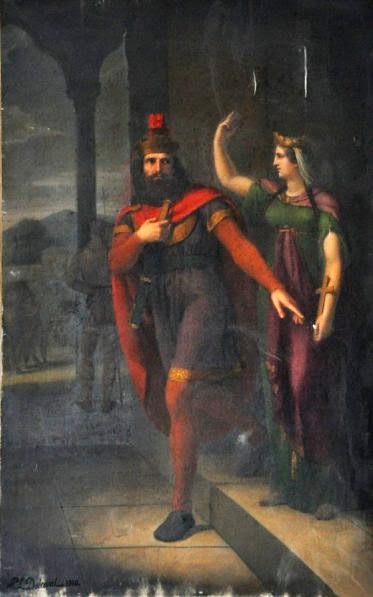
François-Louis Dejuinne (1786–1844)
Clovis 1st king of the Franks (465-511), c. 1837
Oil on canvas
Height: 145.5 cm (57.2 ″); Width: 92 cm (36.2 ″)
Palace of Versailles

On the death of Childeric, his son Clovis succeeded him and consolidated control of the land from the Rhine to the Loire.( c. 466 – c. 511) (The first king to unite all of the Frankish tribes under one ruler. He is considered the founder of the Merovingian dynasty, c. 466 – c. 511) was the first king of the Franks to unite all of the Frankish tribes under one ruler. He is considered the founder of the Merovingian dynasty.) He married Childeric's elder daughter, Clothilde.

François-Louis Dejuinne (1786–1844) was a French painter. He was born in Paris in 1786, and learned the art of painting under Girodet. He visited Rome, where he studied the works of Titian, Paolo Veronese, and other great masters. He died in Paris in 1844. His paintings were mostly historical; among them are the 'Ascension of the Virgin ' and 'St. Geneviève' for Notre-Dame de Lorette, and 'The Four Seasons' for the Trianon Palace. More on François-Louis Dejuinne

Pierre-Louis Delaval (1818)
Sainte Clotilde urging Clovis before the battle
Chapelle Sainte-Geneviève

Geneviève became his trusted counsellor. Clovis entered a harsh battle and promised to be baptized, if he should win. He won and under the influence of Geneviève, he converted in 496. His people and servants followed suit.

Pierre-Louis Delaval, born April 27, 1790 in Paris where he died around 1870, is a French painter.

A pupil of Girodet-Trioson , Delaval began at the Salon of 1810 with two historical pictures which had him included in the small number of artists exempted from conscription by imperial decree. A compliant imitator of his master in his early days, he showed, in the second half of his career, the qualities of colorist and draftsman who could have classified him among the masters if they had been developed by a more vigorous temperament.

Delaval painted mainly history and religious subjects. The historical galleries of Versailles also owe him many portraits. He obtained a second medal in 1817. More on Pierre-Louis Delaval

Master of Saint Giles (d. 511)
The Baptism of Clovis, c. 1500
Wood
National Gallery of Art, Washington

This was painted about a thousand years after Saint Rémy baptized the Frankish King Clovis, thereby converting him to Christianity. Master of Saint Giles has transferred the historic event from Reims to the interior of the Sainte-Chapelle in Paris, thus providing the earliest known record of the interior of the famous, still extant, building.

By the time she died King Clovis of the Franks had grown to venerate the saint. It was at Geneviève's suggestion that Clovis began to build the church of SS. Peter and Paul in the middle of Paris, where they interred her body. Later the church was renamed Sainte Geneviève and it was rebuilt in 1746.

The Master of Saint Giles was a Franco-Flemish painter active, probably in Paris, about 1500, working in a delicate Late Gothic manner, with rendering of textures and light and faithful depictions of actual interiors that show his affinities with Netherlandish painting. It is not clear whether the Master of Saint Giles was a French painter who trained in the Low Countries, or a Netherlander who emigrated to France.

His pseudonym was given him by Max Friedländer, who reconstructed part of the anonymous painter's oeuvre, starting from two panels that were part of the lefthand shutter of an altarpiece, and two further panels, now in Washington, from the same altarpiece. The hand of an assistant can be discerned in the Baptism of Clovis at the National Gallery of Art, Washington. All four panels have, or had, single grisaille figures of saints (Saints Peter, Giles, Denis and an unidentified bishop-saint) in niches, imitating sculpture, on the reverse. The Washington pair, which were in poor condition, have been separated and are lost, although photographs exist. Undoubtedly there were further panels, whose subjects cannot be guessed, as the combination of scenes is original. More on The Master of Saint Giles


Church of St. Genevieve, Paris
Miracles performed at her tomb made her and the Church famous all over France

 Clovis roi des Francs, (1726–1806)
Miracles of the Ardents, c. 1773
Church of St Genevieve at St Roch

Miracle des Ardens or burning fever (ergot-poisoning) in 1129. Bishop Stephen of Paris had her shrine carried through the streets in solemn procession. Many thousands of the sick who saw or touched the shrine were immediately cured, and only several deaths from the plague were said to have occurred thereafter.

Gabriel François Doyen (1726 – 5 June 1806) was a French painter, who was born at Paris.

He became an artist against his father's wishes, becoming a pupil at the age of twelve of Charles-André van Loo. Making rapid progress, he obtained at twenty the Grand Prix de Rome, and in 1748 set out for Rome, then visited Naples, Bologna and, crucially, Venice. While in the latter city Doyen was greatly influenced by the work of the famous colourists, such as Titian.

In 1755 he returned to Paris and, at first unappreciated and disparaged, he resolved by one grand effort to achieve a reputation, and in 1758 he exhibited his Death of Virginia. It was completely successful, and procured him admission to the Académie Royale de Peinture et de Sculpture. Doyen was also influenced by Peter Paul Rubens after a visit to Antwerp. This influence is, perhaps, best displayed in his Le Miracle des ardents, painted for the church of St Genevieve at St Roch (1767). This painting was exhibited in the salon of 1767. In 1776 he was appointed professor at the Academy.

During the initial stages of the French Revolution he became active in the national museum project; however in 1791 he left France for Russia on the invitation of Catherine II of Russia. He settled in St Petersburg, where he was much honoured by the Imperial family and Russian art establishment. He died there on 5 June 1806. More on Gabriel François Doyen

Maurice Quentin de La Tour
Portrait of King Louis XV, c. 1748
Pastel
64x54
Louvre Museum

In 1741, Louis XV came to her church to thank her for a cure wrought at her intercession.

Maurice-Quentin de La Tour, (born Sept. 5, 1704, Saint-Quentin, France—died Feb. 17, 1788, Saint-Quentin), pastelist whose animated and sharply characterized portraits made him one of the most successful and imitated portraitists of 18th-century France.

Early in his youth La Tour went to Paris, where he entered the studio of the Flemish painter Jacques Spoede. He then went to Reims, Cambrai (1724), and England (c. 1725), returning to Paris to resume his studies in about 1727.

In 1737 La Tour exhibited the first of a splendid series of 150 portraits that formed one of the glories of the Salon for the next 37 years. He was able to endow his sitters with a distinctive air of charm and intelligence, and he excelled at capturing the delicate play of facial features. In 1746 he was received into the Academy and in 1751 was promoted to councillor. La Tour was made portraitist to the king in 1750, a position he held until 1773. La Tour retired at age 80 to Saint-Quentin. More on Maurice-Quentin de La Tour

Jean-Pierre Houël, (1735–1813)
Prise de la Bastille/ The Storming of the Bastille, c. 1789
Watercolor
Height: 50.5 cm (19.8 ″); Width: 37.8 cm (14.8 ″)
Bibliothèque nationale de France

In the center is the arrest of Bernard René Jourdan, governor of the Bastille, and his wife

When the Bastille was taken, people again came to thank her. In 1790, the Commune went to her church for Mass.

Jean-Pierre-Louis-Laurent Houël (28 June 1735 – 14 November 1813) was a French painter, engraver and draftsman. During his long life Houël witnessed the reign of Louis XV, the French Revolution, and the period of Napoleon's First Empire.

He was born at Rouen into a family of prosperous artisans, who sent him to the city's drawing academy when he was fifteen.

He was exposed to the art of early Dutch and Flemish painters, which was to have a defining impact on his chosen specialty of landscape painting. In 1758 Houël published a book of landscape engravings, and in 1768 he painted six views of the Duc de Choiseul's country estate, the Château de Chanteloup. The following year his influential patrons secured a place for him at the French Academy in Rome. Here, captivated with Italian customs, landscapes, and ancient sites, he traveled throughout southern Italy, making gouache drawings, which he presented at the Paris Salons of the early 1770s, exhibits that drew the attention of a wide public.

He spent the years 1776 to 1779 traveling in Sicily, Lipari, and Malta, after which, based on his journey, he published a series of four volumes of lavishly illustrated travel books (1782–1787). Houël's main intention was to illustrate local topography, but his delicate applications of watercolor also magnificently captured the effects of light and atmosphere. To help finance these projects, he sold his preliminary drawings in Paris in 1780. Louis XVI purchased 46, and Catherine II of Russia, more than 500, of which 260 are preserved at the Hermitage Museum in St. Petersburg.

In his later years Houël published two illustrated treatises on elephants. Drawings of other animals suggest he was preparing to publish further zoological works; however, his death at the age of seventy-eight cut short his plans. More on Jean-Pierre-Louis-Laurent Houël



Please visit my other blogs: Art CollectorMythologyMarine ArtPortrait of a Lady, The OrientalistArt of the Nude and The Canals of VeniceMiddle East Artists365 Saints365 Days, and Biblical Icons, also visit my Boards on Pinterest and my art stores at  deviantart and Aaroko

Images are copyright of their respective owners, assignees or others. Some Images may be subject to copyright

I don't own any of these images - credit is always given when due unless it is unknown to me. if I post your images without your permission, please tell me.

Ads are shown only to compensate the hosting expenses.

If you enjoyed this post, please share with friends and family.

Thank you for visiting my blog and also for liking its posts and pages.

Please note that the content of this post primarily consists of articles available from Wikipedia or other free sources online.


Sunday, December 29, 2024

04 works, Today, December 29th, is The Holy Innocents' day, or The Massacre in Gaza, their story, illustrated #361

Angelo Visconti, (1829–1861)
The Massacre of the Innocents, c. 1860 - 1861
Oil on canvas
Height: 100.50 mm (3.95 in); Width: 74.50 mm (2.93 in)
Cassioli Museum, Asciano, Italy

Angelo Viscónti (1829–1861) was an Italian painter, mainly depicting turbulent scenes including historic and sacred subjects.

He was born in Siena and trained under Luigi Mussini. In 1854-1855, he won a traveling stipend along with Amos Cassioli. He moved to live with Cassioli in Rome in 1858.[1] He suffered an epileptic convulsion while in the Tiber River in Rome, and drowned. More on Angelo Viscónti

Herod “the Great,” king of Judea, was unpopular with his people because of his connections with the Romans and his religious indifference. Hence he was insecure and fearful of any threat to his throne. He was a master politician and a tyrant capable of extreme brutality. He killed his wife, his brother, and his sister’s two husbands, to name only a few.

Herod was “greatly troubled” when astrologers from the east came asking the whereabouts of “the newborn king of the Jews,” whose star they had seen. They were told that the Jewish Scriptures named Bethlehem as the place where the Messiah would be born. Herod cunningly told them to report back to him so that he could also “do him homage.” They found Jesus, offered him their gifts, and warned by an angel, avoided Herod on their way home. 

Jacopo Tintoretto, (1519–1594)
The Massacre of the Innocents, between 1582 and 1587
Height: 422 cm (13.8 ft); Width: 546 cm (17.9 ft)
Scuola Grande di San Rocco, Venice, Italy

Tintoretto; born Jacopo Comin, (October, 1518 – May 31, 1594) was an Italian painter and a notable exponent of the Renaissance school. For his phenomenal energy in painting he was termed Il Furioso. His work is characterized by its muscular figures, dramatic gestures, and bold use of perspective in the Mannerist style, while maintaining color and light typical of the Venetian School.
 
In his youth, Tintoretto was also known as Jacopo Robusti as his father had defended the gates of Padua in a way that others called robust, against the imperial troops during the War of the League of Cambrai (1509–1516). His real name "Comin" has only recently been discovered by Miguel Falomir, the curator of the Museo del Prado, Madrid, and was made public on the occasion of the retrospective of Tintoretto at the Prado in 2007. More on Tintoretto

Peter Paul Rubens, (1577–1640)
Massacre of the Innocents, between 1611 and 1612
Oil on oak wood
Height: 142 cm (55.9 in); Width: 182 cm (71.6 in)
Art Gallery of Ontario, Ontario, Canada 

Sir Peter Paul Rubens (28 June 1577 – 30 May 1640) was a Flemish Baroque painter. A proponent of an extravagant Baroque style that emphasized movement, colour, and sensuality, Rubens is well known for his Counter-Reformation altarpieces, portraits, landscapes, and history paintings of mythological and allegorical subjects.

In addition to running a large studio in Antwerp that produced paintings popular with nobility and art collectors throughout Europe, Rubens was a classically educated humanist scholar and diplomat who was knighted by both Philip IV of Spain and Charles I of England.  More Sir Peter Paul Rubens

Herod realized that he had been outwitted by the Magi, he was furious, and he gave orders to kill all the boys in Bethlehem and its vicinity who were two years old and under, in accordance with the time he had learned from the Magi.

William Holman Hunt,  (1827–1910)
The Triumph of the Innocents, circa 1883
Oil on canvas
Height: 1,562 cm (17 yd); Width: 254 cm (100 in)
Tate Britain 

Hunt began painting this subject while on a visit to the Holy Land in the 1870s. He originally intended to show just the Holy Family, but he later decided to add the martyred innocents. The Holy Family are surrounded by the spirits of the children slain by Herod. Hunt wanted the bubbles, or ‘airy globes’ which accompany the procession, to convey a sense of the waves of ‘the streams of eternal life’. More on this work

William Holman Hunt OM (2 April 1827 – 7 September 1910) was an English painter and one of the founders of the Pre-Raphaelite Brotherhood. His paintings were notable for their great attention to detail, vivid color, and elaborate symbolism. These features were influenced by the writings of John Ruskin and Thomas Carlyle, according to whom the world itself should be read as a system of visual signs. For Hunt it was the duty of the artist to reveal the correspondence between sign and fact. Of all the members of the Pre-Raphaelite Brotherhood, Hunt remained most true to their ideals throughout his career. He was always keen to maximize the popular appeal and public visibility of his works. More on William Holman Hunt

An angel appeared to Joseph in a dream and warned him to take Jesus and his mother into Egypt

In medieval England children were reminded of the mournfulness of the day by being whipped in bed in the morning; this custom survived into the 17th century. More on Feast of the Holy Innocents


Please visit my other blogs: Art CollectorMythologyMarine ArtPortrait of a Lady, The OrientalistArt of the Nude and The Canals of VeniceMiddle East Artists365 Saints365 Days, and Biblical Icons, also visit my Boards on Pinterest and my art stores at  deviantart and Aaroko

Images are copyright of their respective owners, assignees or others. Some Images may be subject to copyright

I don't own any of these images - credit is always given when due unless it is unknown to me. if I post your images without your permission, please tell me.

Ads are shown only to compensate the hosting expenses.

If you enjoyed this post, please share with friends and family.

Thank you for visiting my blog and also for liking its posts and pages.

Please note that the content of this post primarily consists of articles available from Wikipedia or other free sources online.


Saturday, January 2, 2021

10 works, Today, January 2nd, is Saint Seraphim of Sarov's day, his story, illustrated #365

Unknown artist
Saint Seraphim
Oil on canvas
I have no further description, at this time

Saint Seraphim of Sarov (1754– 1833), born Prokhor Moshnin is one of the most renowned Russian saints and venerated both in the Eastern Orthodox Church and the Catholic Church. He is generally considered the greatest of the 19th-century startsy, elders. 

Seraphim was canonized by the Russian Orthodox Church in 1903. Alongside his veneration in the Catholic calendar, Pope John Paul II also referred to him as a Saint

In 1777, at the age of 19, he joined the Sarov monastery as a novice. He was officially took his monastic vows in 1786 and given the religious name of Seraphim. Shortly afterwards, he was ordained a monastic deacon. In 1793, he was ordained as a monastic priest and became the spiritual leader of the Diveyevo Convent, which has since come to be known as the Seraphim-Diveyevo Convent.

Unknown iconographe
The Virgin Mary tells Saint Seraphim began admitting pilgrims to his hermitage
I have no further description, at this time

Soon after this, Seraphim retreated to a log cabin in the woods outside Sarov monastery and led a solitary lifestyle as a hermit for 25 years. During this time his feet became swollen to the point that he had trouble walking. Sarov's eating and fasting habits became more strict. At first he ate bread obtained from the monastery and vegetables from his garden, then only vegetables. For three years, he ate only grass.

Unknown iconographer
Thieves who beat Saint Seraphim mercilessly
Sarov Monastery
I have no further description, at this time

Unknown iconographer
Seraphim of Sarov had a hunched back for the rest of his life
I have no further description, at this time

One day, while chopping wood, Seraphim was attacked by a gang of thieves who beat him mercilessly with the handle of his own axe. He never resisted, and was left for dead. The robbers never found the money they sought, only an icon of the Theotokos, the Virgin Mary, in his hut. Seraphim had a hunched back for the rest of his life. However, at the thieves' trial he pleaded to the judge for mercy on their behalf.

Unknown iconographer
Seraphim spent 1,000 successive nights on a rock
I have no further description, at this time

Unknown iconographer
Seraphim spent continuous prayer with his arms raised to the sky
I have no further description, at this time

After this incident Seraphim spent 1,000 successive nights on a rock in continuous prayer with his arms raised to the sky, a feat of asceticism deemed miraculous by the Eastern Orthodox Church, especially considering the pain from his injuries.

Unknown Russian artist, Active in the 20th century
Saint Seraphim feeding a bear outside of his hermitage
Oil on canvas
33 cm x 39 cm. 
Private collection

In 1815, in obedience to a reputed spiritual experience that he attributed to the Virgin Mary, Seraphim began admitting pilgrims to his hermitage as a confessor. 

Unknown iconographer
Hundreds of pilgrims per day visited Saint Seraphim
Seraphim-Diveyevo Convent.

He soon became immensely popular due to his reputation for healing powers and gift of prophecy. Hundreds of pilgrims per day visited him, drawn as well by his ability to answer his guests' questions before they could ask.

Unknown iconographer
Saint Seraphim von Sarov prayed to help his spiritual student Nicholai Motovilov to receive the gift of the Holy Spirit 
I have no further description, at this time

As extraordinarily harsh as Seraphim often was to himself, he was kind and gentle toward others — always greeting his guests with a prostration, a kiss, and exclaiming "Christ is risen!", and calling everyone "My joy." 

Unknown iconographer
Saint Seraphim died while kneeling before an Umilenie icon of the Theotokos
I have no further description, at this time

He died while kneeling before an Umilenie icon of the Theotokos which he called "Joy of all Joys". This icon is kept currently in the chapel of the residence of the Patriarch of Moscow.


Please visit my other blogs: Art CollectorMythologyMarine ArtPortrait of a Lady, The OrientalistArt of the Nude and The Canals of VeniceMiddle East Artistsand 365 Saints, also visit my Boards on Pinterest

Images are copyright of their respective owners, assignees or others. Some Images may be subject to copyright

I don't own any of these images - credit is always given when due unless it is unknown to me. if I post your images without your permission, please tell me.

I do not sell art, art prints, framed posters or reproductions. Ads are shown only to compensate the hosting expenses.

If you enjoyed this post, please share with friends and family.

Thank you for visiting my blog and also for liking its posts and pages.

Please note that the content of this post primarily consists of articles available from Wikipedia or other free sources online.


Thursday, December 31, 2020

08 works, Today, December 31st, is Saint Columba (known as the patron saint of witches) of Sens' day, her story, illustrated #363

Giovanni Baronzio, (–1362)
Stories from the life of St. Columba, 1345-1350 circa
Tempera on wood
Pinacoteca di Brera, Milan , Italy

Giovanni Baronzio, also known as Giovanni da Rimini, (died before 1362), was an Italian painter who was active in Romagna and the Marche region during the second quarter of the 14th century. Giovanni Baronzio was the eminent representative of the second generation of painters of the school of Rimini. More on Giovanni Baronzio

Columba was born to a noble pagan family in Zaragoza, the northwestern region of Spain. Her original name was probably Eporita, and she was a member of a very influential noble family. Her relatives worshiped the old deities and didn't follow the new religion. Members of her family were some of the most important people related to the Roman Empire. 

Columba fled as a child to Vienne, France and was baptized, receiving the name Columba, meaning "dove" in French. She left Spain for France because she had been told it was where "a more beautiful religion flourished" and because she "had an insurmountable horror of idols", and to avoid being denounced as a Christian. Columba continued to Sens, near Paris in north-central France, where she was martyred in 273.

Pellegrino da San Daniele, (1467–1547)
Detail; Santa Colomba
Parish church of Osoppo,  Province of Udine in the Italy

Madonna with Child enthroned among Saints Peter, Colomba, John the Baptist, Ermacora, Magdalene, Giacomo, Stefano, Sebastiano and five musician angels

Pellegrino da San Daniele (1467–1547) was an Italian painter in the late-Quattrocento and Renaissance styles, active in the Friulian region.

Born at San Daniele del Friuli, he is also known as Martino da Udine. He completed frescoes in the church of San Antonio in the town of San Daniele. He later was strongly influenced by Il Pordenone. Among his pupils were Luca Monverde, Girolamo da Udine, and Sebastiano Florigerio. More on Pellegrino da San Daniele

Specialists in the lives of saints suggest that Columba of Sens is the same woman as Columba of Spain, who lived during the 9th century AD. Columba of Spain is known as the patron saint of witches, a curious notion in and of itself. On the one hand, she acts as an intercessor on behalf of witches, while on the other hand, people go to her to defend themselves against witches.

Giovanni Baronzio, (1343 circa - 1362)
Detail; Colomba before the Emperor, c. 1340s
Tempera on wood
Pinacoteca di Brera, Milan , Italy

See above for Giovanni Baronzio

Aurelian, the Roman emperor (270-275), passed through Sens and put all the Christians there to death. "Alone, Columba found favour in his eyes, such was the nobility and the beauty of her features revealing her high origin". He wanted her to marry his son, but she refused, so he locked her up in a brothel in the town amphitheater. 

Giovanni Baronzio, (1343 circa - 1362)
Detail; St Colomba Saved by a Bear, c. 1340s
Tempera on wood
Pinacoteca di Brera, Milan , Italy

See above for Giovanni Baronzio

Jacques Callot,
St Columba watching a guard being attacked by a bear, in an amphitheater, c. 1632-1635
Etching
British Museum

Jacques Callot, (born March–August 1592, Nancy, France—died March 24, 1635, Nancy), French printmaker who was one of the first great artists to practice the graphic arts exclusively. His innovative series of prints documenting the horrors of war greatly influenced the socially conscious artists of the 19th and 20th centuries.

He learned the technique of engraving in Rome. About 1612 he went to Florence. At that time Medici patronage expended itself almost exclusively in feste, quasi-dramatic pageants, sometimes dealing in allegorical subjects, and Callot was employed to make pictorial records of these mannered, sophisticated entertainments. He succeeded in evolving a naturalistic style while preserving the artificiality of the occasion, organizing a composition as if it were a stage setting and reducing the figures to a tiny scale, each one indicated by the fewest possible strokes. This required a very fine etching technique. His breadth of observation, his lively figure style, and his skill in assembling a large, jostling crowd secured for his etchings a lasting popular influence all over Europe.

He illustrated sacred books, made a series of plates of the Apostles, and visited Paris to etch animated maps of the sieges of La Rochelle and the Île de Ré. In his last great series of etchings, the “small” (1632) and the “large” (1633) The Miseries and Misfortunes of War, he brought his documentary genius to bear on the atrocities of the Thirty Years’ War. Callot is also well known for his landscape drawings in line and wash and for his quick figure studies in chalk. More on Jacques Callot


 Antonio Tempesta
Sts Columba and Mustiola, c. 1570-1591
Etching
Height: 73 millimetres, Width: 118 millimetres
British Museum

Sts Columba and Mustiola; St Mustiola at centre hanging from a frame by her hands tied above her head, and with a stone tied to her feet, with a torturer standing to right scourging her; behind to left, St Columba praying with a bear behind her.

Antonio Tempesta (1555 – 5 August 1630) was an Italian painter and engraver, whose art acted as a point of connection between Baroque Rome and the culture of Antwerp.
He was born and trained in Florence and painted in a variety of styles, influenced to some degree by "Counter-Maniera" or Counter-Mannerism. He enrolled in the Florentine Accademia delle Arti del Disegno in 1576. He was a pupil of Santi di Tito, then of the Flemish painter Joannes Stradanus. He was part of the large team of artists working under Giorgio Vasari on the interior decoration of the Palazzo Vecchio in Florence.
His favourite subjects were battles, cavalcades, and processions. He relocated to Rome, where he associated with artists from the Habsburg Netherlands, which may have led to his facility with landscape painting. More Antonio Tempesta

While Columba was imprisoned, someone tried to rape her, but she was saved by a she-bear. Aurelian was furious and decided to burn the animal and Columba together, but the bear escaped and survived, while a "provincial rain put out the fire". Columba was condemned to death and beheaded near a fountain named d'Azon. Her body was left on the ground after she was killed, but a man named Aubertus, who had prayed to her for the restoration of his sight, took care of her burial.

Giovanni Baronzio, (1343 circa - 1362)
Detail; Beheading of St Colomba c. 1340s
Tempera on wood
Pinacoteca di Brera, Milan , Italy

The Galician version of the legend about the saint says that St Columba was a witch who met Jesus Christ on the road. He told her that she would not enter his kingdom, so she decided to change her life. However, it seems that she remained a witch while being a Christian. This was a common mixture in the early times of Christianity.

Maestro de Villamediana
Martyrdom of St. Columba
Diocesan Museum of Palencia (Spain)

I have no information about this artist!

During the first centuries of Christianity and even medieval times, it was quite common for women who were witches to try to enter safe places like monasteries. These witches weren't what the newly growing religion wanted them to be. They were well educated women, who knew about nature and had skills to help and heal. With the appearance of the new monotheistic religion the tradition of witchcraft lost its place. Many of these women wanted to continue cultivating the ancient wisdom no matter what, so they joined safe places where they could plant their herbs and spend time with books – in the convents of the nuns. More on Columba of Sens


Please visit my other blogs: Art CollectorMythologyMarine ArtPortrait of a Lady, The OrientalistArt of the Nude and The Canals of VeniceMiddle East Artists365 Saints365 Days, and Biblical Icons, also visit my Boards on Pinterest and my art stores at  deviantart and Aaroko

Images are copyright of their respective owners, assignees or others. Some Images may be subject to copyright

I don't own any of these images - credit is always given when due unless it is unknown to me. if I post your images without your permission, please tell me.

Ads are shown only to compensate the hosting expenses.

If you enjoyed this post, please share with friends and family.

Thank you for visiting my blog and also for liking its posts and pages.

Please note that the content of this post primarily consists of articles available from Wikipedia or other free sources online.