Showing posts with label fine art. Show all posts

Friday, January 3, 2025

15 works, Today, January 3rd, is Saint Genevieve's day, her story, illustrated #003

Puvis de Chavannes
L'Enfance de Sainte Geneviève" (detailles), 1876 - 1878
Oil on canvas
Norton Simon Museum

St. Genevieve (422-512), was born at Nanterre, a village on the outskirts of Paris, during the time of Attila the Hun. She was a shepherdess, the only child of Severus and Gerontia, hardworking peasants. She was seven years old when Saint Germanus, bishop of Auxerre, was visiting the village with Saint Lupus, on their way to great Britain to combat the heresy of Pelagius. Seeing Genevieve in the crowd, Bishop St. Germain laid his hands on her head, and asked if she wanted to give herself to the Lord. Genevieve said “Yes!” Her mother opposed her decision, which angered Genevieve tremendously. Genevieve’s mother was struck blind until she was forgiven by her daughter. Taking a gold coin from his purse, Saint Germanus gave it to her, telling her to keep it always as a reminder of that day and of God to whom her life belonged.

Pierre Puvis de Chavannes (14 December 1824 – 24 October 1898) was a French painter best known for his mural painting, who came to be known as 'the painter for France'. He became the co-founder and president of the Société Nationale des Beaux-Arts, and his work influenced many other artists, notably Robert Genin. Puvis de Chavannes was a prominent painter in the early Third Republic. Émile Zola described his work as "an art made of reason, passion, and will" More on Pierre Puvis de Chavannes

Flemish School, late 16th century
Saint Genevieve keeping her sheep, from 1575 until 1600
Carnavalet Museum, Paris

Sainte Genevieve watching over her flock protected by a stone circle. When she did not destroy these prehistoric megaliths, the Church tried to Christianize the symbols "diabolic"

Flemish School painting flourished from the early 15th century until the 17th century. Flanders delivered the leading painters in Northern Europe and attracted many promising young painters from neighbouring countries. These painters were invited to work at foreign courts and had a Europe-wide influence. Since the end of the Napoleonic era, Flemish painters had again been contributing to a reputation that had been set by the Old Masters. More FLEMISH SCHOOL

Charles Sprague Pearce (1851-1914)
Sainte Genevieve, c. 1887
Oil on canvas
82 x 66 in
Frye Art Museum, Seattle, Washington, USA

On the deaths of her parents, she went to live with her godmother Lutetia in Paris, where she became a nun and dedicated herself to a Christian life. (Coincidentally, "Lutetia" was the former name of the city of Paris). She experienced visions and prophecies, which initially evoked hostility from Parisians--to the point that an attempt was made to take her life. But the support of Germanus, who visited her again, and the accuracy of her predictions eventually changed their attitudes. (Germanus also corrected some of her harsher penances during this visit.)

Charles Sprague Pearce (October 13, 1851 – May 18, 1914) was an American artist. Pearce was born at Boston, Massachusetts. In 1873 he became a pupil of Léon Bonnat in Paris, and after 1885 he lived in Paris and at Auvers-sur-Oise. He painted Egyptian and Algerian scenes, French peasants, and portraits, and also decorative work, notably for the Thomas Jefferson Building at the Library of Congress at Washington. He received medals at the Paris Salon and elsewhere, and was made Chevalier of the French Legion of Honor, decorated with the Order of Leopold, Belgium, the Order of the Red Eagle, Prussia, and the Order of the Dannebrog, Denmark. More on Charles Sprague Pearce

Lucas Cranach the Elder (1472-1553)
Detail from Saints Genevieve and Apollonia, c. 1506
Oil on lime
120.5 x 63 cm
The National Gallery, Trafalgar Square, London

This painting is part of the group: The St Catherine Altarpiece: Reverses of Shutters
Saint Genevieve of Paris holds the candle which she miraculously relit. On the brooch at her neck are the alpha and omega signs.

She loved to pray in church alone at night. One day a gust of wind blew out her candle, leaving her in the dark. Geneviève merely concluded that the devil was trying to frighten her. For this reason she is often depicted holding a candle, sometimes with an irritated devil standing near.

Lucas Cranach the Elder (c. 1472 – 16 October 1553) was a German Renaissance painter and printmaker in woodcut and engraving. He was court painter to the Electors of Saxony for most of his career, and is known for his portraits, both of German princes and those of the leaders of the Protestant Reformation, whose cause he embraced with enthusiasm, becoming a close friend of Martin Luther. He also painted religious subjects, first in the Catholic tradition, and later trying to find new ways of conveying Lutheran religious concerns in art. He continued throughout his career to paint nude subjects drawn from mythology and religion. He had a large workshop and many works exist in different versions; his son Lucas Cranach the Younger, and others, continued to create versions of his father's works for decades after his death. Lucas Cranach the Elder has been considered the most successful German artist of his time. More Lucas Cranach the Elder

Unknown seventeenth-century Artist
Saint Genevieve, Defender of Paris
Musée Carnavalet, Salle Henri III, Paris

In 451, When Attila the Hun approached Paris, with the help of Germanus' archdeacon, she upbraided the panic-stricken people of Paris who wanted to leave town. She reassured the people that they had the protection of heaven. Many of the inhabitants lost heart and fled in panic, but Geneviève again gathered the women around her, and led them out on to the ramparts of the city, where in the morning light and in the face of the spears of the enemy they prayed to God for deliverance. Providentially, the same night, the invader turned south to Orleans. 

Pierre-Cécile Puvis de Chavannes (1824 - 1898)
St. Genevieve Bringing Supplies to the City of Paris after the Siege
Fresco 
Paris, Pantheon

When Childeric I ( 440 – 481/482) (A Merovingian king of the Salian Franks) besieged the Paris in 464 and conquered it, she acted as an intermediary between the city and its conqueror. 

Pierre Puvis de Chavannes (14 December 1824 – 24 October 1898) was a French painter best known for his mural painting, who came to be known as 'the painter for France'. He became the co-founder and president of the Société Nationale des Beaux-Arts, and his work influenced many other artists, notably Robert Genin. Puvis de Chavannes was a prominent painter in the early Third Republic. Émile Zola described his work as "an art made of reason, passion, and will" More on Pierre Puvis de Chavannes

St. Geneviève

Geneviève took a boat and rowed out alone (more likely at the head of a company) upon the river into the darkness to Arcis-sur-Aube and Troyes. She slipped silently and secretly past the lines of the enemy, landing at dawn far outside the city, where she went from village to village imploring help and gathering food, and returned to Paris--again successfully evading the enemy--with eleven boatloads of precious corn. (Other sources say that nightly she captained eleven barges to collect grain in the Champagne region). 

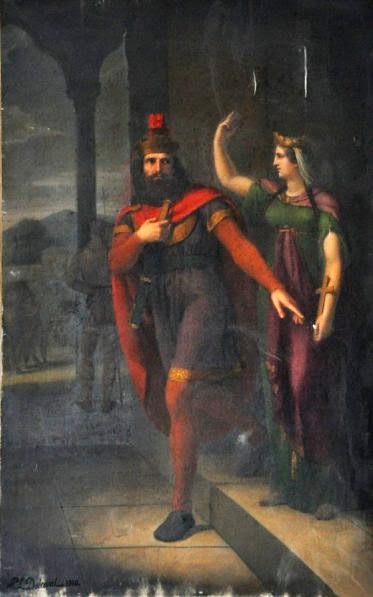
François-Louis Dejuinne (1786–1844)
Clovis 1st king of the Franks (465-511), c. 1837
Oil on canvas
Height: 145.5 cm (57.2 ″); Width: 92 cm (36.2 ″)
Palace of Versailles

On the death of Childeric, his son Clovis succeeded him and consolidated control of the land from the Rhine to the Loire.( c. 466 – c. 511) (The first king to unite all of the Frankish tribes under one ruler. He is considered the founder of the Merovingian dynasty, c. 466 – c. 511) was the first king of the Franks to unite all of the Frankish tribes under one ruler. He is considered the founder of the Merovingian dynasty.) He married Childeric's elder daughter, Clothilde.

François-Louis Dejuinne (1786–1844) was a French painter. He was born in Paris in 1786, and learned the art of painting under Girodet. He visited Rome, where he studied the works of Titian, Paolo Veronese, and other great masters. He died in Paris in 1844. His paintings were mostly historical; among them are the 'Ascension of the Virgin ' and 'St. Geneviève' for Notre-Dame de Lorette, and 'The Four Seasons' for the Trianon Palace. More on François-Louis Dejuinne

Pierre-Louis Delaval (1818)
Sainte Clotilde urging Clovis before the battle
Chapelle Sainte-Geneviève

Geneviève became his trusted counsellor. Clovis entered a harsh battle and promised to be baptized, if he should win. He won and under the influence of Geneviève, he converted in 496. His people and servants followed suit.

Pierre-Louis Delaval, born April 27, 1790 in Paris where he died around 1870, is a French painter.

A pupil of Girodet-Trioson , Delaval began at the Salon of 1810 with two historical pictures which had him included in the small number of artists exempted from conscription by imperial decree. A compliant imitator of his master in his early days, he showed, in the second half of his career, the qualities of colorist and draftsman who could have classified him among the masters if they had been developed by a more vigorous temperament.

Delaval painted mainly history and religious subjects. The historical galleries of Versailles also owe him many portraits. He obtained a second medal in 1817. More on Pierre-Louis Delaval

Master of Saint Giles (d. 511)
The Baptism of Clovis, c. 1500
Wood
National Gallery of Art, Washington

This was painted about a thousand years after Saint Rémy baptized the Frankish King Clovis, thereby converting him to Christianity. Master of Saint Giles has transferred the historic event from Reims to the interior of the Sainte-Chapelle in Paris, thus providing the earliest known record of the interior of the famous, still extant, building.

By the time she died King Clovis of the Franks had grown to venerate the saint. It was at Geneviève's suggestion that Clovis began to build the church of SS. Peter and Paul in the middle of Paris, where they interred her body. Later the church was renamed Sainte Geneviève and it was rebuilt in 1746.

The Master of Saint Giles was a Franco-Flemish painter active, probably in Paris, about 1500, working in a delicate Late Gothic manner, with rendering of textures and light and faithful depictions of actual interiors that show his affinities with Netherlandish painting. It is not clear whether the Master of Saint Giles was a French painter who trained in the Low Countries, or a Netherlander who emigrated to France.

His pseudonym was given him by Max Friedländer, who reconstructed part of the anonymous painter's oeuvre, starting from two panels that were part of the lefthand shutter of an altarpiece, and two further panels, now in Washington, from the same altarpiece. The hand of an assistant can be discerned in the Baptism of Clovis at the National Gallery of Art, Washington. All four panels have, or had, single grisaille figures of saints (Saints Peter, Giles, Denis and an unidentified bishop-saint) in niches, imitating sculpture, on the reverse. The Washington pair, which were in poor condition, have been separated and are lost, although photographs exist. Undoubtedly there were further panels, whose subjects cannot be guessed, as the combination of scenes is original. More on The Master of Saint Giles


Church of St. Genevieve, Paris
Miracles performed at her tomb made her and the Church famous all over France

 Clovis roi des Francs, (1726–1806)
Miracles of the Ardents, c. 1773
Church of St Genevieve at St Roch

Miracle des Ardens or burning fever (ergot-poisoning) in 1129. Bishop Stephen of Paris had her shrine carried through the streets in solemn procession. Many thousands of the sick who saw or touched the shrine were immediately cured, and only several deaths from the plague were said to have occurred thereafter.

Gabriel François Doyen (1726 – 5 June 1806) was a French painter, who was born at Paris.

He became an artist against his father's wishes, becoming a pupil at the age of twelve of Charles-André van Loo. Making rapid progress, he obtained at twenty the Grand Prix de Rome, and in 1748 set out for Rome, then visited Naples, Bologna and, crucially, Venice. While in the latter city Doyen was greatly influenced by the work of the famous colourists, such as Titian.

In 1755 he returned to Paris and, at first unappreciated and disparaged, he resolved by one grand effort to achieve a reputation, and in 1758 he exhibited his Death of Virginia. It was completely successful, and procured him admission to the Académie Royale de Peinture et de Sculpture. Doyen was also influenced by Peter Paul Rubens after a visit to Antwerp. This influence is, perhaps, best displayed in his Le Miracle des ardents, painted for the church of St Genevieve at St Roch (1767). This painting was exhibited in the salon of 1767. In 1776 he was appointed professor at the Academy.

During the initial stages of the French Revolution he became active in the national museum project; however in 1791 he left France for Russia on the invitation of Catherine II of Russia. He settled in St Petersburg, where he was much honoured by the Imperial family and Russian art establishment. He died there on 5 June 1806. More on Gabriel François Doyen

Maurice Quentin de La Tour
Portrait of King Louis XV, c. 1748
Pastel
64x54
Louvre Museum

In 1741, Louis XV came to her church to thank her for a cure wrought at her intercession.

Maurice-Quentin de La Tour, (born Sept. 5, 1704, Saint-Quentin, France—died Feb. 17, 1788, Saint-Quentin), pastelist whose animated and sharply characterized portraits made him one of the most successful and imitated portraitists of 18th-century France.

Early in his youth La Tour went to Paris, where he entered the studio of the Flemish painter Jacques Spoede. He then went to Reims, Cambrai (1724), and England (c. 1725), returning to Paris to resume his studies in about 1727.

In 1737 La Tour exhibited the first of a splendid series of 150 portraits that formed one of the glories of the Salon for the next 37 years. He was able to endow his sitters with a distinctive air of charm and intelligence, and he excelled at capturing the delicate play of facial features. In 1746 he was received into the Academy and in 1751 was promoted to councillor. La Tour was made portraitist to the king in 1750, a position he held until 1773. La Tour retired at age 80 to Saint-Quentin. More on Maurice-Quentin de La Tour

Jean-Pierre Houël, (1735–1813)
Prise de la Bastille/ The Storming of the Bastille, c. 1789
Watercolor
Height: 50.5 cm (19.8 ″); Width: 37.8 cm (14.8 ″)
Bibliothèque nationale de France

In the center is the arrest of Bernard René Jourdan, governor of the Bastille, and his wife

When the Bastille was taken, people again came to thank her. In 1790, the Commune went to her church for Mass.

Jean-Pierre-Louis-Laurent Houël (28 June 1735 – 14 November 1813) was a French painter, engraver and draftsman. During his long life Houël witnessed the reign of Louis XV, the French Revolution, and the period of Napoleon's First Empire.

He was born at Rouen into a family of prosperous artisans, who sent him to the city's drawing academy when he was fifteen.

He was exposed to the art of early Dutch and Flemish painters, which was to have a defining impact on his chosen specialty of landscape painting. In 1758 Houël published a book of landscape engravings, and in 1768 he painted six views of the Duc de Choiseul's country estate, the Château de Chanteloup. The following year his influential patrons secured a place for him at the French Academy in Rome. Here, captivated with Italian customs, landscapes, and ancient sites, he traveled throughout southern Italy, making gouache drawings, which he presented at the Paris Salons of the early 1770s, exhibits that drew the attention of a wide public.

He spent the years 1776 to 1779 traveling in Sicily, Lipari, and Malta, after which, based on his journey, he published a series of four volumes of lavishly illustrated travel books (1782–1787). Houël's main intention was to illustrate local topography, but his delicate applications of watercolor also magnificently captured the effects of light and atmosphere. To help finance these projects, he sold his preliminary drawings in Paris in 1780. Louis XVI purchased 46, and Catherine II of Russia, more than 500, of which 260 are preserved at the Hermitage Museum in St. Petersburg.

In his later years Houël published two illustrated treatises on elephants. Drawings of other animals suggest he was preparing to publish further zoological works; however, his death at the age of seventy-eight cut short his plans. More on Jean-Pierre-Louis-Laurent Houël



Please visit my other blogs: Art Collector, Mythology, Marine Art, Portrait of a Lady, The Orientalist, Art of the Nude and The Canals of Venice, Middle East Artists, 365 Saints, 365 Days, and Biblical Icons, also visit my Boards on Pinterest and my art stores at  deviantart and Aaroko

Images are copyright of their respective owners, assignees or others. Some Images may be subject to copyright

I don't own any of these images - credit is always given when due unless it is unknown to me. if I post your images without your permission, please tell me.

Ads are shown only to compensate the hosting expenses.

If you enjoyed this post, please share with friends and family.

Thank you for visiting my blog and also for liking its posts and pages.

Please note that the content of this post primarily consists of articles available from Wikipedia or other free sources online.


Saturday, December 26, 2020

06 works, Today, December 26th, is Saint Eugenia's day, her story, illustrated #358

Attributed to the Master of Dinteville/Bartholomeus Pons
The Legend of Sainte-Eugénie, c. 1535
Saint-Pierre de Varzy church, Nièvre, Burgundy-Franche-Comté

Bartholomeus Pons (known from 1518 to 1541 ), formerly referred to as "  Félix Chrétien", "  Pseudo Félix Chrétien  ", or more neutrally, " Master of Dinteville", is a painter from Harlem active in Burgundy and Champagne in the first half of the 16th  century.

Originally from Haarlem, Bartholomeus Pons is documented in 1518 in the workshop of Grégoire Guérard in Tourn. He is now identified as the Master of Dinteville (author of the altarpiece of the Legend of Saint Eugenie in Varzy).

Pseudo Félix Chrétien, c.1510 - 1579,
The Legend of Sainte-Eugénie, c. 1535
Central panel: The Martyrdom of St Eugenia.
140 x 215 cm.
Church of Saint-Pierre-ès-ties, Varzy, Dép. Nièvre, France

Pseudo Félix Chrétien, c.1510 - 1579,
The Legend of Sainte-Eugénie, c. 1535
Left panel: St Eugenia, being accused of adultery by Melanthia, is exposing her breasts
140 x 108 cm
Church of Saint-Pierre-ès-ties, Varzy, Dép. Nièvre, France

Pseudo Félix Chrétien, c.1510 - 1579,
The Legend of Sainte-Eugénie, c. 1535
Right panel: St Eugenia appears to her mother.
140 x 108 cm
Church of Saint-Pierre-ès-ties, Varzy, Dép. Nièvre, France

Saint Eugenia (died c AD 258) was an early Christian Roman martyr who was converted by and martyred with Protus and Hyacinth, her Chamberlains during the persecution of Valerian. 

Maarten van Heemskerck, (1498–1574)
Pharos of Alexandria, c. 1572
I have no further description, at this time

Maerten van Heemskerck or Marten Jacobsz Heemskerk van Veen (1 June 1498 – 1 October 1574) was a Dutch portrait and religious painter, who spent most of his career in Haarlem. He was a pupil of Jan van Scorel, and adopted his teacher's Italian-influenced style. He spent the years 1532–6 in Italy. He produced many designs for engravers, and is especially known for his depictions of the Wonders of the World.

According to his biography, he began his artistic training with the painter Cornelius Willemsz in Haarlem. He then left for Delft, where he studied under Jan Lucasz, before moving on to Haarlem, where he became a pupil of Jan van Scorel

Heemskerck then went to lodge at the home of the wealthy curate of the Sint-Bavokerk, Pieter Jan Foppesz. The artist painted him in a now famous family portrait. 

Before setting off for Italy on a Grand Tour in 1532, Heemskerck painted a scene of St. Luke painting the Virgin for the altar of St. Luke in the Bavokerk. 

He travelled around the whole of northern and central Italy, stopping at Rome, where he had letters of introduction from van Scorel to the influential Dutch cardinal[4] William of Enckenvoirt.

While in Rome where he made numerous drawings of classical sculpture and architecture. He was to use them as source material throughout the rest of his career.

On his return to the Netherlands in 1536, he settled back at Haarlem, where he became president of the Haarlem Guild of Saint Luke (in 1540),

The alteration in his style, brought about by his experience of Italy was not universally admired. 

He painted large altarpieces. In 1553 he became curate of the Sint-Bavokerk, where he served for 22 years. More on Maarten van Heemskerck

She was born into the family of a noble Rome. Her father Philip Commodus (180-192) was appointed governor of Egypt and moved to Alexandria with his family. Eugenia studied philosophy, spoke in Latin and Greek. Noble youths wooed her, but she did not want to marry. After Eugenia read the Epistles of St. Paul, she believed in Christ, but, fearing the wrath of her parents, she hid her faith. Under the pretext of a walk, she ran away from home and disguised herself as a man. She came to the monastery together with her servants/eunuchs Prot and Iakinf. Helenus, bishop of Heliopolis was in this monastery. It was revealed to him in a dream that Eugenia was a girl. He baptized them and tonsured them as monks.

Eugenia led an ascetic lifestyle for several years and was honored with the gift of miracles. After the death of the hegumen, the brethren unanimously elected Eugenia to replace him. 

After Abraham Bloemaert
The Discovery of Saint Eugenia, c  1807 
Engraving
 Illustration
I have no further description, at this time

Abraham Bloemaert (1564-1651) was a Dutch painter and son of sculptor and architect Cornelis Bloemaert received his education in Utrecht and Paris. In 1597 he registered as a citizen in Amsterdam and was active in Utrecht from 1611 onwards. Bloemaert was a representative of the Flemish school and refined history painting, portrait painting, genre and landscape painting. He greatly influenced Dutch painting, one of his students was Gerrit van Honthorst. Bloemaert's works can be admired at the Fine Arts Museums of San Francisco, at the Louvre in Paris and at the galleries of Berlin. More on Abraham Bloemaert

A certain woman named Melanthia, healed by Eugenia was inflamed with passion for the young abbot and, failing to achieve reciprocity, slandered him before the ruler of Egypt in an attempt at violence. During the trial, her father, the ruler, recognizing his daughter, and set her free together with the brethren and was baptized himself. 

Unknown artist
Septimius Severus and his family, circa 200
Septimius Severus, Julia Domna, Geta Caracalla
Tempera on panel 
Height: 30.5 cm (12 in)
Altes Museum,  Berlin 

Emperors Septimius Sever (193-211) and Antoninus Pius (138-161), in response to Philip's request, allowed Christians to build temples. Eugenia gathered the virgins around her, and together they served God, her mother Claudia built a hospitable home.

Upon learning that Philip converted to Christianity, the emperors appointed a new ruler in his place. Philip was elected bishop of Alexandria. Soon, by order of the new ruler, he was killed. Her mother Claudia moved with her children to Rome, her sons received high positions, and Eugenia continued to instruct the virgins in Christ.

A photorealistic reconstruction of what the Roman emperor Valerian (r. 253-260 CE) may have looked like. Based on contemporary and near contemporary descriptions, as well as archaeological evidence. Pictured alongside the reconstruction is a bust of Valerian from the Ny Carlsberg Glyptotek. Made using Photoshop and Artbreeder, a neural net tool. More on this work

A photorealistic reconstruction of what the Roman emperor Gallienus (r. 253-268 CE) may have looked like. Based on contemporary and near contemporary descriptions, as well as archaeological evidence. Pictured alongside the reconstruction is a bust of Gallienus from the Ny Carlsberg Glyptotek. Made using Photoshop and Artbreeder, a neural net tool. More on this work

Under the emperors Valerian (253-260) and Gallien (260-268) the persecution of Christians resumed. Vasilla, one of the virgins who believed in Christ and were baptized thanks to Eugenia, as well as Protus and Iacinthus were executed by order of Emp. Gallienus for refusing to marry. 2 eunuchs were also beheaded. 

Elana Brownfield
The maiden walked on the water
I have no further description, at this time

I did not find any meaningful information on Elana Brownfield

Eugenia was seized and taken to the temple of Artemis (Diana) to offer a sacrifice, but the temple collapsed even before she entered it. Then she was tied with a stone around her neck and thrown into the Tiber, but the stone fell into the water, and the maiden walked on the water as if on dry land. 

Unknown artist
Martyrdom of Evgenia and the victims with her
Miniature from Minology of Vasily II

She was put in an oven, but its edges suddenly cooled and Eugenia emerged unharmed. After that, the martyr was thrown into a ditch for several. days so that they starved; but food was sent to her from heaven. The Savior appeared to Eugenia on the day of her martyrdom. She was executed on the feast of the Nativity of Christ. The saint was buried on the Latin road near Rome. After the death  Eugenia appeared to her mother and predicted her imminent death. More on Saint Eugenia


Please visit my other blogs: Art Collector, Mythology, Marine Art, Portrait of a Lady, The Orientalist, Art of the Nude and The Canals of Venice, Middle East Artists, and 365 Saints, also visit my Boards on Pinterest

Images are copyright of their respective owners, assignees or others. Some Images may be subject to copyright

I don't own any of these images - credit is always given when due unless it is unknown to me. if I post your images without your permission, please tell me.

I do not sell art, art prints, framed posters or reproductions. Ads are shown only to compensate the hosting expenses.

If you enjoyed this post, please share with friends and family.

Thank you for visiting my blog and also for liking its posts and pages.

Please note that the content of this post primarily consists of articles available from Wikipedia or other free sources online.


Sunday, December 13, 2020

09 works, Today, December 13th, is Saint Lucia of Syracuse's day, her story, illustrated #346

Master of the Legend of Saint Lucy  (circa 1435 –1506/1509)
Legend of St Lucy, c. 1480
Oil on oak wood
Height: 79 cm (31.1 in); Width: 183 cm (72 in)
St. James Church, Bruges, Belgium

Master of the Legend of Saint Lucy (fl. 1480-1510) was an unidentified Early Netherlandish painter who worked in Bruges, a city in today's Belgium. His name comes from for an altarpiece in the church of Saint James in Bruges, which is dated 1480 and depicts three scenes from the life of Saint Lucy. Since then, twenty-five to thirty-five paintings have been attributed to the same hand. He may have trained Spanish students at his studio in Bruges. Many of his paintings are characterized by views of the city of Bruges in the background, and can be dated according to the level of construction of its belfry. He may have trained with Dieric Bouts, and was certainly influenced by Bruges' greatest artist at the time, Hans Memling. More on the Master of the Legend of Saint Lucy

Lucia of Syracuse (283–304), also called Saint Lucia, or Saint Lucy, was a Christian martyr who died during the Diocletianic Persecution.

Lucy was born of rich and noble parents about the year 283. Her father was of Roman origin, but died when she was five years old,leaving Lucy and her mother without a protective guardian. Her mother's name Eutychia seems to indicate that she came from a Greek background.

Giovanni di Bartolommeo Cristiani
Saint Lucy and Her Mother at the Shrine of Saint Agatha
Tempera on wood, gold ground
9 3/4 x 15 1/8 in. (24.8 x 38.4 cm)
The Met Fifth Avenue

Giovanni di Bartolomeo Cristiani was an Italian painter active in Pistoia and Pisa in the second half of the 14th century.

Originally from Pistoia, Cristiani is documented in Florence in 1366. His career is mainly situated in Pistoia and Pisa. His style points to a training in Pistoia. His work also shows the influence of the Florentine master Niccolò di Tommaso, who had himself worked in Pistoia. Nardo di Cione also seems to have left a mark on Cristiani's style.

He is thought by Ciampi to have been employed at the Campo Santo of Pisa in 1382. His last work, which is now lost, was the decoration of a church in Pistoia, which was begun in 1396 and finished in 1398.

Very little remains of this artist's productions, and no exact date is known of his death. In the Sacristy of San Giovanni Evangelista at Pistoia there is a painting by him of 'St. John the Baptist enthroned with Angels' (1370). A fragmentary panel by the artist is in the church of San Michele at Crespina, near Pisa. More on Giovanni di Bartolomeo Cristiani

Like many of the early martyrs, Lucy had consecrated her virginity to God, and she hoped to distribute her dowry to the poor. However, Eutychia, not knowing of Lucy's promise, and suffering from a bleeding disorder, feared for Lucy's future. She arranged Lucy's marriage to a young man of a wealthy pagan family.

Jacobello del Fiore, (1370–1439) Blue pencil.svg wikidata:Q2634352
Saint Lucia at the tomb of Saint Agatha, c. 1410
Civic Museum, Fermo

Jacobello del Fiore (c. 1370 – 1439) was a Venetian artist in the late fourteenth century and early fifteenth century. His early work is in the Late Gothic style popularized by Altichiero da Verona and Jacopo Avanzi, two of his contemporaries, while his mature work displays a local Venetian style established by the school of Paolo Veneziano, an artist and workshop proprietor with notable Byzantine inspiration in his work. This stylistic return to his roots sets him apart from Venetian contemporaries he is often associated with. During his lifetime, he received commissions primarily on the Adriatic coast and in Venice. More on Jacobello del Fiore

Saint Agatha had been martyred 52 years before during the Decian persecution. Her shrine at Catania, less than 50 miles from Syracuse, attracted a number of pilgrims; many miracles were reported to have happened through her intercession. Eutychia was persuaded to make a pilgrimage to Catania, in hopes of a cure. While there, St. Agatha came to Lucy in a dream and told her that because of her faith her mother would be cured and that Lucy would be the glory of Syracuse, as she was of Catania. 

Giovanni di Bartolomeo Cristiani  (1340–1398)
Saint Lucy Giving Alms, c. between 1366 and 1396 
Tempera on wood, gold ground
10 x 15 in. (25.4 x 38.1 cm)
Metropolitan Museum of Art

For Giovanni di Bartolommeo Cristiani, see above

With her mother cured, Lucy took the opportunity to persuade her mother to allow her to distribute a great part of her riches among the poor.

Eutychia suggested that the sums would make a good bequest, but Lucy countered, "...whatever you give away at death for the Lord's sake you give because you cannot take it with you. Give now to the true Savior, while you are healthy, whatever you intended to give away at your death."

Lorenzo Lotto, (1480–)
Saint Lucy Before the Judge, c. 1532
Oil on panel
243 × 237 cm (95.6 × 93.3 in)
Jesi Municipal Art Gallery, Palazzo Pianetti, Jesi, Italy

The picture shows the central panel of the St Lucy Altarpiece. The altarpiece was commissioned in 1523, however, the execution started only in 1528 and ended in 1532. 

Lucy's fiancé, enraged by losing her dowry, complained to the Roman consul Paschasius, who now questions Lucy about her religious beliefs and demands that she worship idols. After an angry altercation, Paschasius orders her to be removed to a brothel. More on this work

Lorenzo Lotto (c. 1480 – 1556/57) was an Italian painter, draughtsman and illustrator, traditionally placed in the Venetian school, though much of his career was spent in other North Italian cities. He painted mainly altarpieces, religious subjects and portraits. While he was active during the High Renaissance, his nervous and eccentric posings and distortions represent a transitional stage to the first Florentine and Roman Mannerists of the 16th century. More on Lorenzo Lotto

Giovanni di Bartolomeo Cristiani  (1340–1398)
Saint Lucy Resisting Efforts to Move Her , c. between 1366 and 1396 
Tempera on wood, gold ground
9 3/4 x 15 1/8 in. 
Metropolitan Museum of Art

For Giovanni di Bartolommeo Cristiani, see above


News that the patrimony and jewels were being distributed came to Lucy's betrothed, who denounced her to Paschasius, the Governor of Syracuse. Paschasius ordered her to burn a sacrifice to the emperor's image. When she refused, Paschasius sentenced her to be defiled in a brothel, but his minions were unable to move her from the place where she stood, even when they tied her with ropes and attempted to drag her with oxen. 

The Governor asked what witchcraft she used, to which she answered 'I do not use witchcraft — it is the power of God that is with me. Bring ten thousand of your men if you wish; they will not be able to move me unless God wills it.' 

Van de Kruisafneming Van Figdor 1505-1510
The Martyrdom of Saint Lucy, Circa 1505-1510
Oil on oak wood
Height: 132.4 cm (52.1 in); Width: 101.7 cm (40 in)
Rijksmuseum, Amsterdam

Saint Lucia standing on a pyre is stabbed through the neck by an executioner with a sword. Other executioners fanning the flames with bellows, left, look to authority figures. In the background scenes from the life of the saint. Rear left is Lucia for a brothel, on the right a couple making love, they also try one Lucia with a wing to drag oxen Lucia gets a priest last rites are allotted, the right, the governor Paschasius beheaded.

Van de Kruisafneming Van Figdor (1480–1500), was an Early Netherlandish painter.

He was named by Max J. Friedlander after the Austrian banker and art collector Albert Figdor for an altarpiece painting he owned and which was displayed in the Gemäldegalerie, Berlin, but which was destroyed in 1945 during World War II. This artist is sometimes also called the Master of the Martyrdom of St. Lucy after the backside of the destroyed altarpiece, which is in the collection of the Rijksmuseum Amsterdam. On stylistic grounds the painter has been called "Pseudo-Geertgen" or the pupil of Geertgen tot Sint Jans and was probably active in Haarlem.

For the similarity of the alternate name, this artist is sometimes confused with the Flemish Master of the Legend of Saint Lucy. More on Van de Kruisafneming Van Figdor

Bundles of wood were then heaped about her and set on fire, but would not burn. Finally, she met her death by the sword thrust into her throat.

Francesco del Cossa, (1436–1477)
Saint Lucy, c. 1472
Tempera, gold and wood
Height: 77.2 cm (30.3 in); Width: 56 cm (22 in)
National Gallery of Art, Washington, D.C.

Francesco del Cossa (c. 1430 – c. 1477) was an Italian Renaissance painter of the School of Ferrara. The son of a stonemason in Ferrara, little is known about his early works, although it is known that he travelled outside of Ferrara in his late twenties or early thirties.

Cossa is best known for his frescoes. One of the first records we have of him is in 1456 when he was an assistant to his father, Cristofano del Cossa, at that time employed in painting the carvings and statues on the high altar in the chapel of the bishop's palace at Ferrara. More Francesco del Cossa

Absent in the early narratives and traditions, at least until the fifteenth century, is the story of Lucia tortured by eye-gouging. According to later accounts, before she died she foretold the punishment of Paschasius and the speedy end of the persecution, adding that Diocletian would reign no more, and Maximian would meet his end. This so angered Paschasius that he ordered the guards to remove her eyes. 

Paolo Veronese, (1528–1588) 
The Martyrdom and Last Communion of Saint Lucy, circa 1582
Oil on canvas
Height: 140 cm (55.1 in); Width: 173 cm (68.1 in)
National Gallery of Art, Washington, D.C

Paolo Caliari, known as Paolo Veronese (1528–1588), was an Italian Renaissance painter, based in Venice, known for large-format history paintings of religion and mythology, such as The Wedding at Cana (1563) and The Feast in the House of Levi (1573). Included with Titian, a generation older, and Tintoretto, a decade senior, Veronese is one of the “great trio that dominated Venetian painting of the cinquecento” and the Late Renaissance in the 16th century. Known as a supreme colorist, and after an early period with Mannerism, Paolo Veronese developed a naturalist style of painting, influenced by Titian.

His most famous works are elaborate narrative cycles, executed in a dramatic and colorful style, full of majestic architectural settings and glittering pageantry. His large paintings of biblical feasts, crowded with figures, painted for the refectories of monasteries in Venice and Verona are especially famous, and he was also the leading Venetian painter of ceilings. Most of these works remain in situ, or at least in Venice, and his representation in most museums is mainly composed of smaller works such as portraits that do not always show him at his best or most typical.

He has always been appreciated for "the chromatic brilliance of his palette, the splendor and sensibility of his brushwork, the aristocratic elegance of his figures, and the magnificence of his spectacle", but his work has been felt "not to permit expression of the profound, the human, or the sublime", and of the "great trio" he has often been the least appreciated by modern criticism. Nonetheless, "many of the greatest artists ... may be counted among his admirers, including Rubens, Watteau, Tiepolo, Delacroix and Renoir." More on Paolo Caliari, known as Paolo Veronese

Another version has Lucy taking her own eyes out in order to discourage a persistent suitor who admired them. This is one of the reasons that Lucy is the patron saint of those with eye illnesses. When her body was prepared for burial in the family mausoleum it was discovered that her eyes had been miraculously restored. More on Saint Lucia


Please visit my other blogs: Art Collector, Mythology, Marine Art, Portrait of a Lady, The Orientalist, Art of the Nude and The Canals of Venice, Middle East Artists, and 365 Saints, also visit my Boards on Pinterest

Images are copyright of their respective owners, assignees or others. Some Images may be subject to copyright

I don't own any of these images - credit is always given when due unless it is unknown to me. if I post your images without your permission, please tell me.

I do not sell art, art prints, framed posters or reproductions. Ads are shown only to compensate the hosting expenses.

If you enjoyed this post, please share with friends and family.

Thank you for visiting my blog and also for liking its posts and pages.

Please note that the content of this post primarily consists of articles available from Wikipedia or other free sources online.