Andrea Mantegna, (1431–1506)
Saint Mark, c. 1450
Tempera on canvas
Height: 82 cm (32.2 in); Width: 63.5 cm (25 in)
Städel Museum, Frankfurt
Andrea Mantegna ( c. 1431 – September 13,
1506) was an Italian painter, a
student of Roman archeology, and son-in-law of Jacopo Bellini. Like other
artists of the time, Mantegna experimented with perspective, e.g. by lowering
the horizon in order to create a sense of greater monumentality. His flinty,
metallic landscapes and somewhat stony figures give evidence of a fundamentally
sculptural approach to painting. He also led a workshop that was the leading
producer of prints in Venice before 1500. More on Andrea Mantegna
The Coptic Church or the Church of Alexandria is called “Sees of St. Mark”; one of the earliest four sees: Jerusalem, Antioch, Alexandria, and Rome.
St. Mark was an African native who belonged to the Levites’ tribe. His family moved to Jerusalem with their child John Mark. Apparently, he was given a good education and became conversant in both Greek and Latin in addition to Hebrew. His family was highly religious and in close relationship with the Lord Jesus Christ. His cousin was St. Barnabas and his father’s cousin was St. Peter. His mother, Mary, played an important part in the early days of the Church in Jerusalem. Her upper room became the first Christian church in the world. Also, this is the same place where the Lord appeared to the disciples after His resurrection and His Holy Spirit came upon them.
Maerten de Vos, (1532–1603)
The Marriage at Cana, between 1596 and 1597
Oi on panel
Height: 268 cm (105.5 in); Width: 235 cm (92.5 in)
Cathedral of Our Lady, Antwerp, Belgium
Maerten de Vos, Maerten de Vos the Elder or Marten de
Vos (1532 – 4 December 1603) Flemish
painter and draughtsman. In 1552 he went to Italy and studied in Rome, in
Florence, and with Tintoretto in Venice. In 1558 he was back in Antwerp where
after the death of Frans Floris in 1570 he became the leading Italianate artist
in that city. The altarpieces that make up the bulk of his output are typically
Mannerist in their strained, slender elegance.
Together
with the brothers Ambrosius Francken I and Frans Francken I, he ranks among the
most important painters of altarpieces in Antwerp during the 1590s. Due, in
part, to the Counter-Reformation, there was a renewed demand for altarpieces to
replace those lost during iconoclastic riots in 1566 or the reformist movement
of 1581.
Marten de Vos was also a prolific draughtsman, especially
during the first half of the 1580s, when the Calvinists were in power in
Antwerp. During this period he provided numerous designs for print publishers.
A total of some 1600 prints were produced after designs by de Vos. De Vos's
drawings have been praised for their lively, industrious and generally positive
character, frequently with romantic Italianate landscapes in the background.
His obvious proficiency is counterbalanced, however, by a degree of routine
formularization. More on Marten de
Vos
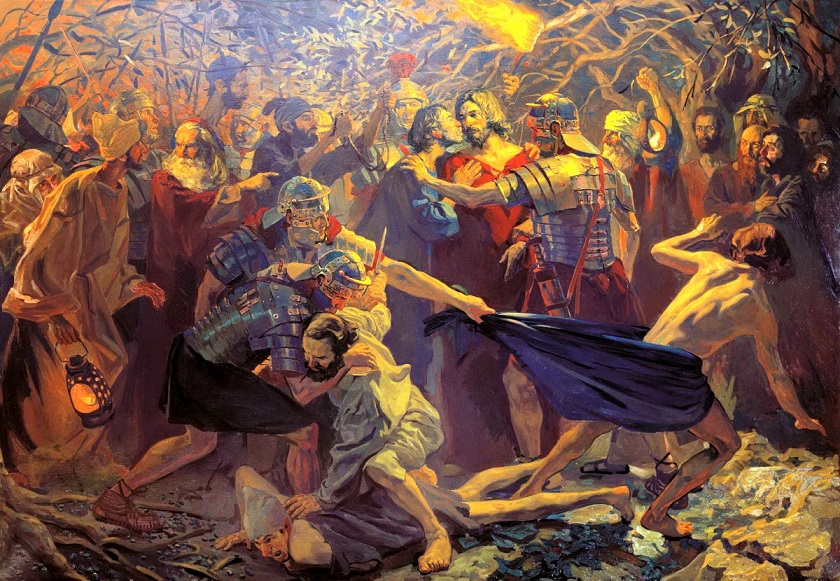
Young Mark was always associated with the Lord, who choose him as one of the seventy. He is mentioned in the Holy Scriptures in a number of events related with the Lord. For example, he was present at the wedding of Cana of Galilee, and was the man who had been carrying the jar when the two disciples went to prepare a place for the celebration of the Passover. As Church Tradition relates, on the night that Christ was betrayed he followed after Him, wrapped only in a linen cloth. He was seized by soldiers, and fled away naked, leaving the cloth behind.
Pavel Petrovich Popov
Judas betrays Christ with a kiss
Pavel Petrovich Popov took up painting at the age of twenty-four. It was preceded by service in the navy and work at Lenin Komsomol Automobile Plant in Moscow. Following an old Soviet custom, the Lenin Komsomol Automobile Plant had a fine collection of still-life and plaster works; there were plaster busts there, as in a specialized college. The teacher was Afanasy Evstafievich Sukhinin.
Popov entered the Russian Academy of Painting, Sculpture and Architecture, at the former legendary School of Painting, Sculpture and Architecture, built by the architect Vasily Bazhenov in 1790. He did this first history painting in his second year at the Academy. It was called, Joseph Tells His Dreams to His Brothers. More on Pavel Petrovich Popov
Il Pordenone, (1484–1539) Blue pencil.svg wikidata: Q983352
Il Pordenone - San Marco, c. 1535
Oil on panel
72 x 74.5 cm
Fine Arts Museum - Budapest
Pordenone, Il Pordenone in Italian, is the byname of Giovanni Antonio de’ Sacchis (c. 1484–1539), an Italian Mannerist painter, loosely of the Venetian school. He painted in several cities in northern Italy "with speed, vigor, and deliberate coarseness of expression and execution—intended to shock.
He visited Rome, and learnt from its High Renaissance masterpieces, but lacked a good training in anatomical drawing. Like Polidoro da Caravaggio, he was one of the artists often commissioned to paint the exteriors of buildings; of such work at most a shadow survives after centuries of weather. Michelangelo is said to have approved of one palace facade in 1527; it is now only known from a preparatory drawing. Much of his work was lost when the Doge's Palace in Venice was largely destroyed by fires in 1574 and 1577. A number of fresco cycles survive.
His life was as energetic and restless as his art; he married three times, and was accused in court of hiring criminals to kill his brother to avoid sharing their inheritance. He perhaps had some influence on later works by Titian and more clearly on Tintoretto, who to some extent took over his position as the leading painter of large mural commissions in Venice. Titian and Pordenone were rivals in his last decade and gossip even claimed that his death was suspicious. More on Pordenone
Once a lion and lioness appeared to John Mark and his father Arostalis while they were traveling in Jordan. The father was very scared and begged his son to escape, while he awaited his fate. John Mark assured his father that Jesus Christ would save them and began to pray. The two beasts fell dead and as a result of this miracle, the father believed in Christ.
At first, St. Mark accompanied St. Peter on his missionary journeys inside Jerusalem and Judea. Then he accompanied St. Paul and St. Barnabas on their first missionary journey to Antioch, Cyprus and Asia Minor. Later St. Paul needed St. Mark with him and they both preached in Colosse, Rome and perhaps in Venice.
After planting the seeds of faith and performing many miracles in Rome,he traveled to Egypt, tand then entered Alexandria from its eastern gate in 61 A.D.
Emmanuel Tzanes, (1610–1690)
St Mark the Evangelist, c. 1657
Icon
Height: 660 mm (25.98 in); Width: 541 mm (21.29 in)
Benaki Museum , Athens
Emmanuel Tzanes (1610 – 28 March 1690), also known as Buniales, was a Greek Renaissance painter.
He was born in Crete and migrated to Venice where he did most of his work. He was one of the most respected Greek painters of his day. Tzanes was a member of the Cretan School and contemporary of another Cretan painter of Venice, Theodore Poulakis. More on Emmanuel Tzanes
Saint Mark was the writer of the Gospel of Mark
Attributed to Pasquale Ottini (–1630)
Saint Mark Writing from the Mouth of Saint Peter, c. 17th century
Oil on canvas
Height: 243 cm (95.6 in); Width: 169 cm (66.5 in)
Bordeaux Beaux-arts museum
Pasquale Ottino or Ottini (1578 in Verona – 1630 in Verona), was an Italian painter.
Ottino was a pupil, alongside Alessandro Turchi, in the studio of Felice Brusasorci. After the master's death in 1605, he completed alongside Turchi the large canvas depicting Fall of Manna in the church of San Giorgio in Braida in Verona, left unfinished on the master’s death in 1605. His early works attest to the decidedly Mannerist character of the initial phase of his career. The sources indicate fairly constant activity in his hometown, even though there are still some doubts as to the reconstruction of his artistic career, especially incongruities regarding a trip to Rome that may have taken place with his companions Turchi and Marcantonio Bassetti around 1615. He died of plague in Verona in 1630. More on Pasquale Ottini
On his arrival St. Mark began to preach to the hungry ears of his converts. The spread of Christianity must have been quite remarkable because pagans were furious and ought St. Mark everywhere. Smelling the danger, he left Alexandria to Berce, then to Rome, where he met St. Peter and St. Paul and remained there until their martyrdom in 64 A.D.
Upon returning to Alexandria in 65 AD, St. Mark found his people firm in faith and thus decided to visit Pentapolis. There, he spent two years preaching and performing miracles, ordaining bishops and priests, and winning more converts.
Gentile Bellini and Giovanni Bellini
Saint Mark Preaching in Alexandria, c. 1507
Oil on anvas
3.47 m × 7.70 m (137 in × 303 in)
Pinacoteca di Brera, Milan, Italy
Gentile da Fabriano (c. 1370 – 1427) was
an Italian painter known for his participation in the International Gothic
painter style. He worked in various places in central Italy, mostly in Tuscany.
By around 1405, Gentile da Fabriano was working in Venice. He painted a panel
for the church of Santa Sofia, now lost; Jacopo Bellini worked perhaps in his
workshop. Between 1408 and 1409, he painted a fresco (now lost) in the Doge's
Palace depicting the naval battle between the Venetians and Otto III. In Venice
he knew Pisanello and perhaps Michelino da Besozzo.
On 6
August 1420 he was in Florence, where he painted his famous altarpiece
depicting the Adoration of the Magi (1423), now in the Uffizi and regarded as
one of the masterpieces of the International Gothic style. His other works in
Florence include the Quaratesi Polyptych (May 1425). In June–August 1425 he was
in Siena, where he painted a Madonna with Child, now lost, for the Palazzo dei
Notai on Piazza del Campo. Until October he was in Orvieto, where he painted
his fresco of the Madonna and Child in the Cathedral. In 1427 he arrived in
Rome, commissioned by Pope Martin V the decoration of the nave of the Basilica
of St. John in Lateran, which was completed by Pisanello after his death.
Gentile is known to have died before 14 October 1427. He is
commonly said to have been buried in the church now called S. Francesca Romana
in Florence, but his tomb vanished; there is evidence, however, that he may be
buried in the church of Santa Maria in Trastevere, in Rome, the place of his
death. More
on Gentile da Fabriano
The work is a huge canvas (telero) destined for the Scuola Grande di San Marco in Venice. It is 26m in surface, and has rich narrative and iconographic features. The cycle of paintings with stories of the life of St Mark was completed around 60 years later by Giorgione and Tintoretto. More on this painting
Jacopo Tintoretto
Saint Mark Saving a Saracen from Shipwreck, c. 1562-66
Oil on canvas
398 x 337 cm.
Gallerie dell'Accademia, Venice
Find in fo on Jacopo Tintoretto below
The painting illustrates an episode in the Golden Legend's account of St. Mark's miracles. A Saracen sailor, cast adrift in a storm, prays to St. Mark for deliverance, promising that he will convert if rescued. Thereupon "a man all shining appeared to him, which took him out of the water and remitted him again into the ship." More on this painting
Finally he returned to Alexandria and was overjoyed to find that Christians had multiplied so much that they were able to build a considerable church in the suburban district of Baucalis.
In the year 68 AD, Easter fell on the same day as the Serapis feast. The furious heathen mob had gathered in the Serapis temple at Alexandria and then descended on the Christians who were celebrating the Resurrection at Baucalis. St. Mark was seized, dragged with a rope through the main streets of the city. At nightfall the saint was thrown into prison, where he was cheered by the vision of an angel, strengthening him. When the angel disappeared, St. Mark thanked God for sending His angel to him.
Artist unknown
The Martyrdom of Saint Mark
Musée Condé, Chantilly.
On the following morning probably during the triumphal procession of Serapis he was again dragged around the city till death. His bloody flesh was torn, and it was their intention to cremate his remains, but the wind blew and the rain fell in torrents and the populaces disperse. Christians stole his body and secretly buried him in a grave that they had engraved on a rock under the altar of the church. More on St. Mark
Jacopo Tintoretto (–1594)
St Mark's Body Brought to Venice, between 1562 and 1566
Oil on canvas
Height: 398 cm (13 ft); Width: 315 cm (10.3 ft)
Gallerie dell'Accademia, Venice
Tintoretto; born Jacopo Comin, (October,
1518 – May 31, 1594) was an Italian painter and a notable
exponent of the Renaissance school. For his phenomenal energy in painting he
was termed Il Furioso. His work is characterized by its muscular figures,
dramatic gestures, and bold use of perspective in the Mannerist style, while
maintaining color and light typical of the Venetian School.
In his youth, Tintoretto was also known as Jacopo Robusti
as his father had defended the gates of Padua in a way that others called
robust, against the imperial troops during the War of the League of Cambrai
(1509–1516). His real name "Comin" has only recently been discovered
by Miguel Falomir, the curator of the Museo del Prado, Madrid, and was made
public on the occasion of the retrospective of Tintoretto at the Prado in
2007. More on
Tintoretto
Unknown artist
The Stealing of St. Mark's Body
Chapel of San Clemente, Basilica of San Marco, 12th century
Mark's relics were allegedly stolen by two sailors in 828 and taken to Venice The local religious and civic authorities quickly elected St. Mark as Venice's patron saint, and the apostle's traditional symbol--a winged lion--became the logo of the Venetian Republic. The Byzantine Basilica of St. Mark was built t to house the relics. There is a mosaic on this Venetian basilica showing how the sailors covered the body relics with a layer of pork. Since Muslims are not allowed to touch pork, Mark's porkification was done to prevent Muslim intervention in the relics removal. More on the stealing of the bosy of St Mark
Unknow artist
Smuggling the ashes of St. Mark depicted on the mosaic of St. Mark's Church in Venice
Images are copyright of their
respective owners, assignees or others. Some Images may be subject to copyright
I don't own any of these images -
credit is always given when due unless it is unknown to me. if I post your
images without your permission, please tell me.
I do not sell art, art prints, framed
posters or reproductions. Ads are shown only to compensate the hosting
expenses.
If you enjoyed this post, please share
with friends and family.
Thank you for visiting my blog and also
for liking its posts and pages.
Please note that the content of this
post primarily consists of articles available from Wikipedia or other free
sources online.