Showing posts with label Daniel. Show all posts

Saturday, December 12, 2020

08 works, Today, December 11th, is Saint Daniel the Stylite's day, his story, illustrated #344

Unknown iconographer
Saint Daniel the Stylite
I have no further description, at this time

Saint Daniel the Stylite (c. 409 – 493)
is a Saint and stylite of the Eastern Orthodox, Roman Catholic and Eastern Catholic Churches.

In 409, a male child was born to Elias and Martha; they had been childless for a long time, after she had vowed in her prayers that if she had a child the child would be dedicated to the Lord. Since the child was born through the good will of God, they vowed that he should receive his name from God.

The child remained nameless until he was five years old when they visited a monastery and approached the igumen to provide a name for the child. The igumen opened at random one of his service books and found the name of the Prophet Daniel on the page. Thus, Martha's son received his name of Daniel. At the age of twelve he left home for a nearby monastery without his parents' knowledge. 

Unknown artist
Ancient Antioch
I have no further description, at this time

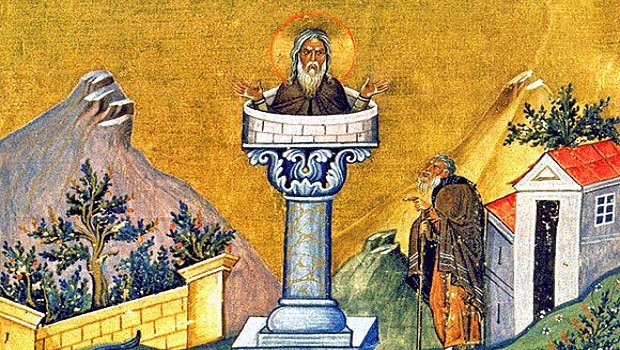
While accompanying his abbot on a call by their archbishop to assemble in Antioch, the party lodged at a large monastery at the village of Telanissae where St. Symeon the Stylite lived on a pillar. There, Daniel sought and received his blessing.

At the age of 42, Daniel then left the monastery for Jerusalem and while en route traveled to see Symeon the Stylite with whom he spent two weeks. While continuing his journey to Jerusalem, Daniel met a monk on the road who convinced Daniel that he should instead go to Constantinople.

Unknown iconographer
Church of the Archangel Michael
I have no further description, at this time

Upon arrival in Anaplus near Constantinople, Daniel took residence in the Church of the Archangel Michael from which he had rid demons. Daniel was greeted warmly by Patriarch Anatolius. Soon after Patr. Anatolius fell seriously ill. He called Daniel and asked that Daniel offer prayers for him. These prayers were answered with the recovery of the patriarch.

William Burges
Saint Simeon the stylites, c. 1874
Print
I have no further description, at this time

William Burges, (born Dec. 2, 1827, London, Eng.—died April 20, 1881, London), one of England’s most notable Gothic Revival architects, a critic, and an arbiter of Victorian taste.
During Burges’s apprenticeship he studied medieval architecture, visiting the Continent to gain firsthand impressions. In 1856 he received the first award in an international competition for the Cathedral of Lille, France. He designed the Cathedral of Brisbane, Australia, in 1859 and in 1862 St. Finbar’s Cathedral of the Church of Ireland in Cork.

In 1864 Burges met the man who would be his most important patron: the passionate medievalist John Patrick Crichton Stuart, 3rd marquess of Bute. In 1865 Burges started an extensive restoration of Cardiff Castle for the marquess; he made many extensions to the existing residential apartments and directed an elaborate scheme of interior decoration, and he worked on the project until his death. In 1875 he began a similar project at nearby Castle Coch, also at the direction of his patron. Burges adopted the Victorian Gothic style for his own home (Tower House) in London (1875–80). A fellow of the Royal Institute of British Architects and an associate of the Royal Academy, he wrote architectural treatises and published (1870) his drawings. More on William Burges

After staying in Anaplus for nine years, Daniel received a vision of Symeon standing on a column above a huge pillar of cloud. Symeon declared to him, "Stand firm and play the man." After describing the vision to those around him, they counseled Daniel to mount a pillar and to take up the mode of life that Symeon had led. Several days later the monk Sergius, who was a disciple of Symeon, arrived in Constantinople bearing the news of Symeon's repose. 

Sergius then decided to continue on the Monastery of Akoimetoi. En route, the sailors of the boat transporting him related a story of Daniel's victory over demons that had previously destroyed boats passing on their route. Hearing this, Sergius changed his route to visit Daniel.

Unknown iconographer
ST. DANIEL THE STYLITE AND ST. SIMEON THE STYLITE
Egg tempera, gold leaf, and gesso on wood panel
Silver halos decorated with floral borders
17.5 x 14.3 cm (6 7/8 x 5 5/8 in.)
Private collection

Daniel had a pillar erected nearby, ready to assume the life of his mentor, remaining for varying periods of time on one or another of three pillars for remaining 33 years of his life. Many people came to Daniel's pillar, the sick and unfortunate as well as those seeking his blessing. 

Unknown iconographer
Emperor Leo and Patriarch Gennadius paying homage
I have no further description, at this time

Among those who paid homage to the holy Daniel were the Emperor Leo and Patriarch Gennadius, as well as members of the imperial court. 

In 475, during the reign of the Emperor Zeno, the senator Basiliscus usurped Leo's throne. Patriarch Acacius opposed Basiliscus, who then ventured to Daniel to obtain his blessing. Instead Basiliscus received Daniel's condemnation. 

Unknown iconographer
 Saint Acacius
I have no further description, at this time

With the Orthodox faith in question, Patr. Acacius begged that Daniel come down from his pillar and travel to Constantinople, to the Great Church, and confront Emperor Basiliscus on the question of his faith. Then, for the only time in his 33 years on the pillar, Daniel came down from it to travel to the Great Church, there to confront the emperor on his faith. Basiliscus affirmed his orthodoxy. More on Saint Daniel 

 Jacques-Louis David
Belisarius, general of the Roman Emperor Justinian, reduced to begging, c. 1784
Oil on canvas
288 cm × 312 cm (113 in × 123 in)
Louvre

Jacques-Louis David (30 August 1748 – 29 December 1825) was a French painter in the Neoclassical style, considered to be the preeminent painter of the era. In the 1780s his cerebral brand of history painting marked a change in taste away from Rococo frivolity toward classical austerity and severity and heightened feeling, harmonizing with the moral climate of the final years of the Ancien Régime.

David later became an active supporter of the French Revolution and friend of Maximilien Robespierre (1758–1794), and was effectively a dictator of the arts under the French Republic. Imprisoned after Robespierre's fall from power, he aligned himself with yet another political regime upon his release: that of Napoleon, the First Consul of France. At this time he developed his Empire style, notable for its use of warm Venetian colours. After Napoleon's fall from Imperial power and the Bourbon revival, David exiled himself to Brussels, then in the United Kingdom of the Netherlands, where he remained until his death. David had many pupils, making him the strongest influence in French art of the early 19th century, especially academic Salon painting. More on Jacques-Louis David


Please visit my other blogs: Art CollectorMythologyMarine ArtPortrait of a Lady, The OrientalistArt of the Nude and The Canals of VeniceMiddle East Artistsand 365 Saints, also visit my Boards on Pinterest

Images are copyright of their respective owners, assignees or others. Some Images may be subject to copyright

I don't own any of these images - credit is always given when due unless it is unknown to me. if I post your images without your permission, please tell me.

I do not sell art, art prints, framed posters or reproductions. Ads are shown only to compensate the hosting expenses.

If you enjoyed this post, please share with friends and family.

Thank you for visiting my blog and also for liking its posts and pages.

Please note that the content of this post primarily consists of articles available from Wikipedia or other free sources online.


Saturday, October 10, 2020

10 works, Today, October 10th, is Saint Daniel and his Companions' day, their story illustrated #282

Licinio, Bernardino
The Martyrs of Marrakesch, Franciscan friars, c. 1524
Oil on canvas
Santa Maria Gloriosa dei Frari, San Polo, Venice, Italy

Bernardino Licinio; Born: 1489  - Death: 1549. Licinio was a painter during the Italian High Renaissance, creating portraits and religious works. He was born in Bergamo in the town of Lombardy. It is said that he may have trained in the studio of Giovanni Bellini (1430 -1516), a prominent Venetian painter of the Bellini family. Licinio stayed close to the artistic developments of the Venetian school of painting.

Licinio’s earlier painting style was much in the vein of other prominent High Renaissance artists of Venice. Giorgione was also said to have trained under Giovanni Bellini’s workshop. 

His later works took much more to the style of Titian (1485 – 1576), a leading Venetian painter of Italy’s Renaissance. These religious works give a highly symmetrical positioning of saints surrounding the Virgin Mary and Child.  More on Bernardino Licinio

Saint Daniel and Companions (died October 10, 1227) are venerated as martyrs by the Catholic Church. They were Friars Minor killed at Ceuta.

Jean-Léon Gérôme, (1824–1904)
Prayer in Cairo, c. 1865
Oil on panel
Height: 50 cm (19.6 in); Width: 81 cm (31.8 in)
Kunsthalle, Hamburg

Jean-Léon Gérôme (11 May 1824 – 10 January 1904) was a French painter and sculptor in the style now known as Academicism. The range of his oeuvre included historical painting, Greek mythology, Orientalism, portraits and other subjects, bringing the Academic painting tradition to an artistic climax. He is considered one of the most important painters from this academic period, and in addition to being a painter, he was also a teacher with a long list of students. More on Jean-Léon Gérôme

The martyrdom of St. Berard and his companions in 1219 had inflamed many of the religious of the Order of Friars Minor with the desire of preaching the Gospel in non-Christian lands; and in 1227, the year following St. Francis's death, six religious of Tuscany, Agnellus, Samuel, Donulus, Leo, Hugolinus, and Nicholas, petitioned Brother Elias of Cortona, then vicar-general of the Order, for permission to preach the Gospel to the Muslims of the Maghreb.

Unknown artist
Saint Daniel and Companions 
Wood, paint, paper, leather, varnish
Height: 6 Inches; Width: 5 Inches
The six missionaries went first to Spain, where they were joined by Daniel, Minister Provincial of Calabria, who became their superior. They set sail from Spain and on 20 September reached the coast of Africa, landing at Ceuta. Saint Daniel and Companions resolved to preach in that large city. 

Wyck, Thomas (1616-77)
Middle East Trading in a Mediterranean Port, c. circa 1640
Medium oil on canvas
Oil on canvas
Height: 81 cm (31.8 in); Width: 100 cm (39.3 in)
Museum of Fine Arts, Budapest

Thomas Wijck (also Thomas Wijk, or Thomas Wyck; 1616–1677) was a Dutch painter of port views and genre paintings.

Wijck was born into an artist family and received his training from his father. He journeyed to Italy, presumably by 1640, the year in which a ‘Tommaso fiammingo, pittore’ (Thomas the Fleming, painter) is documented as residing in Rome in the Via della Fontanella. Although this evidence of his residence in Rome around this time has been questioned, a number of his pictures depict scenes in and around Rome which would indicate a visit to the city at some point. He also resided in the environs of Naples, where he executed many sketches which he subsequently worked up into drawings of coast views.

In 1642 Wijck returned to the northern Netherlands, where he became a member of the Haarlem Guild of St. Luke. In 1660 he was appointed Dean of the Haarlem Guild.

He went to England about the time of the Restoration and was much employed. He was followed there by his son and pupil Jan Wyck, who remained in Britain for the rest of his career and played an important role in the development of English sporting painting. Thomas Wyck was also the teacher of the Haarlem painter Jan van der Vaart, who later also immigrated to England.

He died in Haarlem in August 1677. More on Thomas Wijck

Before entering the city proper, they learned from Christian merchants that a strict order prohibited entrance to all Christians.

Braun and Hogenberg
Ceuta, called Seupta by the Portuguese
I have no further description, at this time

They remained for a few days in a small village inhabited mostly by Christian merchants just beyond the walls of the Saracen city of Ceuta.

Eugène Delacroix, (1798–1863)
They were soon apprehended and brought before the sultan
Moulay Abd-er-Rahman, Sultan of Morocco, leaving his palace in Meknes, surrounded by his guard and his main officers, c. 1845
Oil on canvas
Height: 377 cm (12.3 ft); Width: 340 cm (11.1 ft)
Musée des Augustins, Toulouse, France

Ferdinand Victor Eugène Delacroix (26 April 1798 – 13 August 1863) was a French Romantic artist regarded from the outset of his career as the leader of the French Romantic school.
 
As a painter and muralist, Delacroix's use of expressive brushstrokes and his study of the optical effects of colour profoundly shaped the work of the Impressionists, while his passion for the exotic inspired the artists of the Symbolist movement. A fine lithographer, Delacroix illustrated various works of William Shakespeare, the Scottish author Walter Scott and the German author Johann Wolfgang von Goethe.
 
Delacroix took for his inspiration the art of Rubens and painters of the Venetian Renaissance, with an attendant emphasis on colour and movement rather than clarity of outline and carefully modelled form. Dramatic and romantic content characterized the central themes of his maturity, and led him not to the classical models of Greek and Roman art, but to travel in North Africa, in search of the exotic. Friend and spiritual heir to Théodore Géricault, Delacroix was also inspired by Lord Byron, with whom he shared a strong identification with the "forces of the sublime", of nature in often violent action.
 
However, Delacroix was given to neither sentimentality nor bombast, and his Romanticism was that of an individualist. In the words of Baudelaire, "Delacroix was passionately in love with passion, but coldly determined to express passion as clearly as possible." More on Ferdinand Victor Eugène Delacroix


Finally, very early on Sunday morning, they entered the city, and immediately began to preach the Gospel and to denounce Islam. They were soon apprehended and brought before the sultan who, thinking that they were mad, ordered them to be cast into prison. Here they remained until the following Sunday when they were again brought before the sultan, who, by promises and threats, endeavored in vain to make them deny the Christian religion. 


They were all condemned to death. Each one approached Daniel, the superior, to ask his blessing and permission to die for Christ. They were all beheaded.

Lorenzetti, Ambrogio  (1290-1348)
Martyrdom-of-the-franciscans, c. 1330
Fresco
I have no further description, at this time

Ambrogio Lorenzetti, (born c. 1285, Siena—died c. 1348), Italian artist who ranks in importance with the greatest of the Italian Sienese painters, Duccio and Simone Martini. He is also the younger brother of painter Pietro Lorenzetti. Only six documented works of Ambrogio, apparently covering a period of merely 13 years, have survived. 

It is not known who Ambrogio’s teacher was, but his early works indicate that he early received his main inspiration from the art of Duccio, his brother Pietro, and Giotto. Already his representations reveal a realistic individualism and an intense preoccupation with significant composition and form. His desire to depict spatial depth convincingly led him to an increasingly accurate rendering of space in his paintings and almost to one-point perspective in his last work, the Annunciation. With his profound interest in perspective and in Classical antiquity, Ambrogio anticipated the Renaissance.

The art of the Lorenzettis was widely imitated in Siena during the third quarter of the 14th century, and many works by close followers are still commonly attributed to one or the other brother. More on Ambrogio Lorenzetti

Unknown artist
Martyrdom of Saint Daniel Fasanella and companion martyrs, c. 18C
Oil on canvas
Terni, Umbria , Italy
I have no further description, at this time


Sebastiano Santi
The transport of the body of St. Daniel
Frescoes of the ceiling
Church of Daniel of Padua in Padua

Sebastiano Santi (1788–1866) was an Italian painter, active both in oil and frescoes.

He was born in Murano and trained at the Academy of Fine Arts of Venice under Teodoro Matteini. His works are to be found in the Venetian churches. He painted the nave ceiling frescoes for the church of San Daniele, Padua.

We owe him the decoration of many churches in Veneto and Friuli, in particular the ceiling of the Church of Saint Daniel of Padua , where he produced three frescoes. Other works can be found in 'Church of San Michele Arcangelo in Cervignano del Friuli , Church of Santo Stefano in Ruda , Ognissanti Cathedral in Arzignano , Church of Santa Maria Santa Maria Nascente in Artegna , Church of Sant'Ulderico from Pavia di Udine , the church of SS. Biagio e Daniele from Grantorto, the Church of San Giovanni de Bessica. More on Sebastiano Santi 

St. Daniel and his companions were canonized by Leo X in 1516.


Please visit my other blogs: Art CollectorMythologyMarine ArtPortrait of a Lady, The OrientalistArt of the Nude and The Canals of VeniceMiddle East Artistsand 365 Saints, also visit my Boards on Pinterest

Images are copyright of their respective owners, assignees or others. Some Images may be subject to copyright

I don't own any of these images - credit is always given when due unless it is unknown to me. if I post your images without your permission, please tell me.

I do not sell art, art prints, framed posters or reproductions. Ads are shown only to compensate the hosting expenses.

If you enjoyed this post, please share with friends and family.

Thank you for visiting my blog and also for liking its posts and pages.

Please note that the content of this post primarily consists of articles available from Wikipedia or other free sources online.