Showing posts with label El Greco. Show all posts

Wednesday, November 11, 2020

09 works, Today, November 11th, is Martin of Tours' day, his story illustrated #314

Winifred Margaret Knights (1899–1947)
Scenes from The Life of Saint Martin of Tours by Winifred Knights (c.1928-33)
Milner Memorial Chapel, Canterbury Cathedral

Winifred Margaret Knights (1899–1947) was born on 5 June 1899 in Streatham. From 1912, Knights attended James Allen's Girls' School in Dulwich where she showed an early artistic talent. She pursued formal art training at the Slade School of Fine Art from 1915–17 and again from 1918-20, under the tutelage of Henry Tonks and Fred Brown. During World War One, Knights was traumatised after witnessing the Silvertown explosion at a TNT processing works in January 1917, which led to a break in her studies where she would take refuge at her father's cousins' farm in Worcestershire. 

At the end of the War, returning to the Slade, Knights began to draw upon personal themes. In 1919, Knights won the Slade Summer Composition Prize for Mill Hands on Strike. The following year she became the first woman in England to win the prestigious Scholarship in Decorative Painting awarded by the British School at Rome. In 1920 she moved to Italy to complete her scholarship. In 1922, the Tate purchased an Italian landscape painted by Knights. She remained in Rome from 1920 to 1925. The relationship with Mason ended and she married fellow Rome Scholar Thomas Monnington on 23 April 1924. Her first major work in Rome, The Marriage at Cana, was completed in 1923.

Knights returned to the Slade in the years 1926-27 and exhibited at both the Imperial Gallery in Kensington and the Duveen Gallery. In the period 1928-33 Knights executed the altarpiece Scenes from the Life of St Martin of Tours for the Milner Memorial Chapel at Canterbury Cathedral (above). In 1929 Knights was elected to the New English Art Club, but never exhibited with them. 

Knights died from a brain tumour in London in 1947 at the age of 47.[2] The first major retrospective of Winifred Knights was held at Dulwich Picture Gallery from June to September 2016. More on Winifred Margaret Knights

Martin was born around 330 of pagan parents. His father was a senior officer in the Roman army. A few years after Martin's birth, his father was given veteran status and was allocated land on which to retire in northern Italy, where Martin grew up.

Simone Martini, (1284–1344) 
St. Martin receiving knighthood, c. 1322-1326
Fresco
Lower Basilica of San Francesco, Assisi, Italy

Simone Martini, see below

As the son of a veteran officer, Martin at 15 was required to join a cavalry. At the age of 18 he was stationed at in Gaul. It is likely that he joined the heavy cavalry unit listed in the Notitia Dignitatum. As the unit was stationed at Milan and is also recorded at Trier, it is likely to have been part of the elite cavalry bodyguard of the Emperor, which accompanied him on his travels around the Empire.

El Greco, (1541–1614)
Saint Martin and the Beggar, c. circa 1597-1599
Oil on canvas
Height: 193.5 cm (76.1 in); Width: 103 cm (40.5 in)
National Gallery of Art,  Washington, D.C

Doménikos Theotokópoulos (1541 – 7 April 1614), most widely known as El Greco; Spanish for "The Greek", was a painter, sculptor and architect of the Spanish Renaissance. The nickname "El Greco" refers both to his Greek origin and Spanish citizenship. The artist normally signed his paintings with his full birth name in Greek letters.
 
El Greco was born in Crete, which was at that time part of the Republic of Venice, and the center of Post-Byzantine art. He trained and became a master within that tradition before traveling at age 26 to Venice, as other Greek artists had done. In 1570 he moved to Rome, where he opened a workshop and executed a series of works. During his stay in Italy, El Greco enriched his style with elements of Mannerism and of the Venetian Renaissance. In 1577, he moved to Toledo, Spain, where he lived and worked until his death. In Toledo, El Greco received several major commissions and produced his best-known paintings.
 
El Greco's dramatic and expressionistic style was met with puzzlement by his contemporaries but found appreciation in the 20th century. El Greco is regarded as a precursor of both Expressionism and Cubism, while his personality and works were a source of inspiration for poets and writers. El Greco has been characterized by modern scholars as an artist so individual that he belongs to no conventional school. He is best known for tortuously elongated figures and often fantastic or phantasmagorical pigmentation, marrying Byzantine traditions with those of Western painting. More on El Greco

One winter day he saw an ill-clad beggar at the gate of the city of Amiens. Martin had no money to give, but he cut his cloak in half and gave half to the beggar. In a dream that night, Martin saw Christ wearing the half-cloak. 

Simone Martini, (1284–1344)
St Martin leaves the life of chivalry and renounces the army, c. rom 1322 until 1326
Fresco
Chapel of San Martino, Lower Church, San Francesco, Assisi

Simone Martini (c. 1284 – 1344) was an Italian painter born in Siena. He was a major figure in the development of early Italian painting and greatly influenced the development of the International Gothic style.

It is thought that Martini was a pupil of Duccio di Buoninsegna, the leading Sienese painter of his time. According to late Renaissance art biographer Giorgio Vasari, Simone was instead a pupil of Giotto di Bondone, with whom he went to Rome to paint at the Old St. Peter's Basilica, Giotto also executing a mosaic there. Martini's brother-in-law was the artist Lippo Memmi. Very little documentation of Simone's life survives, and many attributions are debated by art historians. More on Simone Martini

He had for some time considered becoming a Christian, and this ended his wavering. He was promptly baptized. At the end of his next military campaign, he asked to be released from the army, saying: "Hitherto I have faithfully served Caesar. Let me now serve Christ." He was accused of cowardice, and offered to stand unarmed between the contending armies. He was imprisoned, but released when peace was signed.

Jeanne and Richard de Montbaston
The ordination of Saint Hilary of Poitiers, c. 14th C
Publication
I have no further description, at this time

Richard Montbaston was a copyist in Paris in the late 14th  century. From his workshop came out in particular the Roman of the rose , illuminated by his wife, Jeanne.
Having sworn in the booksellers' oath in 1338, Richard de Montbaston is mentioned as a "bookseller" in the colophon in the Life of the Saints . On the other hand, his wife, Jeanne, took the oath of the booksellers in 1353 as illuminatrix and libraria , which gave rise to speculations according to which if Richard had the title of copyist and was indeed the owner of the workshop, he it would be impossible to attribute to him the illuminations of his manuscripts and that they should be due to his wife, Jeanne, although her work is not documented in any surviving manuscript. More on Richard Montbaston

He became a disciple of Hilary of Poitiers, a chief opponent in the West of the Arians, who denied the full deity of Christ, and who had the favor of the emperor Constantius. Returning to his parents' home in Illyricum, he opposed the Arians with such effectiveness that he was publicly scourged and exiled. He was subsequently driven from Milan, and eventually returned to Gaul. There he founded the first monastery in Gaul, which lasted until the French Revolution.

In 371 he was elected bishop of Tours. His was a mainly pagan diocese, but his instruction and personal manner of life prevailed. In one instance, the pagan priests agreed to fell their idol, a large fir tree, if Martin would stand directly in the path of its fall. He did so, and it missed him very narrowly. When an officer of the Imperial Guard arrived with a batch of prisoners who were to be tortured and executed the next day, Martin intervened and secured their release.


Unknown Master, German (active c. 1450)
St Martin of Tours and St Nicholas of Bari, about 1450
Tempera, gold on wood panel
Height: 76.2 cm; Width: 67.3 cm
Art Gallery of South Australia

In the year 384, the heretic (Gnostic) Priscillian and six companions had been condemned to death by the emperor Maximus. The bishops who had found them guilty in the ecclesiastical court pressed for their execution. Martin contended that the secular power had no authority to punish heresy, and that the excommunication by the bishops was an adequate sentence. In this he was upheld by Ambrose, Bishop of Milan. 

Pierre Le Gros the Younger
Religion Overthrowing Heresy and Hatred, c. 1695–1699
Marble
H. 3 m (9 ft. 10 in.)
Church of the Gesù, Rome, Italy.

Pierre Le Gros (12 April 1666 Paris – 3 May 1719 Rome) was a French sculptor, active almost exclusively in Baroque Rome where he was the pre-eminent sculptor for nearly two decades.

He created monumental works of sculpture for the Jesuits and the Dominicans and found himself center stage of the two most prestigious artistic campaigns of his era, the Altar of Saint Ignatius of Loyola in the Gesù and the cycle of the twelve huge Apostle statues in the nave of the Lateran basilica. Le Gros' handling of the marble attracted powerful patrons like the papal treasurer Lorenzo Corsini and Cardinal de Bouillon, as Dean of the Sacred College the highest ranking cardinal. He also played a prominent role in more intimate settings like the chapel of the Monte di Pietà and the Cappella Antamori in San Girolamo della Carità, both little treasures of the Roman late baroque not known to many because they are difficult to access.

Le Gros was the most exuberant baroque sculptor of all his contemporaries but eventually lost his long battle for artistic dominance to a prevailing classicist tendency against which he fought in vain. More on Pierre Le Gros

He refused to leave Treves until the emperor promised to reprieve them. No sooner was his back turned than the bishops persuaded the emperor to break his promise; Priscillian and his followers were executed. This was the first time that heresy was punished by death.

Martin was furious, and excommunicated the bishops responsible. But afterwards, he took them back into communion in exchange for a pardon from Maximus for certain men condemned to death, and for the emperor's promise to end the persecution of the remaining Priscillianists. He never felt easy in his mind about this concession, and thereafter avoided assemblies of bishops where he might encounter some of those concerned in this affair. He died on or about 11 November 397 and his shrine at Tours became a sanctuary for those seeking justice.

Simone Martini, (1284–1344)
Death of St Martin (scene 9), c. 1320-25
Fresco
284 x 230 cm
Cappella di San Martino, Lower Church, San Francesco, Assisi

For Simone Martini, (1284–1344), please see above

The Feast of Martin, a soldier who fought bravely and faithfully in the service of an earthly sovereign, and then enlisted in the service of Christ, is also the day of the Armistice which marked the end of the First World War. On it we remember those who have risked or lost their lives in what they perceived as the pursuit of justice and peace. More on Martin of Tours

Jean Fouquet
The charity of Saint Martin, c. 15th century
Illumination
 Louvre museum, Department of Miniatures and Illuminations

Fouquet placed the story of St. Martin in a Parisian context, at the entrance to the Grand Châtelet. While his companions are already entering the vault, Martin puts his sword back in the scabbard after cutting his coat in half, clothe the poor man with his half. Below, in the letter O, Christ, identifying himself with the poor, appears in a dream to Martin. Two other episodes from the saint's life are mentioned in the lower panels: his fall caused by the demon and the visit of the Virgin, Saint Agnes and Saint Thècle. More on this work

Jean (or Jehan) Fouquet (ca.1420–1481) was a French painter and miniaturist. A master of panel painting, manuscript illumination, and the apparent inventor of the portrait miniature, he is considered one of the most important painters from the period between the late Gothic and early Renaissance. He was the first French artist to travel to Italy and experience first-hand the early Italian Renaissance.
He was born in Tours. Little is known of his life, but it is certain that he was in Italy before 1447, when he executed a portrait of Pope Eugene IV, who died that year. The portrait survives only in copies from much later.
Upon his return to France, while retaining his purely French sentiment, he grafted the elements of the Tuscan style, which he had acquired during his period in Italy, upon the style of the Van Eycks, forming the basis of early 15th-century French art and becoming the founder of an important new school.
His work can be associated with the French court's attempt to solidify French national identity in the wake of its long struggle with England in the Hundred Years' War. More on Jean Fouquet


Please visit my other blogs: Art CollectorMythologyMarine ArtPortrait of a Lady, The OrientalistArt of the Nude and The Canals of VeniceMiddle East Artistsand 365 Saints, also visit my Boards on Pinterest

Images are copyright of their respective owners, assignees or others. Some Images may be subject to copyright

I don't own any of these images - credit is always given when due unless it is unknown to me. if I post your images without your permission, please tell me.

I do not sell art, art prints, framed posters or reproductions. Ads are shown only to compensate the hosting expenses.

If you enjoyed this post, please share with friends and family.

Thank you for visiting my blog and also for liking its posts and pages.

Please note that the content of this post primarily consists of articles available from Wikipedia or other free sources online.


Thursday, October 1, 2020

10 works, Today, September 30th, is Saint Jerome's day, his story illustrated #272

Leonardo da Vinci
Saint Jerome Praying in the Wilderness,” begun c. 1483
Vatican Museums, Vatican City State

The painting is unfinished, its origins shrouded in mystery—and yet it has been hailed as one of the great masterpieces in the history of art. More on this painting

Leonardo da Vinci, (born April 15, 1452, Anchiano, near Vinci, Republic of Florence — died May 2, 1519, Cloux, France), Italian painter, draftsman, sculptor, architect, and engineer whose genius, perhaps more than that of any other figure, epitomized the Renaissance humanist ideal. His Last Supper (1495–98) and Mona Lisa (c. 1503–19) are among the most widely popular and influential paintings of the Renaissance. His notebooks reveal a spirit of scientific inquiry and a mechanical inventiveness that were centuries ahead of their time.
The unique fame that Leonardo enjoyed in his lifetime and that, filtered by historical criticism, has remained undimmed to the present day rests largely on his unlimited desire for knowledge, which guided all his thinking and behaviour. An artist by disposition and endowment, he considered his eyes to be his main avenue to knowledge; to Leonardo, sight was man’s highest sense because it alone conveyed the facts of experience immediately, correctly, and with certainty. Hence, every phenomenon perceived became an object of knowledge, and knowing how to see became the great theme of his studies. He applied his creativity to every realm in which graphic representation is used: he was a painter, sculptor, architect, and engineer. But he went even beyond that. He used his superb intellect, unusual powers of observation, and mastery of the art of drawing to study nature itself, a line of inquiry that allowed his dual pursuits of art and science to flourish. More Leonardo da Vinci

Saint Jerome (ca. 345-420)
was an early Christian biblical scholar. The official Latin Bible of the Roman Catholic Church, the Vulgate, is largely the product of his labors of translation and revision.

Francisco de Zurbarán, (1598–1664)
The Temptation of St. Jerome, c. 1639
Oil on canvas
235 × 290 cm (92.5 × 114.1 in)
Saint Mary of Guadalupe , in Extremadura, Spain

Francisco de Zurbarán (baptized November 7, 1598 – August 27, 1664) was a Spanish painter. He is known primarily for his religious paintings depicting monks, nuns, and martyrs, and for his still-lifes. Zurbarán gained the nickname Spanish Caravaggio, owing to the forceful, realistic use of chiaroscuro in which he excelled. 

Zurbarán was born in Fuente de Cantos, near Badajoz. In 1617, after training in Seville, he returned to Llerena in his native province. By 1629 he was back in Seville, where he became the city's official painter.

In 1634 he was in Madrid painting mythologies for the Buen Retiro, Philip IV's new palace, perhaps through the intervention of his friend Velázquez. His last years were not so successful and he died in Madrid in poverty. More on Francisco de Zurbarán

Born in territory now in northwest Yugoslavia, Jerome studied rhetoric as a youth at Rome in preparation for a career in law, which he did not pursue. As a student, Jerome engaged in the superficial escapades and sexual experimentation of students in Rome; he indulged himself quite casually but he suffered terrible bouts of guilt afterwards.

The 2 decades from his early 20s were a period of much travel and temporary settlement. After a journey to the German city of Trier, he stopped for a time at Aquileia, in Italy, and there became a member of circle of young Christian intellectuals sharing a common commitment to the ascetic life. He had already formed his two consuming interests: scriptural studies and the pursuit of Christian asceticism. 

Giovanni Bellini, (circa 1430 –1516)
St Jerome Reading in the Countryside, c. 1505
Oil on canvas
Height: 49 cm (19.2 in); Width: 39 cm (15.3 in)
National Gallery of Art,  Washington, D.C

Giovanni Bellini (c. 1430 – 26 November 1516) was an Italian Renaissance painter, probably the best known of the Bellini family of Venetian painters. His father was Jacopo Bellini, his brother was Gentile Bellini (who was more highly regarded than Giovanni during his lifetime, although the reverse is true today), and his brother-in-law was Andrea Mantegna. He was considered to have revolutionized Venetian painting, moving it towards a more sensuous and colouristic style. Through the use of clear, slow-drying oil paints, Giovanni created deep, rich tints and detailed shadings. His sumptuous coloring and fluent, atmospheric landscapes had a great effect on the Venetian painting school, especially on his pupils Giorgione and Titian. More on Giovanni Bellini

In Syria from about 374, for 4 or 5 years he lived as a recluse in the desert. He made his first attempt to learn Hebrew under the guidance of a converted Jew; and he seems to have been in correspondence with Jewish Christians in Antioch. 

Niccolò Antonio Colantonio, (ca. 1420–1460) 
Saint Jerome in His Study, circa 1440-1470
Oil on panel
Height: 125 cm (49.2 in); Width: 151 cm (59.4 in)
National Museum of Capodimonte, Naples, Italy 

Colantonio (born Niccolò Antonio) was an Italian painter, who was the outstanding native figure in the art of Naples in the Early Renaissance.

Details of his life are obscure, though the Neapolitan Renaissance humanist Pietro Summonte (1463–1526) gave brief details in a letter to the Venetian Marcantonio Michiel in 1524. A birth-date of about 1420 is a generic calculation from the date of death. Colantonio was active in Naples between about 1440 and 1460 or later. He was perhaps first patronized by René d'Anjou, who ruled in Naples between 1438 and 1442. His last recorded commission is one by Queen Isabella in 1460, unless he is the Colantonio paid for decorating a room in the Castel Capuano in 1487. However Summonte says that he died young. More on Niccolò Antonio Colantonio

Jerome is often depicted with a lion, in reference to the popular hagiographical belief that Jerome had tamed a lion in the wilderness by healing its paw. The source for the story may actually have been the second century Roman tale of Androcles, or confusion with the exploits of Saint Gerasimus (Jerome in later Latin is "Geronimus"). Hagiographies of Jerome talk of his having spent many years in the Syrian desert, and artists often depict him in a "wilderness", which for West European painters can take the form of a wood.

Unknown artist
Gregory the Theologian
The Kariye Mosque, or the Church of the Holy Saviour,Istanbul, Turkey
I have no further description, at this time

The Kariye Mosque, or the Church of the Holy Saviour in Chora, is a medieval Greek Orthodox church used as a mosque today in the Edirnekapı neighborhood of Istanbul, Turkey.

Finding that life not entirely compatible, he journeyed in 379 to Constantinople, where he was a student of Gregory of Nazianzus; and there also he undertook the translation from Greek into Latin of homilies by Origen, that eminent biblical scholar much admired by Jerome.

Unknown artist
St Damasus I, Pope & Confessor
I have no further description, at this time

For 3 years from 382 Jerome was at Rome, serving as secretary to Pope Damasus. At the Pope's suggestion, he undertook a complete revision of the Latin Gospels of the New Testament, the aim of which was to replace older, varying, and inaccurate versions with a uniform one based on the best available Greek manuscripts. 

Francisco de Zurbarán, (1598–1664)
St. Jerome with St. Paula Romana and her daughter, St. Eustochium, from 1638 until 1640
Oil on canvas
Height: 247 cm (97.2 in); Width: 174 cm (68.5 in)
National Gallery of Art,  Washington, D.C.

Francisco de Zurbarán, see above

In Rome Jerome was surrounded by a circle of well-born and well-educated women, including some from the noblest patrician families, such as the widows Lea, Marcella and Paula, with Paula's daughters Blaesilla and Eustochium.

Lawrence Alma-Tadema
Paula's conversion by Saint Jerome, c. 1898
Wood, oil
50.8 x 112.7
Private collection

Sir Lawrence Alma-Tadema, OM, RA (8 January 1836 – 25 June 1912) was a Dutch painter of special British denizenship.

Born in Dronrijp, the Netherlands, and trained at the Royal Academy of Antwerp, Belgium, he settled in England in 1870 and spent the rest of his life there. A classical-subject painter, he became famous for his depictions of the luxury and decadence of the Roman Empire, with languorous figures set in fabulous marbled interiors or against a backdrop of dazzling blue Mediterranean Sea and sky.

Though admired during his lifetime for his draftsmanship and depictions of Classical antiquity, his work fell into disrepute after his death, and only since the 1960s has it been re-evaluated for its importance within nineteenth-century English art. More on Sir Lawrence Alma-Tadema

The resulting inclination of these women towards the monastic life, away from the indulgent lasciviousness in Rome, and his unsparing criticism of the secular clergy of Rome, brought a growing hostility against him among the Roman clergy and their supporters. 

The death of Damasus in 384 led to Jerome's departure from Rome, and in the company of a group of ascetic enthusiasts he made a pilgrimage to the monastic centers of Palestine and Egypt.

El Greco (Domenikos Theotokopoulos)
Saint Jerome in Penitence, c. 1595 - 1600
Oil on canvas
104.20 x 96.50 cm
 National Galleries of Scotland

Doménikos Theotokópoulos (1541 – 7 April 1614), most widely known as El Greco; Spanish for "The Greek", was a painter, sculptor and architect of the Spanish Renaissance. The nickname "El Greco" refers both to his Greek origin and Spanish citizenship. The artist normally signed his paintings with his full birth name in Greek letters.
 
El Greco was born in Crete, which was at that time part of the Republic of Venice, and the center of Post-Byzantine art. He trained and became a master within that tradition before traveling at age 26 to Venice, as other Greek artists had done. In 1570 he moved to Rome, where he opened a workshop and executed a series of works. During his stay in Italy, El Greco enriched his style with elements of Mannerism and of the Venetian Renaissance. In 1577, he moved to Toledo, Spain, where he lived and worked until his death. In Toledo, El Greco received several major commissions and produced his best-known paintings.
 
El Greco's dramatic and expressionistic style was met with puzzlement by his contemporaries but found appreciation in the 20th century. El Greco is regarded as a precursor of both Expressionism and Cubism, while his personality and works were a source of inspiration for poets and writers. El Greco has been characterized by modern scholars as an artist so individual that he belongs to no conventional school. He is best known for tortuously elongated figures and often fantastic or phantasmagorical pigmentation, marrying Byzantine traditions with those of Western painting. More on El Greco

André Reinoso, Portuguese painter (active v. 1610 to 1641).
Saint Paula instructs his nuns, c. 1650
Mosteiro dos Jerónimos, in Lisbon, Portugal

André Reinoso, Portuguese (active v. 1610 to 1641). Attributes to him are the nineteen panels of the Life of St. Francis Xavier (Lisbon, sacristy of the Church of St. Roch), whose picturesque composition, the abundance of characters and bizarre details, the wealth of color and chiaroscuro evoke the influence of contemporary Spanish workshops. The Church of Mercy in Obidos preserves intact the painted ensemble including the Visitation and Pentecost (1628) at the high altar and the Mount at Calvary and the Pietà (1630) on the side altars. Stylistic affinities also give him a panel of the Saint-Roch church and a series devoted to the Life of Saint Jerome (Lisbon, sacristy of the Jeronimos Church of Belém). More on André Reinoso

From 386 to the end of his life Jerome was settled in Bethlehem. There he presided over a monastery endowed by the wealthy Paula, who herself presided nearby over a sister foundation for women. Jerome's most significant accomplishment in his 34 years at Bethlehem was his translation of the Old Testament from the original Hebrew into Latin. It was an act of scholarly courage, arousing in his lifetime the criticism of many (including Augustine) who were wedded to the traditional Greek Old Testament as the basis for Latin translations. Of much less credit to Jerome in these years was his role in a number of vitriolic controversies; in the most unfortunate of these he aligned himself with implacable foes of that teacher, then dead a century and a half, from whom Jerome had learned so much—Origen. More on Saint Jerome


Please visit my other blogs: Art CollectorMythologyMarine ArtPortrait of a Lady, The OrientalistArt of the Nude and The Canals of VeniceMiddle East Artistsand 365 Saints, also visit my Boards on Pinterest

Images are copyright of their respective owners, assignees or others. Some Images may be subject to copyright

I don't own any of these images - credit is always given when due unless it is unknown to me. if I post your images without your permission, please tell me.

I do not sell art, art prints, framed posters or reproductions. Ads are shown only to compensate the hosting expenses.

If you enjoyed this post, please share with friends and family.

Thank you for visiting my blog and also for liking its posts and pages.

Please note that the content of this post primarily consists of articles available from Wikipedia or other free sources online.


Sunday, September 27, 2020

12 works, Today, September 26th, is Saint John the Evangelist's day, his story illustrated #268

El Greco, (1541–1614)
Opening of the Fifth Seal, The Vision of Saint John, from 1608 until 1614
Oil on canvas
87.5 × 76 in (222.2 × 193 cm); 88.5 × 78.5 in (224.7 × 199.3 cm)
Metropolitan Museum, New York

Doménikos Theotokópoulos (1541 – 7 April 1614), most widely known as El Greco; Spanish for "The Greek", was a painter, sculptor and architect of the Spanish Renaissance. The nickname "El Greco" refers both to his Greek origin and Spanish citizenship. The artist normally signed his paintings with his full birth name in Greek letters.
 
El Greco was born in Crete, which was at that time part of the Republic of Venice, and the center of Post-Byzantine art. He trained and became a master within that tradition before traveling at age 26 to Venice, as other Greek artists had done. In 1570 he moved to Rome, where he opened a workshop and executed a series of works. During his stay in Italy, El Greco enriched his style with elements of Mannerism and of the Venetian Renaissance. In 1577, he moved to Toledo, Spain, where he lived and worked until his death. In Toledo, El Greco received several major commissions and produced his best-known paintings.
 
El Greco's dramatic and expressionistic style was met with puzzlement by his contemporaries but found appreciation in the 20th century. El Greco is regarded as a precursor of both Expressionism and Cubism, while his personality and works were a source of inspiration for poets and writers. El Greco has been characterized by modern scholars as an artist so individual that he belongs to no conventional school. He is best known for tortuously elongated figures and often fantastic or phantasmagorical pigmentation, marrying Byzantine traditions with those of Western painting. More on El Greco

Saint John came from Bethsaida, a poor village in Galilee. He was the son of Zebedee the fisherman and of Salome, the daughter of Joseph, the Betrothed of the Virgin Mary. Joseph had four sons by his first marriage: James, Joses, Jude, and Simon, and three daughters: Esther, Martha, and Salome. Thus, Jesus Christ our Savior was the uncle of Saint John the Theologian, since He was the half-brother of John’s mother Salome.

John and his brother James were helping their father Zebedee with the fishing when the Savior called them to follow Him and become fishers of men. John became the “beloved disciple.

Unknown artist
The last supper, Saint John  leaned on the breast of his beloved Master
I have no further description, at this time

At the Last Supper, the Lord placed him at His side, where he leaned on the breast of his beloved Master. When the Jews laid hold of Jesus, Saint John followed Him into the palace of the high priest. 

Anthony van Dyck, (1599–1641)
Christ Crucified with the Virgin, Saint John and Mary Magdalene, c. between 1617 and 1619
Oil on canvas
Height: 3.3 cm (1.2 in); Width: 2.8 cm (1.1 in)
Louvre Museum , Paris

Sir Anthony van Dyck, ( 22 March 1599 – 9 December 1641) was a Flemish Baroque artist who became the leading court painter in England, after enjoying great success in Italy and Flanders. He is most famous for his portraits of Charles I of England and his family and court, painted with a relaxed elegance that was to be the dominant influence on English portrait-painting for the next 150 years. He also painted biblical and mythological subjects, displayed outstanding facility as a draughtsman, and was an important innovator in watercolour and etching. The Van Dyke beard is named after him. More Sir Anthony van Dyck

He alone remained with the Virgin Mary at the foot of the Cross when the Savior was crucified. Seeing John standing by, Christ said to His mother: “Woman, behold your son!” and to John: “Behold your mother!” From that hour, John took the Virgin Mary into his own home.

Giotto di Bondone, (–1337)
Descent from the cross, c, between 1304 and 1306
Fresco
Height: 200 cm (78.7 in); Width: 185 cm (72.8 in)
Scrovegni Chapel,  Padua, Italy

St. John is wearing a red robe with open hands in the center of the screen

Giotto di Bondone (1266/7 – January 8, 1337), known mononymously as Giotto, and Latinized as Giottus, was an Italian painter and architect from Florence in the late Middle Ages. He is generally considered the first in a line of great artists who contributed to the Renaissance.
In his Lives of the Most Excellent Painters, Sculptors, and Architects, the late-16th century artist and art historian Giorgio Vasari describes Giotto as making a decisive break with the prevalent Byzantine style and as initiating "the great art of painting as we know it today, introducing the technique of drawing accurately from life, which had been neglected for more than two hundred years."
Giotto's masterwork is the decoration of the Scrovegni Chapel in Padua, also known as the Arena Chapel, completed around 1305. This fresco cycle depicts the Life of the Virgin and the Life of Christ. It is regarded as one of the supreme masterpieces of the Early Renaissance.[4] That Giotto painted the Arena Chapel and that he was chosen by the Commune of Florence in 1334 to design the new campanile (bell tower) of Florence's Cathedral are among the few certainties of his biography. Almost every other aspect of it is subject to controversy: his birthdate, his birthplace, his appearance, his apprenticeship, the order in which he created his works, whether or not he painted the famous frescoes in the Upper Basilica of Saint Francis in Assisi, and his burial place. More Giotto di Bondone

He saw Christ after His Resurrection and was commissioned with the other disciples to preach the Gospel throughout the world when. He was present also at the Lord’s Ascension into heaven and received the Holy Spirit. He remained the last of the disciples in Jerusalem, in the company of the Virgin Mary, whom he served until the time of her Dormition.

Peter Paul Rubens, (1577–1640)
Assumption of Mary, c. 1626
Oil on panel
Height: 490 cm (16 ft); Width: 325 cm (10.6 ft)
Cathedral of Our Lady, Antwerp

Sir Peter Paul Rubens (28 June 1577 – 30 May 1640) was a Flemish Baroque painter. A proponent of an extravagant Baroque style that emphasized movement, colour, and sensuality, Rubens is well known for his Counter-Reformation altarpieces, portraits, landscapes, and history paintings of mythological and allegorical subjects.
In addition to running a large studio in Antwerp that produced paintings popular with nobility and art collectors throughout Europe, Rubens was a classically educated humanist scholar and diplomat who was knighted by both Philip IV of Spain and Charles I of England.  More on Sir Peter Paul Rubens

After the Dormition of the Mother of God the Apostle John went to Ephesus and other cities of Asia Minor to preach the Gospel, taking with him his own disciple Prochorus. 

Unknown artist
They boarded a ship, which floundered during a terrible tempest
I have no further description, at this time


They boarded a ship, which floundered during a terrible tempest. All the travellers were cast up upon dry ground, and only the Apostle John remained in the depths of the sea. Prochorus, bereft of his spiritual father and guide, and he went on towards Ephesus alone.

Germán Hernández Amores, (1823–1894)
Travel of the Blessed Virgin and St. John to Ephesus after the death of Savior, c. 1862
The Virgin didn't travel with him to Ephesus!
Oil on canvas
Height: 244 cm (96 in); Width: 390 cm (12.7 ft)
Museo del Prado

Germán Hernández Amores (10 June 1823, Murcia – 16 May 1894, Murcia) was a Spanish painter who specialized in Classical, mythological, and Biblical scenes. He was one of the few artists in Spain to adopt stylistic elements from the German Nazarene movement.

He began by studying drawing with the Italian-born sculptor, Santiago Baglietto (1781-1853), at the Sociedad Económica de los Amigos del País in Murcia. Then, he studied at the Real Academia de Bellas Artes de San Fernando, with José and Federico de Madrazo. During this time, he paid his way by doing book illustrations.

The year 1851 found him in Paris, on a scholarship from the Consejo y Comisaría de Cruzada. Two years later, he received a pension that allowed him to stay at the Academia de España en Roma. He was there until 1857 and made contact with several German painters of the Nazarene movement, which influenced his style.

In 1858, he was awarded a Second Class prize at the National Exhibition of Fine Arts. His depiction of the Virgin Mary and Saint John on their way to Ephesus received a First Class prize at the Exhibition of 1862. He would continue to participate until 1892, but won no further prizes.

Later, he became a Professor at the Escuela Superior de Pintura and, in 1892, was named a member of the Real Academia. More on Germán Hernández Amores


On the fourteenth day of his journey he stood at the shore of the sea and saw that the waves had cast a man ashore. Going up to him, he recognized the Apostle John, whom the Lord had preserved alive for fourteen days in the sea. Teacher and disciple went to Ephesus, where the Apostle John preached incessantly to the pagans about Christ. His preaching was accompanied by such numerous and great miracles, that the number of believers increased with each day.

Alonso Cano, (1601–1667)
Saint John the Evangelist and the Poisoned Cup, c. between 1635 and 1637
Oil on canvas
Height: 53.5 cm (21 in); Width: 35.5 cm (13.9 in)
Louvre Museum, Paris

The chalice held by Saint John alludes to tradition according to which St. John was handed a cup of poisoned wine, from which, at his blessing, the poison fled in the shape of a serpent.

Alonzo Cano or Alonso Cano (19 March 1601 – 3 September 1667) was a Spanish painter, architect and sculptor born in Granada. He learned architecture from his father, Miguel Cano; painting in the academy of Juan del Castillo, and from Francisco Pacheco the teacher of Velázquez; and sculpture from Juan Martínez Montañés. As a sculptor, his most famous works are the Madonna and Child in the church of Lebrija.

He was made first royal architect, painter to Philip IV, and instructor to the prince, Balthasar Charles, Prince of Asturias. The King gave him the church preferment of a canon of the Granada Cathedral, in order to take up a position as chief architect of the cathedral, where his main achievement in architecture was the façade, designed at the end of his life.

After the death of his wife he took Holy Orders. More on Alonzo Cano

During this time there had begun a persecution of Christians under the emperor Nero (56-68). They took the Apostle John for trial at Rome. Saint John was sentenced to death for his confession of faith in the Lord Jesus Christ, but the Lord preserved His chosen one. The apostle drank a cup of deadly poison, but he remained alive. 

Sigmund Gleismüller, (1449-1511)
Saint John on Patmos, c. 1490
Oil on canvas
Germanisches Nationalmuseum,  Nuremberg, Germany

Meister von Mörlbach or Meister des Mörlbacher Marienaltar is the emergency name for a painter of the late 15th century who was under Flemish influence. Björn Statnik identified him in 2009 with the Landshut court painter Sigmund Gleismüller.

The panels of the Annunciation altar in the church of St. Stephan in Mörlbach come from the master of Mörlbach . The panels of the Catherine Altar in the former monastery church of the Attel monastery (now the parish church of St. Michael) are ascribed to him. More on Sigmund Gleismüller

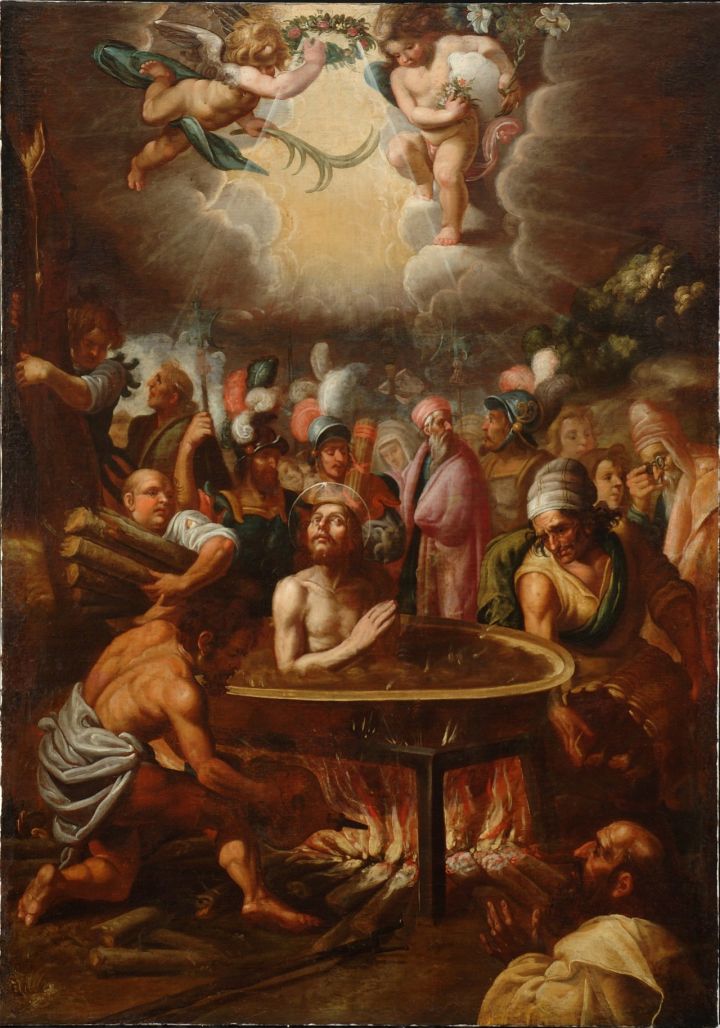
Juan de las Roelas, (Spanish, 1558–1625)Title:
The Martyrdom of Saint John the Evangelist
Oil on Canvas
147 x 105 cm. (57.9 x 41.3 in.)
Private collection

Juan de Roelas, de las Roelas or Ruela (c. 1570, in Flanders – 1625, in Olivares) was a Flemish painter whose entire documented career took place in Spain. He played a major role in the transition from Mannerist to Baroque painting in Spain.

The new findings about the prior mix-up of the biographical details of the painter with those of a Spanish monk and the lack of other documentation have made it difficult to separate and confirm the details of his life.

It is known that in 1598 he worked in Valladolid in the commemorative ceremonies for the death of king Philip II of Spain, contributing to the design of his funerary monument. He remained there until 1604, when he obtained a benefice or favour from the Count-Duke of Olivares. In the village of, Olivares, near Seville, de Roelas made several large paintings to decorate altars in and around Seville. It is reported that he moved to Madrid where he tried to obtain an appointment as painter to the royal court, but that when he failed he returned to Olivares where he died in 1625.

He had many disciples, among whom Francisco Varela from Seville and Pablo Legote from Luxembourg. More on Juan de Roelas

Later, he emerged unharmed from a cauldron of boiling oil into which he had been thrown on orders from the torturer.

After this, they sent the Apostle John off to imprisonment to the island of Patmos, for many years. Proceeding along on his way to the place of exile, Saint John worked many miracles. On the island of Patmos, his preaching and miracles attracted to him all the inhabitants of the island, and he enlightened them with the light of the Gospel. 

Domenichino, (1581–1641)
Saint John the Evangelist, c. between 1624 and 1629
Oil on canvas
Height: 259 cm (101.9 in); Width: 199.4 cm (78.5 in)
National Gallery, London

Domenichino, original name Domenico Zampieri, (born October 1581, Bologna, Papal States —died April 6, 1641, Naples), Italian painter who was a leading practitioner of Baroque classicism in Rome and Bologna.

He was trained in the academy of Lodovico Carracci and in 1602 was in Rome, where he joined the Bolognese artists at work in the decoration of the Farnese Palace. He decorated a room in the Villa Belvedere at Frascati with mythological frescoes and a chapel in the Badia at Grottaferrata...

In 1617–18 Domenichino painted for Cardinal Aldobrandini the celebrated canvas of The Hunt of Diana. This work shows that he was a sensitive colourist, and its idyllic mood departs from the arid classicism of his frescoes. Though Domenichino’s work remained in great demand, there was a reaction against the rigid classicism of his style, and in the last works that he produced in Rome he worked in a broader, less classical style. This closer approximation to the Baroque is also apparent In Naples his style was less acceptable than it had proved in Rome. More on Domenichino

Unknown artist
The Evangelist St. John with his symbol the eagle on Patmos, the devil stealing the ink-well
National Library of the Netherlands
I have no further description, at this time


After his prolonged exile, the Apostle John received his freedom and returned to Ephesus, where he continued with his activity In the year 95, the Apostle John wrote his Gospel at Ephesus. 

When it was time for the departure of the Apostle John, he went out beyond the city limits of Ephesus with the families of his disciples. He bade them prepare for him a cross-shaped grave, in which he lay, telling his disciples that they should cover him over with the soil. The disciples tearfully kissed their beloved teacher, but not wanting to be disobedient, they fulfilled his bidding. They covered the face of the saint with a cloth and filled in the grave. Learning of this, other disciples of Saint John came to the place of his burial. When they opened the grave, they found it empty. More on John the Evangelist


Please visit my other blogs: Art CollectorMythologyMarine ArtPortrait of a Lady, The OrientalistArt of the Nude and The Canals of VeniceMiddle East Artistsand 365 Saints, also visit my Boards on Pinterest

Images are copyright of their respective owners, assignees or others. Some Images may be subject to copyright

I don't own any of these images - credit is always given when due unless it is unknown to me. if I post your images without your permission, please tell me.

I do not sell art, art prints, framed posters or reproductions. Ads are shown only to compensate the hosting expenses.

If you enjoyed this post, please share with friends and family.

Thank you for visiting my blog and also for liking its posts and pages.

Please note that the content of this post primarily consists of articles available from Wikipedia or other free sources online.