El Greco, (1541–1614)
Opening of the Fifth Seal, The Vision of Saint John, from 1608 until 1614
Oil on canvas
87.5 × 76 in (222.2 × 193 cm); 88.5 × 78.5 in (224.7 × 199.3 cm)
Metropolitan Museum, New York
Doménikos Theotokópoulos (1541 – 7 April 1614), most widely known as El Greco; Spanish for "The Greek", was a painter, sculptor and architect of the Spanish Renaissance. The nickname "El Greco" refers both to his Greek origin and Spanish citizenship. The artist normally signed his paintings with his full birth name in Greek letters.
El Greco was born in Crete, which was at that time part of the Republic of Venice, and the center of Post-Byzantine art. He trained and became a master within that tradition before traveling at age 26 to Venice, as other Greek artists had done. In 1570 he moved to Rome, where he opened a workshop and executed a series of works. During his stay in Italy, El Greco enriched his style with elements of Mannerism and of the Venetian Renaissance. In 1577, he moved to Toledo, Spain, where he lived and worked until his death. In Toledo, El Greco received several major commissions and produced his best-known paintings.
El Greco's dramatic and expressionistic style was met with puzzlement by his contemporaries but found appreciation in the 20th century. El Greco is regarded as a precursor of both Expressionism and Cubism, while his personality and works were a source of inspiration for poets and writers. El Greco has been characterized by modern scholars as an artist so individual that he belongs to no conventional school. He is best known for tortuously elongated figures and often fantastic or phantasmagorical pigmentation, marrying Byzantine traditions with those of Western painting. More on El Greco
Saint John came from Bethsaida, a poor village in Galilee. He was the son of Zebedee the fisherman and of Salome, the daughter of Joseph, the Betrothed of the Virgin Mary. Joseph had four sons by his first marriage: James, Joses, Jude, and Simon, and three daughters: Esther, Martha, and Salome. Thus, Jesus Christ our Savior was the uncle of Saint John the Theologian, since He was the half-brother of John’s mother Salome.
John and his brother James were helping their father Zebedee with the fishing when the Savior called them to follow Him and become fishers of men. John became the “beloved disciple.
Unknown artist
The last supper, Saint John leaned on the breast of his beloved Master
I have no further description, at this time
At the Last Supper, the Lord placed him at His side, where he leaned on the breast of his beloved Master. When the Jews laid hold of Jesus, Saint John followed Him into the palace of the high priest.
Anthony van Dyck, (1599–1641)
Christ Crucified with the Virgin, Saint John and Mary Magdalene, c. between 1617 and 1619
Oil on canvas
Height: 3.3 cm (1.2 in); Width: 2.8 cm (1.1 in)
Louvre Museum , Paris
Sir Anthony van Dyck, ( 22 March 1599 – 9 December 1641) was a Flemish Baroque artist who became the leading court painter in England, after enjoying great success in Italy and Flanders. He is most famous for his portraits of Charles I of England and his family and court, painted with a relaxed elegance that was to be the dominant influence on English portrait-painting for the next 150 years. He also painted biblical and mythological subjects, displayed outstanding facility as a draughtsman, and was an important innovator in watercolour and etching. The Van Dyke beard is named after him. More Sir Anthony van Dyck
He alone remained with the Virgin Mary at the foot of the Cross when the Savior was crucified. Seeing John standing by, Christ said to His mother: “Woman, behold your son!” and to John: “Behold your mother!” From that hour, John took the Virgin Mary into his own home.
Giotto di Bondone, (–1337)
Descent from the cross, c, between 1304 and 1306
Fresco
Height: 200 cm (78.7 in); Width: 185 cm (72.8 in)
Scrovegni Chapel, Padua, Italy
St. John is wearing a red robe with open hands in the center of the screen
Giotto di Bondone (1266/7 – January 8, 1337), known mononymously as Giotto, and Latinized as Giottus, was an Italian painter and architect from Florence in the late Middle Ages. He is generally considered the first in a line of great artists who contributed to the Renaissance.
In his Lives of the Most Excellent Painters, Sculptors, and Architects, the late-16th century artist and art historian Giorgio Vasari describes Giotto as making a decisive break with the prevalent Byzantine style and as initiating "the great art of painting as we know it today, introducing the technique of drawing accurately from life, which had been neglected for more than two hundred years."
Giotto's masterwork is the decoration of the Scrovegni Chapel in Padua, also known as the Arena Chapel, completed around 1305. This fresco cycle depicts the Life of the Virgin and the Life of Christ. It is regarded as one of the supreme masterpieces of the Early Renaissance.[4] That Giotto painted the Arena Chapel and that he was chosen by the Commune of Florence in 1334 to design the new campanile (bell tower) of Florence's Cathedral are among the few certainties of his biography. Almost every other aspect of it is subject to controversy: his birthdate, his birthplace, his appearance, his apprenticeship, the order in which he created his works, whether or not he painted the famous frescoes in the Upper Basilica of Saint Francis in Assisi, and his burial place. More Giotto di Bondone
He saw Christ after His Resurrection and was commissioned with the other disciples to preach the Gospel throughout the world when. He was present also at the Lord’s Ascension into heaven and received the Holy Spirit. He remained the last of the disciples in Jerusalem, in the company of the Virgin Mary, whom he served until the time of her Dormition.
Peter Paul Rubens, (1577–1640)
Assumption of Mary, c. 1626
Oil on panel
Height: 490 cm (16 ft); Width: 325 cm (10.6 ft)
Cathedral of Our Lady, Antwerp
Sir Peter Paul Rubens (28 June 1577 – 30 May 1640) was a Flemish Baroque painter. A proponent of an extravagant Baroque style that emphasized movement, colour, and sensuality, Rubens is well known for his Counter-Reformation altarpieces, portraits, landscapes, and history paintings of mythological and allegorical subjects.
In addition to running a large studio in Antwerp that produced paintings popular with nobility and art collectors throughout Europe, Rubens was a classically educated humanist scholar and diplomat who was knighted by both Philip IV of Spain and Charles I of England. More on Sir Peter Paul Rubens
After the Dormition of the Mother of God the Apostle John went to Ephesus and other cities of Asia Minor to preach the Gospel, taking with him his own disciple Prochorus.
Unknown artist
They boarded a ship, which floundered during a terrible tempest
I have no further description, at this time
They boarded a ship, which floundered during a terrible tempest. All the travellers were cast up upon dry ground, and only the Apostle John remained in the depths of the sea. Prochorus, bereft of his spiritual father and guide, and he went on towards Ephesus alone.
Germán Hernández Amores, (1823–1894)
Travel of the Blessed Virgin and St. John to Ephesus after the death of Savior, c. 1862
The Virgin didn't travel with him to Ephesus!
Oil on canvas
Height: 244 cm (96 in); Width: 390 cm (12.7 ft)
Museo del Prado
Germán Hernández Amores (10 June 1823, Murcia – 16 May 1894, Murcia) was a Spanish painter who specialized in Classical, mythological, and Biblical scenes. He was one of the few artists in Spain to adopt stylistic elements from the German Nazarene movement.
He began by studying drawing with the Italian-born sculptor, Santiago Baglietto (1781-1853), at the Sociedad Económica de los Amigos del País in Murcia. Then, he studied at the Real Academia de Bellas Artes de San Fernando, with José and Federico de Madrazo. During this time, he paid his way by doing book illustrations.
The year 1851 found him in Paris, on a scholarship from the Consejo y Comisaría de Cruzada. Two years later, he received a pension that allowed him to stay at the Academia de España en Roma. He was there until 1857 and made contact with several German painters of the Nazarene movement, which influenced his style.
In 1858, he was awarded a Second Class prize at the National Exhibition of Fine Arts. His depiction of the Virgin Mary and Saint John on their way to Ephesus received a First Class prize at the Exhibition of 1862. He would continue to participate until 1892, but won no further prizes.
On the fourteenth day of his journey he stood at the shore of the sea and saw that the waves had cast a man ashore. Going up to him, he recognized the Apostle John, whom the Lord had preserved alive for fourteen days in the sea. Teacher and disciple went to Ephesus, where the Apostle John preached incessantly to the pagans about Christ. His preaching was accompanied by such numerous and great miracles, that the number of believers increased with each day.

Alonso Cano, (1601–1667)
Saint John the Evangelist and the Poisoned Cup, c. between 1635 and 1637
Oil on canvas
Height: 53.5 cm (21 in); Width: 35.5 cm (13.9 in)
Louvre Museum, Paris
The chalice held by Saint John alludes to tradition according to which St. John was handed a cup of poisoned wine, from which, at his blessing, the poison fled in the shape of a serpent.
Alonzo Cano or Alonso Cano (19 March 1601 – 3 September 1667) was a Spanish painter, architect and sculptor born in Granada. He learned architecture from his father, Miguel Cano; painting in the academy of Juan del Castillo, and from Francisco Pacheco the teacher of Velázquez; and sculpture from Juan Martínez Montañés. As a sculptor, his most famous works are the Madonna and Child in the church of Lebrija.
He was made first royal architect, painter to Philip IV, and instructor to the prince, Balthasar Charles, Prince of Asturias. The King gave him the church preferment of a canon of the Granada Cathedral, in order to take up a position as chief architect of the cathedral, where his main achievement in architecture was the façade, designed at the end of his life.
During this time there had begun a persecution of Christians under the emperor Nero (56-68). They took the Apostle John for trial at Rome. Saint John was sentenced to death for his confession of faith in the Lord Jesus Christ, but the Lord preserved His chosen one. The apostle drank a cup of deadly poison, but he remained alive.

Sigmund Gleismüller, (1449-1511)
Saint John on Patmos, c. 1490
Oil on canvas
Germanisches Nationalmuseum, Nuremberg, Germany
Meister von Mörlbach or Meister des Mörlbacher Marienaltar is the emergency name for a painter of the late 15th century who was under Flemish influence. Björn Statnik identified him in 2009 with the Landshut court painter Sigmund Gleismüller.
The panels of the Annunciation altar in the church of St. Stephan in Mörlbach come from the master of Mörlbach . The panels of the Catherine Altar in the former monastery church of the Attel monastery (now the parish church of St. Michael) are ascribed to him. More on Sigmund Gleismüller
Juan de las Roelas, (Spanish, 1558–1625)Title:
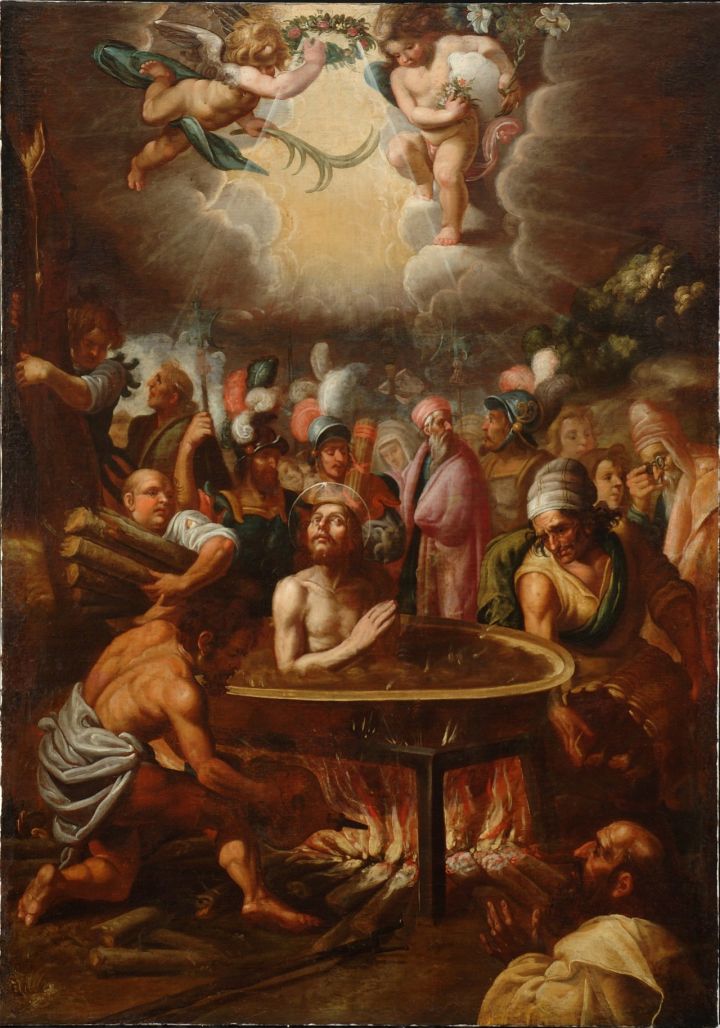
The Martyrdom of Saint John the Evangelist
Oil on Canvas
147 x 105 cm. (57.9 x 41.3 in.)
Private collection
Juan de Roelas, de las Roelas or Ruela (c. 1570, in Flanders – 1625, in Olivares) was a Flemish painter whose entire documented career took place in Spain. He played a major role in the transition from Mannerist to Baroque painting in Spain.
The new findings about the prior mix-up of the biographical details of the painter with those of a Spanish monk and the lack of other documentation have made it difficult to separate and confirm the details of his life.
It is known that in 1598 he worked in Valladolid in the commemorative ceremonies for the death of king Philip II of Spain, contributing to the design of his funerary monument. He remained there until 1604, when he obtained a benefice or favour from the Count-Duke of Olivares. In the village of, Olivares, near Seville, de Roelas made several large paintings to decorate altars in and around Seville. It is reported that he moved to Madrid where he tried to obtain an appointment as painter to the royal court, but that when he failed he returned to Olivares where he died in 1625.
He had many disciples, among whom Francisco Varela from Seville and Pablo Legote from Luxembourg. More on Juan de Roelas
Later, he emerged unharmed from a cauldron of boiling oil into which he had been thrown on orders from the torturer.
After this, they sent the Apostle John off to imprisonment to the island of Patmos, for many years. Proceeding along on his way to the place of exile, Saint John worked many miracles. On the island of Patmos, his preaching and miracles attracted to him all the inhabitants of the island, and he enlightened them with the light of the Gospel.
Domenichino, (1581–1641)
Saint John the Evangelist, c. between 1624 and 1629
Oil on canvas
Height: 259 cm (101.9 in); Width: 199.4 cm (78.5 in)
National Gallery, London
Domenichino, original name Domenico Zampieri, (born October 1581, Bologna, Papal States —died April 6, 1641, Naples), Italian painter who was a leading practitioner of Baroque classicism in Rome and Bologna.
He was trained in the academy of Lodovico Carracci and in 1602 was in Rome, where he joined the Bolognese artists at work in the decoration of the Farnese Palace. He decorated a room in the Villa Belvedere at Frascati with mythological frescoes and a chapel in the Badia at Grottaferrata...
In 1617–18 Domenichino painted for Cardinal Aldobrandini the celebrated canvas of The Hunt of Diana. This work shows that he was a sensitive colourist, and its idyllic mood departs from the arid classicism of his frescoes. Though Domenichino’s work remained in great demand, there was a reaction against the rigid classicism of his style, and in the last works that he produced in Rome he worked in a broader, less classical style. This closer approximation to the Baroque is also apparent In Naples his style was less acceptable than it had proved in Rome. More on Domenichino
Unknown artist
The Evangelist St. John with his symbol the eagle on Patmos, the devil stealing the ink-well
National Library of the Netherlands
I have no further description, at this time
After his prolonged exile, the Apostle John received his freedom and returned to Ephesus, where he continued with his activity In the year 95, the Apostle John wrote his Gospel at Ephesus.
When it was time for the departure of the Apostle John, he went out beyond the city limits of Ephesus with the families of his disciples. He bade them prepare for him a cross-shaped grave, in which he lay, telling his disciples that they should cover him over with the soil. The disciples tearfully kissed their beloved teacher, but not wanting to be disobedient, they fulfilled his bidding. They covered the face of the saint with a cloth and filled in the grave. Learning of this, other disciples of Saint John came to the place of his burial. When they opened the grave, they found it empty.
More on John the Evangelist
Please visit my other blogs: Art
Collector, Mythology, Marine
Art, Portrait of a Lady, The
Orientalist, Art of the Nude and The
Canals of Venice, Middle
East Artists, and 365 Saints, also visit my Boards on Pinterest
Images are copyright of their respective owners, assignees or others.
Some Images may be subject to copyright
I don't own any of these images - credit is always given when due unless
it is unknown to me. if I post your images without your permission, please tell
me.
I do not sell art, art prints, framed posters or reproductions. Ads are
shown only to compensate the hosting expenses.
If you enjoyed this post, please share with friends and family.
Thank you for visiting my blog and also for liking its posts and pages.
Please note that the content of this post primarily consists of articles
available from Wikipedia or other free sources online.