Showing posts with label Figurative. Show all posts

Tuesday, September 29, 2020

07 works, Today, September 28th, is Saint Wenceslas' day, his story illustrated #270

Unknown artist
Saint Wenceslas
Czech Institute of Monuments
I have no further description, at this time

Wenceslas I,
also called Saint Wenceslas, (born c. 907, Stochov, near Prague—died Sept. 28, 929, Stará Boleslav, Bohemia), prince of Bohemia, martyr, and patron saint of the Czech Republic.

Josef Mathauser
Princess Drahomíra, Prince Václav and Ludmila
Oil on canvas
33.3 x 21.5 cm | 13.1 x 8.5 inches
I have no further description, at this time

Josef Mathauser (24 July 1846 in Staňkov – 10 January 1917 in Prague) was a Czech Romantic painter. He is known for his religious paintings, and for his series of "History of the Czech Nation in Pictures".

Among his religious works are the Stations of the Cross in the Assumption of Mary church in Mariánské Lázně (1886/7) and an altar in the church of St. Peter and Paul, and the restoration of religious scenes at Svatá Hora Monastery near Příbram (1895). More on Josef Mathauser

Wencelas was raised a Christian by his grandmother St. Ludmila, but his ambitious mother, Drahomíra (Dragomir), a pagan, had her murdered and acted as regent herself, until Wenceslas came of age in 924 or 925. Her court intrigues and the wishes of the people to end the conflicts between Christian and non-Christian factions in Bohemia led Wenceslas to take the reins of government. As duke he was pious, reportedly taking a vow of virginity, and encouraged the work of German missionary priests in the Christianization of Bohemia. His zeal in spreading Christianity, however, antagonized his non-Christian opponents.

Unknown artist
Radslav of Kouřim surrenders to St. Wenceslaus after seeing two Angels accompanying him into battle
I have no further description, at this time

According to legend, one Count Radislas rose in rebellion and marched against King Wenceslas. The latter sent a deputation with offers of peace, but Radislas viewed this as a sign of cowardice. The two armies were drawn up opposite each other in battle array, when Wenceslas, to avoid shedding innocent blood, challenged Radislas to single combat. As Radislas advanced toward the king, he saw by Wenceslas' side two angels, who cried: "Stand off!" Thunderstruck, Radislas repented his rebellion, threw himself from his horse at Wenceslas's feet, and asked for pardon. Wenceslas raised him and kindly received him again into favor.

Unknown author
King Henry I, circa 1597-1618
Oil on panel
Height: 58.4 cm (22.9 in); Width: 44.4 cm (17.4 in)
National Portrait Gallery, London

Faced with German invasions in 929, Wenceslas submitted to the German king Henry I the Fowler. His submission provoked some of the nobles to conspire against him, and they prompted his younger brother, Boleslav (Boleslaus), to murder him. 

Unknown artist
Wenceslas is murdered by his brother Boleslaw
I have no further description, at this time

Gumpold of Mantua, Vita of St. Wenzel (Wolfenbüttel, Herzog August Bibliothek, Cod. Guelf. 11.2 Aug. 4 °, fol. 21r, written before 1006). Wenceslas death. From left: Wenceslaus snatches the sword from Boleslav. Boleslav attacks Wenceslas, who takes refuge in the church. A priest closes the door.

Unknown artist
The shrine of the holy king Wenceslas was honored with many miracles
I have no further description, at this time

Waylaid by Boleslav en route to mass, Wenceslas was killed at the church door. Frightened by the reports of miracles occurring at Wenceslas’ tomb, Boleslav had his remains transferred in 932 to the Church of St. Vitus, Prague, which became a great pilgrimage site during the medieval period. Wenceslas was regarded as Bohemia’s patron saint almost immediately after his assassination. His virtues are sung in the Christmas carol (19th century) “Good King Wenceslas.” More on Saint Wenceslas

Unknown artist
 King Wenceslas was crowned martyr
Emma venerates St. Wenceslaus
Vita of St. Wenceslaus
Wolfenbüttel, Herzog
I have no further description, at this time

Emma († 1005/1006) was a Bohemian princess. She lived in Prague Castle as the wife and widow of Boleslav II until 1002. She was also Wenceslaus' sister-in-law.


Please visit my other blogs: Art CollectorMythologyMarine ArtPortrait of a Lady, The OrientalistArt of the Nude and The Canals of VeniceMiddle East Artistsand 365 Saints, also visit my Boards on Pinterest

Images are copyright of their respective owners, assignees or others. Some Images may be subject to copyright

I don't own any of these images - credit is always given when due unless it is unknown to me. if I post your images without your permission, please tell me.

I do not sell art, art prints, framed posters or reproductions. Ads are shown only to compensate the hosting expenses.

If you enjoyed this post, please share with friends and family.

Thank you for visiting my blog and also for liking its posts and pages.

Please note that the content of this post primarily consists of articles available from Wikipedia or other free sources online.


Tuesday, September 8, 2020

05 works, Today, September 7th, is John Duckett's day, his story illustrated #250

Unknown artist
James Duckett was  Beatified by Pope Pius XI on 15 December 1929
St James’ church, Spanish Place in London
I have no further description, at this time


“A tryptich showing some of the martyrs who died for the Catholic faith from 1535 – 1680. In the centre is the triple gallows known as the ‘Tyburn Tree’.

John Duckett (1613 – 7 September 1644) was an English Catholic priest and martyr.

John Duckett was born at Underwinder, in the parish of Sedbergh, in Yorkshire, in 1603, the son of James and Francis Duckett. He was a relative, possibly grandson of James Duckett who had been executed at Tyburn on 19 April 1601 for printing Catholic books.

Leymonnerye, Léon (1803 - 1879)
College of Arras in Paris, c. 1858
Pencil
Carnavalet Museum, History of Paris
I have no further information on the artist

He was baptized on 24 February 1614 and educated at Sedbergh School. At the age of seventeen, he entered the English College, Douai; he was ordained a priest by the Archbishop of Cambrai in 1639 and was then sent to study for three years at the College of Arras in Paris.

He is said to have had an extraordinary gift of prayer, and as a student would spend whole nights in contemplation. After Paris it came time to embark on the English mission, but on his way he spent two months in retreat under the direction of his uncle, John Duckett, prior of the Charterhouse at Nieupoort.

He arrived at Newcastle upon Tyne around Christmas 1643, Duckett worked largely in the North and laboured for about a year in Durham. It was in the time of the Civil War and he was arrested by Roundhead soldiers only a few months later, on 2 July 1644, at Redgate Head, Wolsingham, County Durham, while on his way to baptize two children. Taken to Sunderland, he was examined by a Parliamentary Committee of sequestrators and placed in irons. 

Unknown artist
40 Martyrs of England and Wales
I have no further description, at this time

He admitted he was a priest and so was taken to London with the Jesuit Ralph Corby, arrested about the same time near Newcastle-on-Tyne. They were both confined in Newgate, where they were the cause of crowds of Catholics gathering. On these and on others who encountered them they made an impression by their cheerfulness and sanctity. 

Daphne Pollen, (1904–1986)
Forty Martyrs of England and Wales
Martyrs of England and Wales including three Carthusians
I have no further description of this artwork at this time

Daphne Pollen, 1904–1986, was born into a wealthy family.


Daphne attended the Slade School of Art, and developed a particular gift as a muralist. By 1923, aged only nineteen, she was working on an immensely ambitious work; a sixty-foot mural of ‘Christ Healing the Sick’ in the church of All Hallows, Poplar. The church was badly damaged in 1942 during the Blitz, and was demolished in 1952, so this work has been lost.


However, also in 1923, she went with her family to India to see Lutyens’ work at New Delhi, and found a fellow Slade alumnus was also travelling on the boat: Arthur Pollen. They fell in love, and in 1926, she married him, and converted to Catholicism. 


After her marriage, her practice as an artist declined as her domestic commitments increased, but such work as she did, like her husband’s, was focused on Christian themes, and Catholic church art in particular, though she was also a competent portraitist. ‘The Forty English Martyrs’ was painted in 1968. This was commissioned by the Society of Jesus at a time when Philip Caraman and John Walsh SJ were working towards the canonisation of the English martyrs.


The Pollens’ belief in the importance of religious art was transmitted to the next generation.  Both their sons, the architect Francis Pollen (he designed Worth Abbey in Sussex) and the stained-glass artist Patrick Pollen, worked regularly on religious subjects throughout their respective careers. More on Daphne Pollen 


Unknown artist
Supremacy and Survival: The English Reformation
I have no further description, at this time


He was brought to trial on 4 September and given the inevitable sentence of hanging, drawing and quartering. Corby was offered a reprieve, but deferred in favor of the younger Duckett, who refused to walk away and leave his friend. Both were executed at Tyburn in London on 7 September 1644.

Both priests were declared Blessed by Pope Pius XI on 15 December 1929. More on John Duckett


Please visit my other blogs: Art CollectorMythologyMarine ArtPortrait of a Lady, The OrientalistArt of the Nude and The Canals of VeniceMiddle East Artistsand 365 Saints, also visit my Boards on Pinterest

Images are copyright of their respective owners, assignees or others. Some Images may be subject to copyright

I don't own any of these images - credit is always given when due unless it is unknown to me. if I post your images without your permission, please tell me.

I do not sell art, art prints, framed posters or reproductions. Ads are shown only to compensate the hosting expenses.

If you enjoyed this post, please share with friends and family.

Thank you for visiting my blog and also for liking its posts and pages.

Please note that the content of this post primarily consists of articles available from Wikipedia or other free sources online.


Saturday, September 5, 2020

05 works, Today, September 4th, is St. Charitina of Amisus's day, her story illustrated #247

Unknown artist
Rape As A Weapon Of War
CCTV America (A Britannica Publishing Partner)
I have no further description, at this time

St. Charitina of Amisus
(also known as Charitina of Rome), was a virgin from Asia Minor, distinguished by strict chastity and piety.

Unknown artist
Saint Charitina of Amisus
Gold leaf, tempera and gesso on wood
50×60
I have no further description, at this time

Orphaned young, she was the servant of an eminent Christian man called Claudius the pious, who brought her up as his own daughter. The young woman was very pretty, sensible, and kind. She imparted her love for Christ to others, and she converted many to the way of salvation. Charitina was meek, humble, obedient and silent. Although not as yet baptized, she was a Christian at heart. She studied the law of God day and night and vowed to live in perpetual virginity as a true bride of Christ.

Unknown artist
Emperor Diocletian (284-305 A.D.)
From Izmit (ancient Nicomedia)
Arkeoloji Muzerleri (Archaeological Museum), Turkey. Istanbul, 

Having brought others to the Christian faith, the Emperor Diocletian's governor, Dometius, heard of her and sent soldiers to take her from her foster-father for trial. The judge asked her: "Is it true, little girl, that you are a Christian, and that you delude others by bringing them to this dishonourable faith?" Charitina courageously replied: "It is true that I am a Christian, and a lie that I delude others. I lead those in error to the way of truth, bringing them to my Christ."

Unknown artist
St. Charitina of Amisus
Kharitina Amisiyskaya , Constantinople. 985
Miniature Minology of Vasily II.
Vatican Library. Rome.

The judge ordered that her hair be cut off and live coals put on her head, but the maiden was preserved by God's power. They threw her into the sea, but she clambered out saying, "This is my baptism." God delivered her from it. 

Unknown artist
She was bound to a wheel which began to turn
I have no further description, at this time

She was bound to a wheel which began to turn, but an angel of God stopped the wheel and Charitina remained unharmed. Then the judge sent some dissolute youths to rape her. Fearing this dishonour, St Charitina prayed to God to receive her soul before these dissolute men could foul her virginal body and so, while she was kneeling in prayer, her soul went out from her body. St. Charitina died a martyr’s death. After torture, death, burial and desecration, her body was thrown into the sea in the year 304. More on St. Charitina of Amisus


Please visit my other blogs: Art CollectorMythologyMarine ArtPortrait of a Lady, The OrientalistArt of the Nude and The Canals of VeniceMiddle East Artists365 Saints365 Days, and Biblical Icons, also visit my Boards on Pinterest

Images are copyright of their respective owners, assignees or others. Some Images may be subject to copyright

I don't own any of these images - credit is always given when due unless it is unknown to me. if I post your images without your permission, please tell me.

I do not sell art, art prints, framed posters or reproductions. Ads are shown only to compensate the hosting expenses.

If you enjoyed this post, please share with friends and family.

Thank you for visiting my blog and also for liking its posts and pages.

Please note that the content of this post primarily consists of articles available from Wikipedia or other free sources online.


Friday, September 4, 2020

10 works, Today, September 3rd, is Constantine IV's day, his story illustrated #246

Geoffroy Villardouin
Byzantine emperor
JEAN II COMNÈNE & EMPRESS IRENE THE HUNGARIAN
OIL PAINTING ON CANVAS
I have no further description, at this time

Geoffrey I of Villehardouin (c. 1169 – c. 1229) was a French knight from the County of Champagne who joined the Fourth Crusade. He participated in the conquest of the Peloponnese and became the second prince of Achaea (1209/1210–c. 1229).

Under his reign, the Principality of Achaea became the direct vassal of the Latin Empire of Constantinople. He extended the borders of his principality, but the closing years of his rule were marked by his conflict with the church. More on Geoffroy Villardouin

Constantine IV ruled as emperor of the Byzantine empire from 668 to 685 CE. His reign is best remembered today for the five-year Arab siege of Constantinople from 674 CE, which the Byzantines resisted thanks to their strong fortifications and the secret weapon of Greek Fire. Although not hugely successful in other theatres, the reign of Constantine would at least stabilize the Empire, perpetuate the rule of Christianity in the East, and permit something of a revival of Byzantine fortunes under subsequent emperors.

Unknown artist
Byzantine emperor Constantine IV (r. 668-685 CE) and entourage, c. 7th century
Mosaic
Basilica of Sant'Apollinare, in Classe, Ravenna, Italy.

Constantine was the eldest son of Constans II (r. 641-668 CE) and he had been crowned co-emperor, as was customary for the chosen heir, in 654 CE. Constans was unpopular with the Church He did not win any admirers for his military record, either, as the Arab Caliphate inflicted a series of defeats on Byzantine armies throughout his reign. When the emperor relocated to Syracuse on Sicily for greater safety it was the last straw for the Byzantine aristocracy who envisaged their abandonment in Constantinople, the capital. 

Watson Charlton
Death of Constans II, c. 1872
Hutchinson publishing house's book History of the Nations (1920)
I have no further description, at this time

Watson Charlton (1872 - ?) was a British illustrator of children's books. He was born in Sunderland, Durham, the son of the painter John William Charlton (1848–1917).

It was no surprise, then, that Constans was assassinated - the deed done, while he took his bath, by one of his own military entourage on 15 September 668 CE, with a soap dish as the inglorious weapon.

Constantine travelled to Sicily where he put down the rebellion led by Mizizios, one of the conspirators who had murdered his father. It was in the east, though, with the now annual incursions of Byzantine Asia Minor by the Arab Caliphate, that the empire was most threatened. 

Unknown artist
Clash between Byzantines and Arabs 
I have no further description, at this time

One of the most persistent attacks in Constantinople’s long history came with the Arab siege of 674-678 CE. Muawiya (r. 661-680 CE), the caliph and founder of the Umayyad Caliphate, had already enjoyed victories against Byzantine armies during the reign of Constans II and in 670 CE the Muslim fleet took Cyprus, Rhodes and Kos, and then moved into the northern Aegean. Next, they attacked Kyzikos (Cyzicus) on the south coast of the Sea of Marmara. Now possessing a handy peninsula from which to launch attacks, Constantinople was the next major target in 674 CE. The city’s legendary fortifications, the Theodosian Walls, and the Byzantine secret incendiary weapon of Greek Fire meant that, ultimately, the five-year siege was unsuccessful.

During the siege, every summer the city resisted siege engines and artillery fire from huge catapults, to the frustration of the army of Muawiya. Meanwhile, the Caliphate’s armies in Asia Minor had been suffering setbacks - for example, there were attacks by the Mardaites tribesmen of Lebanon (encouraged by Constantine). 

Unknown artist
The crew of a Byzantine dromond spraying an enemy ship with Greek fire
I have no further description, at this time

His fleet was torched by Greek Fire, the caliph was forced to sign a 30-year truce with Byzantium. It was the first major defeat the Arabs had suffered since the rise of Islam. In 679 CE Muawiya was obliged to give up the Aegean islands he had conquered and pay an annual tribute which included 3,000 gold coins, 50 slaves and 50 thoroughbred horses.

Constantine still faced problems elsewhere, though. The Empire had fast been crumbling at the edges throughout the first half of the 7th century CE. Now the Arabs in North Africa were steadily increasing their territory at the expense of the empire and the Bulgars, led by Asparuch, were also flexing their military muscle south of the Danube. On top of that, the Slavs had attacked Thessaloniki, the empire’s second most important city. 

The Byzantine fleet as seen in the Chronicle of John Skylitzes, circa 13th century
Madrid National Library.

Thessaloniki was successfully defended but, after a failed Byzantine naval mission in 680 CE, the Bulgar kingdom became the first in Byzantine territory which an emperor was obliged to recognize as independent. Constantine, preferring to concentrate his armies in Asia, was constrained to sign a treaty in 681 CE which necessitated the emperor paying a handsome annual tribute to the Bulgars as a price for peace. 

Unknown artist
Bulgarian forces rout the Byzantines, 11th-12th centuries
illustrated illuminated manuscript of the Synopsis of Histories
Madrid, Skylitzes
I have no further description, at this time

In Italy, meanwhile, Constantine was obliged to sign a peace treaty with the ambitious Lombards who had captured Byzantine territory in the south. 

Graham Sumner
The ambitious Lombards
I have no further description, at this time

Graham Sumner was born in 1958. He studied illustration at Wrexham Art School and has specialised in archaeological reconstruction drawings. Graham has been involved with the Ermine Street Guard for nearly 20 years. He has written a number of articles for ‘Military Illustrated’ magazine and was the author of the popular ‘Roman Army: Wars of the Empire’ in Brasseys’ ‘History of Uniform’ series. More on Graham Sumner

A similar treaty was signed with the Avars in central Europe. Greater success was enjoyed in Cilicia in 684 CE and most of the lands of the  Armenians became a Byzantine protectorate at their own request. The empire had found its military feet again and stopped the rot after half a century of serious setbacks .

Unknown artist
The Sixth Ecumenical Council
I have no further description, at this time

Another notable event of Constantine’s reign was the Sixth Ecumenical Council of 680-681 CE. 

Unknown artist
Pope Agatho
The Lives and Times of the Popes, c. 1842
The Catholic Publication Society of America, 1911
I have no further description, at this time

Constantine had communicated with Pope Agatho (678-681 CE) who enthusiastically agreed that a decision needed to be made on the Christian Church’s fundamental principles regarding the two natures of Jesus Christ, the embodiment of both the human and divine spirit. Accordingly, 174 delegates representing the Church from all parts of the empire gathered in the Domed Hall of the royal palace in Constantinople. The Council, meeting 18 times over ten months and presided over by the emperor himself, condemned both Monotheletism (the idea that Jesus Christ had a single will) and Monoenergism (that Christ had a single energy or force). Anyone who had or still disagreed with that view was condemned as a heretic. 

Constantine died of dysentery aged just 33 in 685 CE and was succeeded by his son and chosen heir Justinian II (r. 685-695 CE). More on Constantine IV


Please visit my other blogs: Art CollectorMythologyMarine ArtPortrait of a Lady, The OrientalistArt of the Nude and The Canals of VeniceMiddle East Artistsand 365 Saints, also visit my Boards on Pinterest

Images are copyright of their respective owners, assignees or others. Some Images may be subject to copyright

I don't own any of these images - credit is always given when due unless it is unknown to me. if I post your images without your permission, please tell me.

I do not sell art, art prints, framed posters or reproductions. Ads are shown only to compensate the hosting expenses.

If you enjoyed this post, please share with friends and family.

Thank you for visiting my blog and also for liking its posts and pages.

Please note that the content of this post primarily consists of articles available from Wikipedia or other free sources online.


Thursday, September 3, 2020

10 works, Today, September 2nd, is the Martyrs of Nicomedia's day, their story illustrated #245

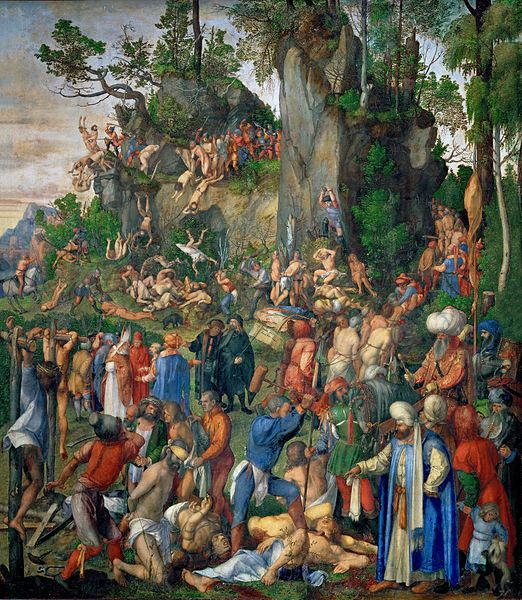
Albrecht Dürer, (1471–1528)
20,000 Martyrs of Nicomedia
Martyrdom of ten thousand Christians, c. 1508
Oil on panel
Height: 99 cm (38.9 in); Width: 87 cm (34.2 in)
Kunsthistorisches Museum, Vienna, Austria

Albrecht Dürer (21 May 1471 – 6 April 1528) was a painter, printmaker and theorist of the German Renaissance. Born in Nuremberg, Dürer established his reputation and influence across Europe when he was still in his twenties, due to his high-quality woodcut prints. He was in communication with the major Italian artists of his time, including Raphael, Giovanni Bellini and Leonardo da Vinci, and from 1512 he was patronized by emperor Maximilian I.

His vast body of work includes engravings, his preferred technique in his later prints, altarpieces, portraits and self-portraits, watercolours and books. The woodcuts, such as the Apocalypse series (1498), retain a more Gothic flavour than the rest of his work. His well-known engravings include the Knight, Death, and the Devil (1513), Saint Jerome in his Study (1514) and Melencolia I (1514), which has been the subject of extensive analysis and interpretation. His watercolours also mark him as one of the first European landscape artists, while his ambitious woodcuts revolutionized the potential of that medium.

Dürer's introduction of classical motifs into Northern art, through his knowledge of Italian artists and German humanists, has secured his reputation as one of the most important figures of the Northern Renaissance. This is reinforced by his theoretical treatises, which involve principles of mathematics, perspective and ideal proportions. More on Albrecht Dürer


The 20,000 Martyrs of Nicomedia refers to victims of persecution of Christians in Nicomedia, Bithynia (Izmit, Turkey) by the Roman Emperors Diocletian and Maximian in the early 4th century AD.

Unknown artist
20,000 martyrs of Nicomedia, c. 985
Te burning of a church that held numerous Christians
Miniature Minology of Vasily II, Vatican Library, Rome

The 20,000 martyrs of Nicomedia, including: Glycerius, Zeno, Theophilus, Dorotheus, Mardonius, Migdonius, Indes, Gorgonius, Peter, Euthymius, and the virgins Agape, Domna, and Theophila


According to various martyrologies and menologion, the persecution included the burning of a church that held numerous Christians on Christmas Day.

Unknown artist
Maximinus Thrax, 235-238 CE
I have no further description, at this time

At the turn of the fourth century, the Roman emperor Maximian (284-305) was growing increasingly angry over the spread of Christianity throughout the Empire. Even members of his court had been revealed as secret Christians.

Unknown artist
St. Domna of Nicomedia
I have no further description, at this time

The pagan priestess Domna was living in Maximian’s palace and had secretly become intrigued by the teachings of Christianity. She went secretly to Bishop Anthimus, who was the successor to Saint Cyril, and received holy Baptism. Domna soon began helping the poor, and even secretly distributed food from the imperial kitchens to the needy.

Bernardo Cavallino
Saint Agatha, c. 1640s
Oil on canvas
27 1/8 × 22 1/4 inches (68.9 × 56.5 cm)
Detroit Institute of Arts

Bernardo Cavallino (1616–1656) was an Italian painter and draughtsman. He is regarded as one of the most original painters active in Naples during the first half of the 17th century. 

Born in Naples, his paintings are some of the more stunningly expressive works emerging from the Neapolitan artists of his day. Little is known about his background or training. Of eighty attributed paintings, less than ten are signed. He worked through private dealers and collectors whose records are no longer available.


One of his masterpieces is the billowing proletarian Blessed Virgin at the Brera Gallery in Milan. Passive amid the swirling, muscular putti, this Neapolitan signorina delicately rises from the fog, the updated Catholic baroque equivalent of a Botticelli's Venus. His The Ecstasy of St Cecilia exists both as cartoon (Museo di Capodimonte, Naples)[2] and final copy in the Palazzo Vecchio of Florence. Finally, his Esther and Ahasuerus hangs in the Uffizi Gallery.

He is thought to have died during the plague epidemic in 1656. More on Bernardo Cavallino


When the chief eunuch of the palace found out about the food, he had Domna put in jail in hopes that she would confess. Domna feigned insanity and she was subsequently released. She then somehow managed to leave the imperial court while Maximian was off to war. The abbess Agatha dressed Domna in men’s clothing, cut her hair and sent her to a monastery.

Unknown artist
Triumph of Maximian
Triumph of Titus
Los Angeles County Museum of Art
I have no further description, at this time

A reconstructed relief panel from the original on the Arch of Titus, Rome, c. 81 CE. The scene, showing the triumph of Titus, is carved in three-quarter view and has Titus riding a four-horse chariot (quadriga) and shows him being crowned by a personification of Victory. The goddess Roma stands in front, holding the bridle of one of the horses. The two figures to the right of the chariot are personifications of the people of Rome (naked torso) and the Senate (wearing a toga). 

Upon his return from battle, emperor Maximian ordered that a search be made for the former pagan priestess. The soldiers found the monastery, razed it to the ground, and threw all the sisters into prison. Maximian’s rage against Christians continued to grow as he saw more and more of his citizens converting to the new religion.

Maximian commanded the presbyter Glycerius be arrested for trial. Unable to force Saint Glycerius to stop confessing his belief in the teachings of Christ, Maximian ordered him to be burned to death.

Maximian gave orders to destroy Christian churches, to burn service books, and to deprive all Christians of their civil rights.

This event took place when the emperor Maximian returned with victory over Ethiopians in 304 AD. It happened after they had refused to sacrifice to idols during Christmas Mass in order to thank gods for the victory he had acquired. Later Maximian and his soldiers entered the church and told the Christians they could escape punishment if they renounced Christ. 

Unknown artist
Hieromartyr Anthimus, Bishop of Nicomedia, and those with him, captured and tortured to death, c. 985
Miniature Minology of Vasily II, Vatican Library, Rome

The Christian priest Glycerius answered that the Christians would never "renounce their faith, even under the threat of torture". Maximian ordered him to be burned to death. Those who had not been burned in the church were captured and tortured to death. 

Theophanes the Greek
Saint Anthimos from Nicomedia
Frescoes of the Church of the Transfiguration of the Savior
Novgorod, Russia

Theophanes the Greek (c. 1340 – c. 1410) was a Byzantine Greek artist and one of the greatest icon painters of Muscovite Russia, and was noted as the teacher and mentor of the great Andrei Rublev.

Theophanes was born in Constantinople. After studying art and philosophy at the University of Constantinople, he moved to Novgorod in 1370, and in 1395 to Moscow. His style is considered unsurpassed in expression achieved by almost mono-colored painting. Some of his contemporaries observed that he appeared to be "painting with a broom", in reference to the bold, broad execution in some of his finest frescos, which are unique in the larger Byzantine tradition. Theophanes was described by the Muscovites as "learned in philosophy", a reflection on his broad education and erudition. The balance of mathematical harmony in line and shape, wed to a master's use of an earthtone palette and precious gold leaf, evokes a spirituality that is immensely powerful, and speaks to the genius of this relatively unknown painter. More on Theophanes the Greek 

The bishop Anthimos who had escaped burning in the church was captured and beheaded.

The former pagan priestess Domna had been hiding in a cave during this persecution, and she managed to survive the holocaust. She discovered the remains of three of her new Christian friends who had been martyred, and gave them a decent burial, even burning incense at their gravesite and offering prayers there.

Giovanni da Milano
Domna was beheaded at the order of the Emperor
La degollación de Santa Catalina" (1530)
I have no further description, at this time

Giovanni da Milano (Giovanni di Jacopo di Guido da Caversaccio) was an Italian painter, known to be active in Florence and Rome between 1346 and 1369.


His style is, like many Florentine painters of the time, considered to be derivative of Giotto's. Vasari misidentified him as a student of Taddeo Gaddi, a noted Giotto protégé.


Hailing from Lombardy, the earliest documentation shows Giovanni in Florence on October 17, 1346, under the name Johannes Jacobi de Commo, listed amongst the foreign painters living in Tuscany. More Giovanni da Milano


She was reported to the imperial authorities when she was seen praying at the site, and was arrested. She was beheaded at the order of the Emperor. The atrocities of Nicomedia have never been forgotten, and are commemorated to this day in churches all over the Orthodox world. More on Martyrs of Nicomedia

Unknown artist
20,000 Martyrs of Nicomedia
I have no further description, at this time

The top two parts depict various prominent saints, as well as the “Not Made by Hands” image of Jesus at the very top.


Please visit my other blogs: Art CollectorMythologyMarine ArtPortrait of a Lady, The OrientalistArt of the Nude and The Canals of VeniceMiddle East Artistsand 365 Saints, also visit my Boards on Pinterest

Images are copyright of their respective owners, assignees or others. Some Images may be subject to copyright

I don't own any of these images - credit is always given when due unless it is unknown to me. if I post your images without your permission, please tell me.

I do not sell art, art prints, framed posters or reproductions. Ads are shown only to compensate the hosting expenses.

If you enjoyed this post, please share with friends and family.

Thank you for visiting my blog and also for liking its posts and pages.

Please note that the content of this post primarily consists of articles available from Wikipedia or other free sources online.