Showing posts with label Murillo. Show all posts

Saturday, January 2, 2021

16 works, Today, January 1st, is Mary the Blessed Virgin's day, her story, illustrated #364

Edvard Munch, (1863–1944)
Detail; Madonna, c. 1895
Oil on canvas
Height: 90 cm (35.4 in); Width: 71 cm (27.9 in)
Kunsthalle, Hamburg

Edvard Munch (12 December 1863 – 23 January 1944) was a Norwegian painter and printmaker whose intensely evocative treatment of psychological themes built upon some of the main tenets of late 19th-century Symbolism and greatly influenced German Expressionism in the early 20th century. One of his most well-known works is The Scream of 1893. More

Edvard Munch was a prolific yet perpetually troubled artist preoccupied with matters of human mortality such as chronic illness, sexual liberation, and religious aspiration. He expressed these obsessions through works of intense color, semi-abstraction, and mysterious subject matter. Following the great triumph of French Impressionism, Munch took up the more graphic, symbolist sensibility of the influential Paul Gauguin, and in turn became one of the most controversial and eventually renowned artists among a new generation of continental Expressionist and Symbolist painters. Munch came of age in the first decade of the 20th century, during the peak of the Art Nouveau movement and its characteristic focus on all things organic, evolutionary and mysteriously instinctual. More on Edvard Munch 

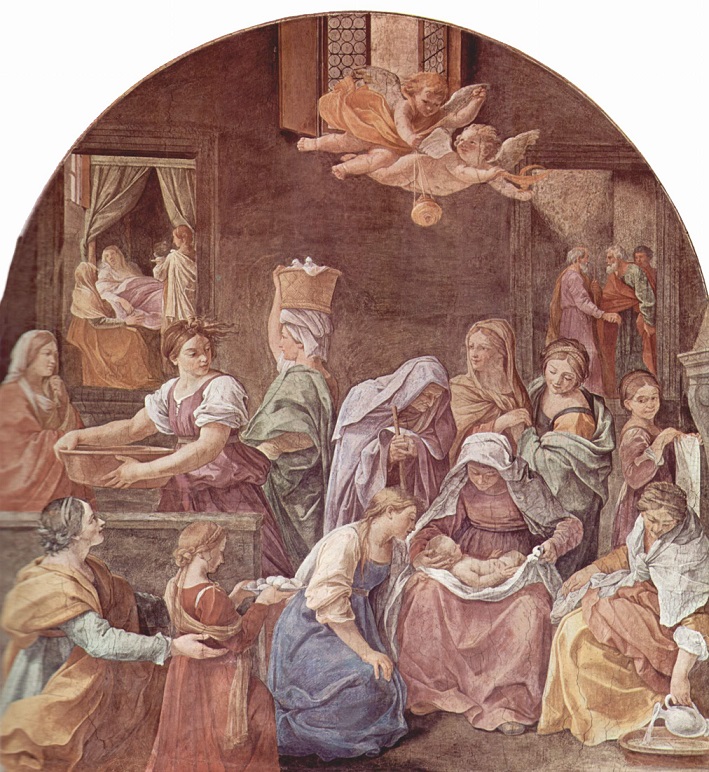
Mary's father Joachim was a wealthy member of one of the Twelve Tribes of Israel. He and his wife Anne were deeply grieved by their childlessness. Joachim consequently withdrew to the desert, where he fasted and did penance for 40 days. Angels then appeared to both Joachim and Anne to promise them a child.

Sainte Anne vowed to dedicate the child to the service in the Temple.

Guido Reni
Mary's Birth, c. 1609 - 1611
Oil on canvas
360 x 335 cm
I have no further description, at this time

Guido Reni (4 November 1575 – 18 August 1642) was an Italian painter of high-Baroque style. Born in Bologna into a family of musicians, Guido Reni was the son of Daniele Reni and Ginevra de’ Pozzi. As a child of nine, he was apprenticed under the Bolognese studio of Denis Calvaert. When Reni was about twenty years old he migrated to the rising rival studio, named Accademia degli Incamminati (Academy of the "newly embarked", or progressives), led by Lodovico Carracci. He went on to form the nucleus of a prolific and successful school of Bolognese painters who followed Annibale Carracci to Rome. Like many other Bolognese painters, Reni's painting was thematic and eclectic in style. More on Guido Reni

Mary was a first-century Galilean Jewish woman of Nazareth, the wife of Joseph, and the mother of Jesus, according to the canonical gospels and the Quran.

Alfred Stevens, born 1817 - died 1875
The Presentation of the Virgin in the Temple, at the age of three years, c. 1840 - 1875
Mary lived in the Temple precincts until the age of 14 when she was betrothed to Saint Joseph
Oil on canvas
Victoria and Albert Museum, London

This painting of the Presentation of the Virgin at the Temple is a scaled down replica of Titian’s original, at the Gallerie dell'Accademia, Venice. It depicts a scene not from the New Testament but the apocryphal Gospel of James in which Mary, Mother of Jesus is brought to the Temple of Jerusalem by her parents in thanks to God for having gifted them a child. More on this work

Alfred Stevens, born 1817 - died 1875
Detail; The Presentation of the Virgin in the Temple, at the age of three years, c. 1840 - 1875
Oil on canvas
Victoria and Albert Museum, London

Alfred George Stevens (30 December 1817 – 1 May 1875), was a British sculptor. 

Stevens spent nine formative years in Italy, travelling there in 1833 at the age of sixteen. There he studied Renaissance painting, copying frescoes in Florence and the works of Andrea del Sarto at Naples, and sketching at Pompeii. He received some formal training at the Accademia di Belle Arti in Florence. Later, in 1841-2, he worked in Rome as an assistant to the major neo-classical sculptor Bertel Thorvaldsen. In 1845, following his return to England, he was appointed as an instructor in painting and ornament at the Government School of Design at Somerset House, where he taught architectural drawing, perspective, modelling and ornamental painting. 

In 1850 he became chief designer to a Sheffield firm, Messrs. Hoole and Robson, who specialised in metalwork and won renown for metalwork exhibited at the Great Exhibition of 1851. In 1856 Stevens received two major commissions that would occupy him until his death in 1875. More on Alfred George Stevens

El Greco, (1541–1614)
The Annunciation, c.1590 - 1603
Oil on canvas
Height: 1,091 mm (42.95 in); Width: 802 mm (31.57 in)
Ohara Museum of Art, Kurashiki, Japan

Doménikos Theotokópoulos (1541 – 7 April 1614), most widely known as El Greco; Spanish for "The Greek", was a painter, sculptor and architect of the Spanish Renaissance. The nickname "El Greco" refers both to his Greek origin and Spanish citizenship. The artist normally signed his paintings with his full birth name in Greek letters.
 
El Greco was born in Crete, which was at that time part of the Republic of Venice, and the center of Post-Byzantine art. He trained and became a master within that tradition before traveling at age 26 to Venice, as other Greek artists had done. In 1570 he moved to Rome, where he opened a workshop and executed a series of works. During his stay in Italy, El Greco enriched his style with elements of Mannerism and of the Venetian Renaissance. In 1577, he moved to Toledo, Spain, where he lived and worked until his death. In Toledo, El Greco received several major commissions and produced his best-known paintings.
 
El Greco's dramatic and expressionistic style was met with puzzlement by his contemporaries but found appreciation in the 20th century. El Greco is regarded as a precursor of both Expressionism and Cubism, while his personality and works were a source of inspiration for poets and writers. El Greco has been characterized by modern scholars as an artist so individual that he belongs to no conventional school. He is best known for tortuously elongated figures and often fantastic or phantasmagorical pigmentation, marrying Byzantine traditions with those of Western painting. More on El Greco

Mary resided in "her own house" in Nazareth in Galilee, possibly with her parents, and during her betrothal the angel Gabriel announced to her that she was to be the mother of the promised Messiah by conceiving him through the Holy Spirit, and, after initially expressing incredulity at the announcement, she responded, "I am the handmaid of the Lord. Let it be done unto me according to your word." 

Anton Raphael Mengs, (1728–1779)
The Dream of St. Joseph, between circa 1773 and circa 1774
Oil on oak wood
Height: 114 cm (44.8 in); Width: 86 cm (33.8 in)
Kunsthistorisches Museum, Vienna, Austria

Anton Raphael Mengs (March 22, 1728 – June 29, 1779) was a German painter, active in Dresden, Rome and Madrid, who while painting in the Rococo period of the mid-17th century became one of the precursors to Neoclassical painting that replaced Rococo as the dominant painting style.

In 1749 he was appointed first painter to Frederick Augustus, elector of Saxony, but this did not prevent him from continuing to spend much of his time in Rome. He converted to Catholicism, and in 1754 he became director of the Vatican school of painting. His fresco painting of Parnassus at Villa Albani gained him a reputation as a master painter.

In 1749 Mengs accepted a commission from the Duke of Northumberland to make a copy, in oil on canvas, of Raphael's fresco The School of Athens for his London home. 

On two occasions he accepted invitations from Charles III of Spain to go to Madrid. There he produced some of his best work, most notably the ceiling of the banqueting hall of the Royal Palace of Madrid. After the completion of this work in 1777, Mengs returned to Rome, where he died two years later, in poor circumstances, leaving twenty children, seven of whom were pensioned by the king of Spain. More on Anton Raphael Mengs

Joseph planned to quietly divorce her, but was told her conception was by the Holy Spirit in a dream by "an angel of the Lord"; the angel told him to not hesitate to take her as his wife, which Joseph did, thereby formally completing the wedding rites.

Pieter Brueghel the Elder, (1526/1530–1569)
The People's Census at Bethlehem, c. 1566 / 1566
Oil on oak wood
Height: 115.5 cm (45.4 in); Width: 163.5 cm (64.3 in)
Royal Museums of Fine Arts of Belgium

Pieter Bruegel (also Brueghel) the Elder (c. 1525 – 9 September 1569) was a Netherlandish Renaissance painter and printmaker from Brabant, known for his landscapes and peasant scenes. He is sometimes referred to as the "Peasant Bruegel". From 1559, he dropped the 'h' from his name and signed his paintings as Bruegel.

Bruegel was born in Breda, and entered the Antwerp painters' guild in 1551, it is inferred that he was born between 1525 and 1530. His master was the Antwerp painter Pieter Coecke van Aelst, whose daughter Maria Bruegel married in 1563. 

Bruegel became a free master in the Guild of Saint Luke of Antwerp. In 1552 Bruegel was assigned to paint the rear of two wings of a triptych in Mechelen; the middle panel was painted by Pieter Balten. Between 1552 and 1553 Bruegel traveled to Italy, probably by way of France. He visited Rome, where he met the miniaturist Giulio Clovio, whose will of 1578 lists three paintings by Bruegel. About 1555 Bruegel returned to Antwerp by way of the Alps, which resulted in a number of exquisite drawings of mountain landscapes. These sketches, which form the basis for many of his later paintings, are not records of actual places but "composites" made in order to investigate the organic life of forms in nature.

He received the nickname "Peasant Bruegel" or "Bruegel the Peasant" for his practice of dressing up like a peasant in order to socialize at weddings and other celebrations, thereby gaining inspiration and authentic details for his genre paintings. He died in Brussels on 9 September 1569 and was buried in the Kapellekerk. More on Pieter Brueghel the Elder

A decree of the Roman Emperor Augustus required that Joseph return to his hometown of Bethlehem to register for a Roman census. 

Bartolomé Esteban Murillo, (1617–1682)
The Adoration of the Shepherds, circa 1650
Oil on canvas
Height: 187 cm (73.6 in); Width: 228 cm (89.7 in)
Museo del Prado,  Madrid

Bartolomé Esteban Murillo (born late December 1617, baptized January 1, 1618 – April 3, 1682) was a Spanish Baroque painter. Although he is best known for his religious works, Murillo also produced a considerable number of paintings of contemporary women and children. These lively, realist portraits of flower girls, street urchins, and beggars constitute an extensive and appealing record of the everyday life of his times. More on Bartolomé Esteban Murillo

While he was there with Mary, she gave birth to Jesus; but because there was no place for them in the inn, she used a manger as a cradle.

Waldemar Flaig, (1892–1932)
Star of Bethlehem, c. 1920
Franciscan Museum Villingen

Waldemar Flaig (* 27. January 1892 in Villingen , † 4. April 1932 in Villingen) was a German painter of Expressionism.

Waldemar Flaig grew up in Villingen, attended the art and trade school in Karlsruhe and from 1911–1913 the art academy in Munich .

1915–1918 he took part in the First World War, which he artistically processed in 76 drawings in his war diary. Wounded in 1918, he was released from the hospital in 1919. After a brief interlude as co-owner of the Huber-Flaig arts and crafts workshops in Villingen, he moved to Meersburg in 1920 . From then on he worked there as a freelance artist and was able to record his first commercial and artistic successes in the Lake Constance region.

In the 1920s he sent exhibitions in Konstanz, Baden-Baden, Düsseldorf, Ulm and Dessau, where he also worked as a set designer for the Anhalt State Theater. In Meersburg he continued to spend the summers in addition to many large city stays. He joined the international Lake Constance artists' association Der Kreis around Norbert Jacques and painted portraits of famous contemporaries with whom he was known,.

Flaig's health deteriorated from 1931; During a stay for medical treatment, he died in 1932 in his hometown. More on Waldemar Flaig

Magi arrived at Bethlehem where Jesus and his family were living. Joseph was warned in a dream that King Herod wanted to murder the infant, and the family fled by night to Egypt and stayed there for some time. 

Philipp Otto Runge, (1777–1810)
Rest on the road to Egypt, c. 1805-1806
Oil on canvas
Height: 98 cm (38.5 in); Width: 132 cm (51.9 in)
Kunsthalle Hamburg 

Philipp Otto Runge (23 July 1777 – 2 December 1810) was a Romantic German painter and draughtsman. Although he made a late start to his career and died young, he is considered among the best German Romantic painters.

Runge was born in a family of shipbuilders with ties to the Prussian nobility of Sypniewski / von Runge family. As a sickly child he often missed school and at an early age learned the art of scissor-cut silhouettes from his mother. In 1795 he began a commercial apprenticeship at his older brother Daniel's firm in Hamburg. In 1799 Daniel supported Runge financially to begin study of painting . In 1801 he moved to Dresden to continue his studies. I

In 1808 he intensified his work on color, including making disk color mixture experiments. He also published written versions of two local folk fairy tales In 1810 in Hamburg. In 1810, ill with tuberculosis, Runge painted another self-portrait as well as portraits of his family and brother Daniel. 

Runge was of a mystical, deeply Christian turn of mind, and in his artistic work he tried to express notions of the harmony of the universe through symbolism of colour, form, and numbers. 

In 1803 Runge had large-format engravings made of the drawings of the Times of the Day series that became commercially successful.

Runge was also one of the best German portraitists of his period; several examples are in Hamburg. His style was rigid, sharp, and intense, at times almost naïve. More on Philipp Otto Runge

After Herod's death in 4 BC, they returned to Nazareth in Galilee, rather than Bethlehem, because Herod's son Archelaus was ruler of Judaea.

After Peter Paul Rubens, (Flemish, 1577–1640)
The Return of the Holy Family from Egypt , ca. 1600–1699
Oil on copper
41.8 x 31.2 cm. (16.5 x 12.3 in.)
Kaluga Art Museum

Sir Peter Paul Rubens (28 June 1577 – 30 May 1640) was a Flemish Baroque painter. A proponent of an extravagant Baroque style that emphasized movement, colour, and sensuality, Rubens is well known for his Counter-Reformation altarpieces, portraits, landscapes, and history paintings of mythological and allegorical subjects.
In addition to running a large studio in Antwerp that produced paintings popular with nobility and art collectors throughout Europe, Rubens was a classically educated humanist scholar and diplomat who was knighted by both Philip IV of Spain and Charles I of England.  More Sir Peter Paul Rubens

Mary was present when, at her suggestion, Jesus worked his first miracle during a wedding at Cana by turning water into wine. 

Maerten de Vos, (1532–1603)
The Marriage at Cana, between 1596 and 1597
Oil on panel
Height: 268 cm (105.5 in); Width: 235 cm (92.5 in)
Cathedral of Our Lady, Antwerp, Belgium 

Maerten de Vos, Maerten de Vos the Elder or Marten de Vos (1532 – 4 December 1603) was a Flemish painter mainly of history paintings and portraits. He became, together with the brothers Ambrosius Francken I and Frans Francken I, one of the leading history painters in the Spanish Netherlands after Frans Floris’ career slumped in the second half of the sixteenth century as a result of the Iconoclastic fury of the Beeldenstorm.

De Vos was a prolific draughtsman and produced numerous designs for the Antwerp printers. More on Marten de Vos

Subsequently, there are events when Mary is present along with James, Joseph, Simon, and Judas, called Jesus' brothers, and Salome and a Mary or a Salome and an Anna, sisters. 

Gabriel Wüger, (1829–1893) 
Crucifixion, Stabat Mater, c. 1868
Virgin Mary, Mary of Clopas and Mary Magdalene
Oil on canvas
Beuron Archabbey and the Beuron Art School, Germany

Gabriel Wüger (2 December 1829–1892) was an artist and a Benedictine monk. He was one of the founders of the Beuron Art School in Germany in the late nineteenth century.

In 1863 Wüger travelled to Rome to work with the artists of the Nazarene movement. Like the Nazarenes, these artists who were to become known as the “Beuronese” were in search of natural simplicity and clarity with an emphasis on essentials and conscious neglect of accidentals and details. They chose as their guiding principles the use of plain backgrounds and basic colours, a limited use of perspective and a repetition of decoration.

Lenz and Wüger thought of forming a monastic community of artists. They believed that in order to make sacred art one should lead a Catholic life in community. In 1868 in Rome, they met Maurus Wolter, who had similar artistic aspirations for his young Benedictine monastery at Beuron. Maurus Wolter wanted his monastery to play a role in the revival of Church art just as it was beginning to do in the revival of Gregorian chant.

Lenz approached Princess Katherina von Hohenzollern, and produced an architectural design for the building which was accepted and built. In September 1868 he went to Rome to recruit Wüger.

Wüger died at the monastery of Monte Cassino in 1892. More on Gabriel Wüger

Mary is also depicted as being present among the women at the crucifixion during the crucifixion standing near "the disciple whom Jesus loved" along with Mary of Clopas and Mary Magdalene.  This representation is called a Stabat Mater. 

Enguerrand Quarton, (1411–1466)
Pietà of Villeneuve-lès-Avignon, circa 1460
Tempera on wood
Height: 162 cm (63.7 in); Width: 218 cm (85.8 in)
Louvre Museum, Paris

Enguerrand Quarton (or Charonton) (c. 1410 – c. 1466) was a French painter and manuscript illuminator whose few surviving works are among the first masterpieces of a distinctively French style, very different from either Italian or Early Netherlandish painting. Six paintings by him are documented, of which only two survive, and in addition the Louvre now follows most art historians in attributing to him the famous Avignon Pietà. His two documented works are the remarkable Coronation of the Virgin (1453–54, Villeneuve-les-Avignon) and The Virgin of Mercy (1452, Musée Condé, Chantilly). Two smaller altarpieces are also attributed to him. More on Enguerrand Quarton

While not recorded in the Gospel accounts, Mary cradling the dead body of her son is a common motif in art, called a "pietà" or "pity".

Workshop of Carlo Saraceni, (Italian, 1579–1620)
Death of the Virgin
Oil on copper
37.5 x 28.8 cm. (14.8 x 11.3 in.)
Private collection

Sold for EUR 75,000.- in Oct 2015

Carlo Saraceni (1579 – 16 June 1620) was an Italian early-Baroque painter, whose reputation as a "first-class painter of the second rank" was improved with the publication of a modern monograph in 1968.

He moved to Rome in 1598, joining the Accademia di San Luca in 1607. He never visited France, though he spoke fluent French and had French followers. His paintings, however, was influenced at first by the densely forested, luxuriantly enveloping landscape settings for human figures of Adam Elsheimer.

When Caravaggio's notorious Death of the Virgin was rejected in 1606 as an altarpiece suitable for a chapel of Santa Maria della Scala, it was Saraceni who provided the acceptable substitute. He was influenced by Caravaggio's dramatic lighting, monumental figures, naturalistic detail, and momentary action.

Saraceni's style matured rapidly between 1606 and 1610, and the next decade gave way to his fully mature works, synthesizing Caravaggio and the Venetians.

In 1620 he returned to Venice, where he died in the same year. More on Carlo Saraceni

Her death is not recorded in the scriptures, but Catholic and Orthodox tradition and doctrine have her assumed into Heaven. 

Juan Martín Cabezalero, (1633–1673)
The Assumption of the Virgin, circa 1665
Oil on canvas
Height: 237 cm (93.3 in); Width: 169 cm (66.5 in)
Museo del Prado, Madrid

The work represents the assumption of the Virgin Mary body and soul to Heaven.

Juan Martín Cabezalero (1633–1673) was a Spanish draftsman and painter. Born in Almadén, he studied under Juan Carreño de Miranda, court painter to Charles II of Spain; Cabezalero lived at Carreño de Miranda's house until 1666. Both he and Carreño were influenced by Van Dyck.

Few works by Cabezalero have survived. His surviving works include his St Jerome (1666, Meadows Museum, Southern Methodist University, Dallas) and the Assumption of the Virgin (ca. 1670; Madrid, Prado). The latter had been formerly attributed to Mateo Cerezo, also a pupil of Carreño de Miranda.

Antonio Palomino praises Cabezalero's modest, studious nature and laments that he died young. More on Juan Martín Cabezalero


Belief in the corporeal assumption of Mary is a dogma of the Catholic Church, in the Latin and Eastern Catholic Churches alike, and is believed as well by the Eastern Orthodox Church, the Coptic Orthodox Church, and parts of the Anglican Communion and Continuing Anglican movement.

Mary has been venerated since early Christianity, and is considered by millions to be the most meritorious saint of the religion. She is said to have miraculously appeared to believers many times over the centuries. The Eastern and Oriental Orthodox, Catholic, Anglican, and Lutheran churches believe that Mary, as mother of Jesus, is the Theotokos (Mother of God, God-bearer). There is significant diversity in the Marian beliefs and devotional practices of major Christian traditions. The Catholic Church holds distinctive Marian dogmas, namely her status as the Mother of God, her Immaculate Conception, her perpetual virginity, and her Assumption into heaven. Many Protestants minimize Mary's role within Christianity, basing their argument on the lack of biblical support for any beliefs other than the virgin birth. Mary also has the highest position in Islam among all women. She is mentioned in the Quran more often than in the New Testament, where two of the longer chapters of the Quran are devoted to her and her family. More on Mary the Blessed Virgin


Please visit my other blogs: Art CollectorMythologyMarine ArtPortrait of a Lady, The OrientalistArt of the Nude and The Canals of VeniceMiddle East Artists365 Saints365 Days, and Biblical Icons, also visit my Boards on Pinterest and my art stores at  deviantart and Aaroko

Images are copyright of their respective owners, assignees or others. Some Images may be subject to copyright

I don't own any of these images - credit is always given when due unless it is unknown to me. if I post your images without your permission, please tell me.

Ads are shown only to compensate the hosting expenses.

If you enjoyed this post, please share with friends and family.

Thank you for visiting my blog and also for liking its posts and pages.

Please note that the content of this post primarily consists of articles available from Wikipedia or other free sources online.


Friday, October 30, 2020

07 works, Today, October 30th, is Saints Hermenegild"s day, his story illustrated #301

Ulpiano Checa Sanz (Spanish, 1860–1916)Title:
The invasion of the Visigoths, c. 1887
Oil on Canvas
98 x 170 cm. (38.6 x 66.9 in.)
Private collection

Ulpiano Fernández-Checa y Saiz (April 3, 1860 – January 5, 1916), known as Ulpiano Checa, was a Spanish painter, sculptor, poster designer and illustrator. He used both impressionistic and academic techniques, and mainly painted historical subjects.

He was born in Colmenar de Oreja, Spain, and exhibited a talent for art when he was a young child. At thirteen, he met Don José Ballester, the husband of a neighbor in Colmenar, who owned the Cafe de la Concepción in Madrid. Ballester was impressed with his work and, after consultation with Luis Taberner (1844–1900), a recognized and popular artist in Madrid, Ballester decided to bring Checa and his family to the capital to begin his art studies.[1]

In 1873, he entered the Escuela de Bellas Artes de San Fernando in Madrid, followed by study at the Spanish Academy of Fine Arts in Rome [es], where he would paint Invasion of the Barbarians (since lost in a fire) which won the gold medal at the National Exhibition of Fine Arts in 1887. More on Ulpiano Checa Sanz 

Saint Hermenegild, or Ermengild, (died 13 April 585) was the eldest son of king Liuvigild, of the Visigothic Kingdom in the Iberian Peninsula and southern France, and his first wife, Princess Theodosia. He was brother to Reccared I and brought up an Arian. Liuvigild made his sons co-regents.

The Arian concept of Christ is based on the belief that the Son of God did not always exist but was begotten within time by God the Father, therefore Jesus was not co-eternal with God the Father

In 579 he married Ingund, daughter of the Frankish King Sigebert I of Austrasia who was a Chalcedonian Christian. Her mother was the Visigoth princess Brunhilda of Austrasia. The twelve-year-old Ingund was pressured by Hermenegild's stepmother Goiswintha to abjure her beliefs, but she stayed firm in her faith.

Anonymous
San Hermenegildo, Mid 19th century
Oil on canvas
Height: 117 cm (46 in); Width: 97 cm (38.1 in)
Seville City Council

Chalcedonian Christians follow the Definition of Chalcedon, Council of Chalcedon, the Fourth Ecumenical Council held in 451, a religious doctrine concerning the divine and human natures of Jesus Christ.

Bartolome Esteban Murillo
St. Leander and St. Bonaventure, c. 1665 - 1666
200 x 176 cm
Museum of Fine Arts of Seville, Seville, Spain

Bartolomé Esteban Murillo (born late December 1617, baptized January 1, 1618 – April 3, 1682) was a Spanish Baroque painter. Although he is best known for his religious works, Murillo also produced a considerable number of paintings of contemporary women and children. These lively, realist portraits of flower girls, street urchins, and beggars constitute an extensive and appealing record of the everyday life of his times. More on Bartolomé Esteban Murillo

Liuvigild sent Hermenegild to the south to govern on his behalf. There he came under the influence of Leander of Seville, the Catholic Bishop of Seville. Hermenegild was converted to Chalcedonian Christianity. His family demanded that he return to Arianism, but he refused.

Francisco Herrera the Younger  (1622–1685)
The Triumph of St Hermengild, c. 1654
Oil on canvas
Height: 326 cm (10.6 ft); Width: 228 cm (89.7 in)
Prado, Madrid

Francisco Herrera the Younger ("el Mozo"; 1622 - 25 August 1685) was a Spanish painter and architect. He began his career under his father's instruction; but the father's violent temper at last became so intolerable that the youth fled to Rome. For six years the younger Herrera devoted himself to the study of architecture, perspective, and the antique, his aim being fresco painting.

He left to Madrid where he painted a great Triumph of St. Hermengild for the church of the Carmelite friars, and a group of frescoes in San Felipe el Real which was appreciated by Philip IV of Spain, who commissioned him the painting of the dome of the chapel of Our Lady of Atocha, and thereafter made him painter to the king and superintendent of royal buildings. Besides his work in still life he painted many portraits, and while these lacked the vigour which characterized his father's work, they exhibit a greater knowledge and use of chiaroscuro.

Charles II of Spain kept him at his Court and made him master of the royal works. For this king Herrera renovated the Basilica of Our Lady of the Pillar, in Zaragoza.

Herrera died at Madrid in 1685. More on Francisco Herrera

Around this time, he led a revolt against Liuvigild, his father. Contemporary accounts attribute this to politics rather than primarily to religious differences. He asked for the aid of the Byzantine Empire but they were occupied with defending against territorial incursions by the Sasanian Empire, officially known as the Empire of Iranians. For a time Hermenegild had the support of the Suebi, Germanic peoples originally from the Elbe river region in what is now Germany and the Czech Republic, who had been defeated by Liuvigild in 579. However, Liuvigild forced them to capitulate once again in 583.

Hermenegild fled to Seville and when that fell to a siege in 584 went to Córdoba. After Liuvigild paid 30,000 pieces of gold, the Byzantines withdrew, taking Ingund and her son with them. Hermenegild sought sanctuary in a church. Liuvigild would not violate the sanctuary. He sent Reccared inside to speak with Hermenegild and to offer peace. This was accepted and peace was made for some time.

Francisco Goya, (1746–1828)
St. Hermengild at prison, circa 1810
Museo Lázaro Galdiano 

Francisco José de Goya y Lucientes (30 March 1746 – 16 April 1828) was a Spanish romantic painter and printmaker. He is considered the most important Spanish artist of late 18th and early 19th centuries and throughout his long career was a commentator and chronicler of his era. Immensely successful in his lifetime, Goya is often referred to as both the last of the Old Masters and the first of the moderns. He was also one of the great portraitists of modern times. More on Francisco José de Goya

Goiswintha, Queen consort and stepmother to Liuvigild's sons Hermenegild and Reccared I, brought about another alienation within the family. Hermenegild was imprisoned in Tarragona or Toledo. During his captivity in the tower of Seville, an Arian bishop was sent to Hermenegild for Easter but he would not accept the Eucharist from him. King Liuvigild ordered him beheaded; he was executed on 13 April 585. The enraged King sent soldiers, who at his orders put his own son to death. 

Juan Ramírez de Arellano (1725–1782) 
Beheading of Saint Hermenegild (564-586), c. 1515
 Oil on panel 
Fine Arts Museum of Granada, Andalusia. Spain.

Juan Ramírez de Arellano (1725–1782) was a Spanish Baroque painter.

Ramírez was a member of a family of artists from Aragon. He was the son of the sculptor Juan Ramírez Mejandre, and brother of sculptor José Ramírez de Arellano, who helped in the colors of some of his works for churches in Zaragoza. He first trained with José Luzán and later moved to Madrid with his countryman, Pablo Pernicharo. His works also show an influence of Corrado Giaquinto.

Among the few known works by his hand, include the Virgin and Child with St. Anne (National Museum of Romanticism and sketch in the Museo del Prado) which, despite being signed J. Ra z, was claimed in the past the young Francisco Goya. He also painted a portrait of the Charles III of Spain (Real Academia de Bellas Artes de San Fernando). More on Juan Ramírez de Arellano

Later, the King repented of this inhuman deed and asked Bishop Leander to instruct his youngest son Recared in the Orthodox faith. Thus the Visigoth people was brought into the Faith. More on Saint Hermenegild

Corrado Giaquinto, (Italian, b. ca. 1703–1765)
Saint Hermenegild surrounded by angels and cherubs
Oil on canvas
82.6 x 56.4 cm. (32.5 x 22.2 in.)
Private collection

Corrado Giaquinto was an Italian painter. He was apprenticed to Nicola Maria Rossi, then to Solimena. His spiritual master, however, was undoubtedly Luca Giordano. By the 1740s Giaquinto was the leading exponent of the Rococo school that flourished in Rome during the first half of the 18th century. Later he established himself as Europe's foremost fresco painter after Giambattista Tiepolo.

From 1753 to 1762, Giaquinto moved to Madrid where he achieved great academic honours as well as professional ones. In 1755 he frescoed the Royal Chapel in the Royal Palace, painted seven canvases for the Palace of Aranjuez, supplied further canvases for the Salesian convent in Madrid, and finally painted the famous frescoes in the Royal Palace depicting The Birth of the Sun in the Hall of the Columns, and Spain Saluting Religion and the Church on the staircase. Giaquinto had great influence on Spanish painters, particularly the young Goya.

In 1762 he returned to Naples where his work influenced Neapolitan artists. More on Corrado Giaquinto


Please visit my other blogs: Art CollectorMythologyMarine ArtPortrait of a Lady, The OrientalistArt of the Nude and The Canals of VeniceMiddle East Artistsand 365 Saints, also visit my Boards on Pinterest

Images are copyright of their respective owners, assignees or others. Some Images may be subject to copyright

I don't own any of these images - credit is always given when due unless it is unknown to me. if I post your images without your permission, please tell me.

I do not sell art, art prints, framed posters or reproductions. Ads are shown only to compensate the hosting expenses.

If you enjoyed this post, please share with friends and family.

Thank you for visiting my blog and also for liking its posts and pages.

Please note that the content of this post primarily consists of articles available from Wikipedia or other free sources online.