Showing posts with label Pierre Subleyras. Show all posts

Saturday, July 18, 2020

07 Works, Today, July 18th, is Camillus de Lellis's day, his story in art #199

Tracy L. Christianson
St. Camillus de Lellis, 1550-1614
Icon
7.25" x 10" x .375"

Tracy Christianson spends her days and nights with the angels and saints.

More than seven years ago, she decided to turn her art work into an apostolate promoting devotion to those raised to the altars, and those whose causes are still advancing. 

Christianson had a good job as a corporate graphic designer when she was encouraged to make her avocation into a full-time vocation. What started very small has blossomed into a successful business that employs an entire family. 


Her work gives a face and voice to lesser-known figures. And her depictions of popular saints like St. Thérèse of Lisieux, St. Pio of Pietrelcina, and St. Patrick have familiarity with a new warmth to them. She added 50 new portraits to the catalog over the past year, with new requests coming in all the time. More on Tracy Christianson

Camillus de Lellis was born on May 25, 1550, Kingdom of Naples. His mother, Camilla Compelli de Laureto, was nearly fifty when she gave birth to him. His father was an officer in both the Neapolitan and French royal armies and was seldom home. Due to his mother's age and retiring nature, she felt unable to control him. He grew up neglected by the family members who took him in after her death. De Lellis joined his father in the Venetian army and fought in a war against the Turks.


Unknown artist, signed H. Letter
The Battle of Lepanto of 1571
Oil on canvas
1270 mm x 2324 mm
National Maritime Museum, Greenwich, London

After a number of years of military service, his regiment was disbanded in 1575. Having gambled away all his possessions, De Lellis took work as a laborer at the Capuchin friary at Manfredonia
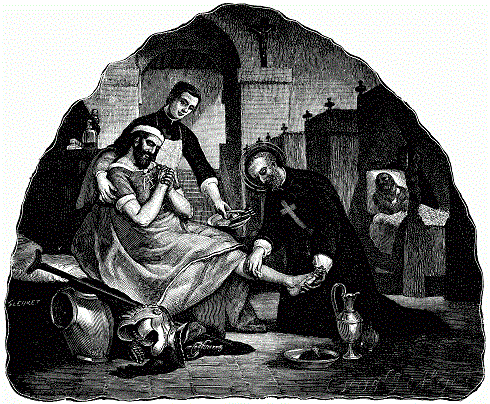

Unknown artist
Saint Camillus de Lellis
I have no further description of this artwork at this time

Pierre Subleyras (1699 - 1749)
The loving courtesan (1735)
A leg wound he received was declared incurable by the physicians
Oil on canvas
24 x 30 cm (9,2 x 12,0 inches)
Private collection

Information on Pierre Subleyras is below

He was constantly plagued, however, by a leg wound he received while in the army, which would not heal, and was declared incurable by the physicians.


Pierre Subleyras (1699 - 1749)
San Camillo saves the sick from the Tiber
Oil on canvas
 48 x 33.2 cm | 18.9 x 13.1 inches
 Museo di Roma


Pierre Subleyras (November 25, 1699 – May 28, 1749) was a French painter, active during the late-Baroque and early-Neoclassic period, mainly in Italy.

He left France in 1728, having carried off the French Academy's grand prix, which provided scholarship for study in Rome. In Rome, he painted for the Elector of Saxony, Frederick Christian, a "Christ's Visit to the House of Simon the Pharisee", (later engraved by Subleyras himself), this work procured his admission into the famed Roman artists guild, Accademia di San Luca.

Cardinal Valenti Gonzaga next obtained for him the order for Saint Basil & Emperor Valens (also known as the Mass of St. Basil.

He was a remarkably incisive portraitist. The pope himself commanded two great paintings, the "Marriage of St Catherine" and the "Ecstasy of St Camilla", which he placed in his own private apartments.

Subleyras shows greater individuality in his curious genre pictures, which he produced in considerable number. In his illustrations of La Fontaine and Boccaccio his true relation to the modern era comes out; and his drawings from nature are often admirable.


Exhausted by overwork, Subleyras tried a change to Naples, but returned to Rome at the end of a few months to die. More on Pierre Subleyras

He then moved to Rome where he entered the San Giacomo Hospital, which cared for incurable cases. He himself became a caregiver at the hospital, and later its Superintendent. He now a strict ascetic life, performing many penances.


Unknown artist
 Conversion of St. Camillus
I have no further description of this artwork at this time

De Lellis was led to invite a group of pious men to express their faith through the care of the patients at the hospital. Eventually he established a religious community for this purpose. Neri, his confessor, gave him approval for this endeavor, and a wealthy donor provided him with the income necessary to undertake his seminary studies.


He established the Order of Clerks Regular, Ministers of the Infirm, the Camillians. His experience in wars led him to establish a group of health care workers who would assist soldiers on the battlefield. The large red cross on their cassock remains a universal symbol of charity and service. 


Unknown artist
Saint Camillus
I have no further description of this artwork at this time

Members of the Order also devoted themselves to victims of Bubonic plague. It was due to the efforts of the brothers and supernatural healings by de Lellis that the people of Rome credited de Lellis with ridding the city of a great plague and the subsequent famine. For a time, he became known as the "Saint of Rome".


Cristóbal Lozano ,(1705–1776)
Ecstasy of Saint Camillus de Lellis, c. 1762
Oil on canvas
Height: 1,345 mm (52.95 in); Width: 990 mm (38.97 in)
Lima Art Museum
I have no further on the artist, at this time


Throughout his life De Lellis' ailments caused him suffering, but he allowed no one to wait on him and would crawl to visit the sick when unable to stand and walk. It is said that Camillus possessed the gifts of healing and prophecy. He resigned in 1607, but continued to serve. He died in Rome in 1614. More on Camillus de Lellis 

Wednesday, February 13, 2019

03 Works, Today, February 13th, is Saint Catherine de' Ricci's Day, With Footnotes - 44

Giovanni Battista Tiepolo,  (1696–1770)
Saint Catherine of Siena, c. 1746
Oil on canvas
Oval: 70 x 52 cm
Kunsthistorisches Museum, Vienna

Giovanni Battista Tiepolo, 1696 - 1770. Born into a wealthy and noble family in Venice, Giambattista Tiepolo was recognized by contemporaries throughout Europe as the greatest painter of large-scale decorative frescoes in the 1700s. He was admired for having brought fresco painting to new heights of technical virtuosity, illumination, and dramatic effect. Tiepolo possessed an imagination characterized by one of his contemporaries as "all spirit and fire." 

A gifted storyteller, Tiepolo painted walls and ceilings with large, expansive scenes of intoxicating enchantment. In breath-taking visions of mythology and religion, the gods and saints inhabit light-filled skies. His ability to assimilate his predecessor and compatriot Paolo Veronese's use of color was so profound that his contemporaries named him Veronese redivio (a new Veronese). 

Tiepolo's commissions came from the old established families of Italy, religious orders, and the royal houses of Spain, Germany, Sweden, and Russia. His frescoes adorn palaces, churches, and villas, and his artistic legacy consists of some eight hundred paintings, 2,400 drawings, two sets of etchings, and acres of fresco. When Tiepolo died at the age of seventy-four, a Venetian diarist noted the "bitter loss" of "the most famous Venetian painter, truly the most renowned...well known in Europe and the most highly praised in his native land." More on Giovanni Battista Tiepolo

Saint Catherine de' Ricci, O.S.D. (Caterina de' Ricci) (23 April 1522 – 2 February 1590), was an Italian Dominican Tertiary sister. She is believed to have had miraculous visions and corporeal encounters with Jesus, both with the infant Jesus and with the adult Jesus. She is said to have spontaneously bled with the wounds of the crucified Christ. She is venerated for her mystic visions and is honored as a saint by the Catholic Church.

She was born Alessandra Lucrezia Romola de' Ricci in Florence to a patrician family. At age 6 or 7, her father enrolled her in a school run by a monastery of Benedictine nuns in the Monticelli quarter of the city. There she developed a lifelong devotion to the Passion of Christ. She then entered the Convent of St Vincent in Prato, Tuscany, a cloistered community of religious sisters who followed the strict regimen of life she desired. In May 1535 she received the religious habit, and the religious name of Catherine, after the Dominican tertiary, Catherine of Siena.

Her period of novitiate was a time of trial. She would experience ecstasies during her routine, which caused her to seem asleep during community prayer services, dropping plates and food, so much so that the community began to question her competence, if not her sanity. Eventually the other Sisters became aware of the spiritual basis for her behavior. By the age of 30 she had risen to the post of prioress.

As the prioress, De' Ricci developed into an effective and greatly admired administrator. She was an advisor on various topics to princes, bishops and cardinals. An expert on religion, management and administration, her advice was widely sought. She gave counsel both in person and through exchanging letters. It is reported that she was extremely effective and efficient in her work, managing her priorities very well.


Pierre Subleyras
The Mystic Marriage of St. Catherine of Ricci, c. 1740-1745
Oil on canvas
Private collection
Pierre Subleyras (November 25, 1699 – May 28, 1749) was a French painter, active during the late-Baroque and early-Neoclassic period, mainly in Italy.

He left France in 1728, having carried off the French Academy's grand prix, which provided scholarship for study in Rome. In Rome, he painted for the Elector of Saxony, Frederick Christian, a "Christ's Visit to the House of Simon the Pharisee", this work procured his admission into the famed Roman artists guild, Accademia di San Luca.

Cardinal Valenti Gonzaga next obtained for him the order for Saint Basil & Emperor Valens (also known as the Mass of St. Basil.

He was a remarkably incisive portraitist. The pope himself commanded two great paintings, the "Marriage of St Catherine" and the "Ecstasy of St Camilla", which he placed in his own private apartments.

Subleyras shows greater individuality in his curious genre pictures, which he produced in considerable number. In his illustrations of La Fontaine and Boccaccio his true relation to the modern era comes out; and his drawings from nature are often admirable.


Exhausted by overwork, Subleyras tried a change to Naples, but returned to Rome at the end of a few months to die. More on Pierre Subleyras

It is claimed that De' Ricci's meditation on the Passion of Christ was so deep that she spontaneously bled, as if scourged. She also bore the Stigmata. During times of deep prayer, like Catherine of Siena, her patron saint, a coral ring representing her marriage to Christ, appeared on her finger.


BATONI, Pompeo, (b. 1708, Lucca, d. 1787, Roma)
The Ecstasy of St Catherine of Siena, c. 1743
Oil on canvas
Museo di Villa Guinigi, Lucca

Pompeo Girolamo Batoni (25 January 1708 – 4 February 1787) Pompeo Batoni was born in Lucca. He moved to Rome in 1727, and apprenticed with Agostino Masucci, Sebastiano Conca and/or Francesco Imperiali. He displayed a solid technical knowledge in his portrait work and in his numerous allegorical and mythological pictures. Batoni won international fame largely thanks to his customers, mostly British of noble origin, whom he portrayed, often with famous Italian landscapes in the background. 

In addition to art-loving nobility, Batoni's subjects included the kings and queens of Poland, Portugal and Prussia, the Holy Roman Emperors Joseph II and Leopold II (a fact which earned him noble dignity), as well the popes Benedict XIV, Clement XIII and Pius VI, Elector Karl Theodor of Bavaria and many more. He also received numerous orders for altarpieces for churches in Italy (Rome, Brescia, Lucca, Parma, etc.), as well as for mythological and allegorical subjects.


Batoni's style took inspiration and incorporated elements of classical antiquity, French Rococo, Bolognese classicism, and the work of artists such as Nicolas Poussin, Claude Lorrain and especially Raphael. As such Pompeo Batoni is considered a precursor of Neoclassicism. More on Pompeo Girolamo Batoni 

One of the miracles that was documented for her canonization was her appearance many hundreds of miles away from where she was physically located. This involved appearing in a vision St Philip Neri, a resident of Rome, with whom she had maintained a long-term correspondence. 

De' Ricci lived in the convent until her death in 1590 after a prolonged illness. More on Saint Catherine de' Ricci


Images are copyright of their respective owners, assignees or others. Some Images may be subject to copyright

I don't own any of these images - credit is always given when due unless it is unknown to me. if I post your images without your permission, please tell me.

I do not sell art, art prints, framed posters or reproductions. Ads are shown only to compensate the hosting expenses.

If you enjoyed this post, please share with friends and family.

Thank you for visiting my blog and also for liking its posts and pages.

Please note that the content of this post primarily consists of articles available from Wikipedia or other free sources online.