Sunday, October 4, 2020

10 works, Today, October 4th, is Saint Francis of Assisi's day, his story illustrated #276

ROMANESQUE PAINTER, Italian, (active in 1220s)
St Francis of Assisi, before 1224
Fresco
Cappella di San Gregorio, Subiaco

In the Chapel of San Gregorio in the lower church at Subiaco can be found the earliest portrait of St Francis. This fresco represents him without halo and stigmata, therefore it was probably made before 1224, when he received the stigmata. More on this work

Born circa 1181, in Assisi, duchy of Spoleto, Italy, Saint Francis of Assisi began his life as a confirmed sinner. His father was a wealthy cloth merchant who owned farmland around Assisi, and his mother was a beautiful Frenchwoman. Francis was not in want during his youth; he was spoiled, indulging himself with fine food, wine, and wild celebrations. By age 14, he had left school and become known as a rebellious teenager who frequently drank, partied and broke the city curfew. He was also known for his charm and vanity.

He was expected to follow his father into the family textile business. Instead of planning a future as a merchant, he began daydreaming of a future as a knight; knights were Medieval action heroes, and if Francis had any ambition, it was to be a war hero like them. 

Pedro Subercaseaux
Francis eagerly took his place with the cavalry
I have no further description, at this time

Pedro León Maximiano María Subercaseaux Errázuriz (December 10, 1880 – Santiago de Chile, Chile, January 3, 1956) was a Chilean painter; son of the painter and diplomat Ramón Subercaseaux Vicuña. He painted many portraits about events from the history of Chile, such as the Crossing of the Andes. He painted portraits of the history of Argentina requested during the Argentina Centennial. He married Elvira Lyon Otaégui in 1907, but the Pope later annulled their marriage so that they could both get into religious orders. More on Pedro Subercaseaux

In 1202 war broke between Assisi and Perugia, and Francis eagerly took his place with the cavalry.

Francis and the men of Assisi came under heavy attack, and in the face of superior numbers, they took flight. 

Unskilled and with no combat experience, Francis was quickly captured by enemy soldiers. Dressed like an aristocrat and wearing expensive new armor, he was considered worthy of a decent ransom Francis would spend nearly a year in such miserable conditions , during which time he may well have contracted a serious disease. Also during this time, he would later report, he began to receive visions from God.

After a year of negotiations, Francis' ransom was accepted, and he was released from prison in 1203. When he came back to Assisi, however, Francis was a very different man. Upon his return, he was dangerously sick in both mind and body — a battle-fatigued casualty of war.

Baccio Maria Bacci
St Francis of Assisi and the leper, c. 1927
Oil on canvas
37.3cm × 42.0cm
Florence in the Italian

Baccio Maria Bacci (1888 - 1974) was an Italian painter of the Tuscan Novocento movement. He also published various books on contemporary art movements.

He was born in Florence, he traveled to Paris in 1908. He returned to Florence in 1910 and exhibited with Giovanni Costetti, gaining the encouragement of Emilio Cecchi, Thomas Neal, and Matteo Marangoni. During 1913-1918, he painted in a style influenced by the Futurists, with canvases titled Aeropittoriche. In his later years, he painted for a number of churches and created mosaic designs. More on Baccio Maria Bacci

One day, as legend has it, while riding on a horse in the local countryside, Francis encountered a leper. Prior to the war, Francis would have run from the leper. Viewing the leper as a symbol of moral conscience, he embraced and kissed him, later describing the experience as a feeling of sweetness in his mouth. 

Giotto di Bondone  (–1337)
Renunciation of Wordly Goods, c. 1295 Edit this at Wikidata
Fresco
Height: 230 cm (90.5 in); Width: 270 cm (106.2 in)
Basilica of San Francesco d'Assisi,  Assisi, Umbria, Italy

Giotto di Bondone  (–1337), see below

In order to raise money to rebuild the Christian church, he sold a bolt of cloth from his father's shop, along with his horse. His father became furious upon learning of his son's actions and subsequently dragged Francis before the local bishop. The bishop told Francis to return his father's money, to which his reaction was extraordinary: He stripped off his clothes, and along with them, returned the money back to his father. The bishop gave Francis a rough tunic, and dressed in these new humble clothes, Francis left Assisi. 

Giotto di Bondone, 1295-1300
Christ, who told him to rebuild the Christian Church, 1297-99
Fresco
270 x 230 cm
Basilica of San Francesco d'Assisi,  Assisi, Umbria, Italy

Giotto di Bondone  (–1337), see below

Francis, now in his early 20s, began turning his focus toward God. Instead of working, he spent an ever-increasing amount of time at a remote mountain hideaway as well as in old, quiet churches around Assisi, praying, looking for answers, and helping nurse lepers. During this time, while praying before an old Byzantine crucifix at the church of San Damiano, Francis reportedly heard the voice of Christ, who told him to rebuild the Christian Church and to live a life of extreme poverty. Francis obeyed and devoted himself to Christianity. He began preaching around Assisi and was soon joined by 12 loyal followers.

Giotto di Bondone, 1295-1300
The Pope approving the statutes of the order of the Franciscans
Frescoe
Le Louvre

Giotto di Bondone (1266/7 – January 8, 1337), known mononymously as Giotto, and Latinized as Giottus, was an Italian painter and architect from Florence in the late Middle Ages. He is generally considered the first in a line of great artists who contributed to the Renaissance.
In his Lives of the Most Excellent Painters, Sculptors, and Architects, the late-16th century artist and art historian Giorgio Vasari describes Giotto as making a decisive break with the prevalent Byzantine style and as initiating "the great art of painting as we know it today, introducing the technique of drawing accurately from life, which had been neglected for more than two hundred years."
Giotto's masterwork is the decoration of the Scrovegni Chapel in Padua, also known as the Arena Chapel, completed around 1305. This fresco cycle depicts the Life of the Virgin and the Life of Christ. It is regarded as one of the supreme masterpieces of the Early Renaissance.[4] That Giotto painted the Arena Chapel and that he was chosen by the Commune of Florence in 1334 to design the new campanile (bell tower) of Florence's Cathedral are among the few certainties of his biography. Almost every other aspect of it is subject to controversy: his birthdate, his birthplace, his appearance, his apprenticeship, the order in which he created his works, whether or not he painted the famous frescoes in the Upper Basilica of Saint Francis in Assisi, and his burial place. More Giotto di Bondone

In 1209 Francis led his first eleven followers to Rome to seek permission from Pope Innocent III to found a new religious Order. After several days, the pope agreed to admit the group informally, adding that when God increased the group in grace and number, they could return for an official admittance.

José Benlliure y Gil  (1855–1937)
Saint Clare of Assisi is received by Francisco
I have no further description, at this time


José Benlliure y Gil (30 September 1858, Valencia – 5 April 1937, Valencia), was a Spanish painter.

He was born at Cañamelar, Valencia, studied painting under Francisco Domingo Marqués, and showed from the first such marked talent that he was sent to the Spanish school in Rome. From 1903 to 1913, he was director of the Spanish Academy of Fine Arts.

He was one of the select circle pensioned by the Spanish government for residence in Italy and executed several state orders for the decoration of public buildings. He became the leader of the Spanish art colony in Rome.

Benlliure obtained several successes in Paris, Munich, Stuttgart and Berlin with his paintings. In 1903 he assumed leadership of the Spanish Academy in Rome, a position he would keep for ten years.

In late 1919 he offered a tribute to Rome with an exhibition of 45 paintings in Madrid in the halls of the Theatre Royal. When he returned to Valencia he was appointed as honorary president of the Circle of Fine Arts in Valencia, and became director of the Museu de Belles Arts de Valencia, a position he held until 1924. He received the Grand Cross of the Crown of Italy and the Cross of Officer of the Legion of Honor from the French government. More on José Benlliure y Gil

Hearing Francis preaching in the church of San Rufino in Assisi in 1211, a young noblewoman Clare of Assisi became deeply touched by his message and realized her calling. On the night of Palm Sunday, 28 March 1212, Clare clandestinely left her family's palace. Francis received her at the Porziuncola and thereby established the Order of Poor Ladies

Br. Robert Lentz, OFM
 St. Francis and the Sultan
I have no further description, at this time

Robert Lentz is a Franciscan friar. Besides painting many hours each day, he teaches apprentices, writes, and conducts workshops on art and spirituality.

Brother Robert was born in rural Colorado in 1946. His grandparents emigrated from tsarist Russia in the early 1900's. He studied Byzantine iconography by apprenticing himself to a master painter from the school of Photios Kontoglou in a Greek Orthodox monastery founded from Mount Athos. 

His icons reflect his experiences among the poor in this country and in the Third World, as well as his Franciscan and Russian roots. They are filled with bright colors and often depict contemporary subjects. While always striving to remain true to the essence of Byzantine iconography, he adapts traditional conventions in order to minister better to the emerging Church. His icons remain transcendent expressions of the ancient Christian Tradition, and they invite us into communion with God and the saints. More on Br. Robert Lentz

In 1219 St. Francis and Brother Illuminato accompanied the armies of western Europe to Damietta, Egypt, during the Fifth Crusade. His desire was to speak peacefully with Muslim people about Christianity. He tried to stop the Crusaders from attacking the Muslims at the Battle of Damietta, but failed. After the defeat of the western armies, he crossed the battle line with Brother Illuminato, was arrested and beaten by Arab soldiers, and eventually was taken to the sultan, Malek al-Kamil.

Unknown artist
 St. Francis and the Sultan
I have no further description, at this time

The incident was immortalized in art across Europe in the centuries after it happened. For Christians, the radical vision of fraternity and forgiveness which the saint from Assisi carried to Damietta was adapted to fit his developing spiritual reputation and the political reality of Order and the Church — especially in relationship to Islam. 

After an initial attempt by Francis and the sultan to convert the other, both quickly realized that the other already knew and loved God. Francis and Illuminato remained with al-Kamil and his Sufi teacher Fakhr ad-din al-Farisi for as many as twenty days, discussing prayer and the mystical life. When Francis left, al-Kamil gave him an ivory trumpet, which is still preserved in the crypt of the Basilica of San Francesco in Assisi.

Francis was soon preaching in up to five villages per day, teaching a new kind of emotional and personal Christian religion that everyday people could understand. Francis' message was spread far and wide, and thousands of people were captivated by what they heard.

Orazio Gentileschi, (1563–1639)
The Stigmatization of Saint Francis
Oil on canvas oil on canvas
Height: 165.10 mm (6.50 in); Width: 116.20 mm (4.57 in)
Museum of Fine Arts, Houston

Orazio Lomi Gentileschi (1563–1639) was an Italian painter. Born in Tuscany, he began his career in Rome, painting in a Mannerist style, much of his work consisting of painting the figures within the decorative schemes of other artists. After 1600, he came under the influence of the more naturalistic style of Caravaggio. He received important commissions in Fabriano and Genoa before moving to Paris to the court of Marie de Medici. He spent the last part of his life at the court of Charles I of England. He was the father of the painter Artemisia Gentileschi. More on Orazio Gentileschi

In 1224 Francis reportedly received a vision that left him with the stigmata of Christ — marks resembling the wounds Jesus Christ suffered when he was crucified, through his hands and the gaping lance wound in his side. This made Francis the first person to receive the holy wounds of the stigmata. They would remain visible for the rest of his life. Because of his earlier work treating lepers, some believe that the wounds were actually symptoms of leprosy.

When his health began to decline rapidly, Francis went home. Knights were sent from Assisi to guard him and to make sure that no one from neighboring towns would carry him off (the body of a saint was viewed, at the time, as an extremely valuable relic that would bring, among many things, glory to the town where it rested).

Francis of Assisi died on October 3, 1226, at the age of 44, in Assisi, Italy.  More on Francis of Assisi


Please visit my other blogs: Art CollectorMythologyMarine ArtPortrait of a Lady, The OrientalistArt of the Nude and The Canals of VeniceMiddle East Artistsand 365 Saints, also visit my Boards on Pinterest

Images are copyright of their respective owners, assignees or others. Some Images may be subject to copyright

I don't own any of these images - credit is always given when due unless it is unknown to me. if I post your images without your permission, please tell me.

I do not sell art, art prints, framed posters or reproductions. Ads are shown only to compensate the hosting expenses.

If you enjoyed this post, please share with friends and family.

Thank you for visiting my blog and also for liking its posts and pages.

Please note that the content of this post primarily consists of articles available from Wikipedia or other free sources online.


Saturday, October 3, 2020

04 works, Today, October 3rd, is Saint Dionysius' day, his story illustrated #275

Unknown artist
Denis the Areopagite, c. 1403-1405
Miniature taken from a manuscript of his complete works
Illumination on parchment
Height: 27.3 cm; Width: 20.0 cm
Louvre Museum

The portrait of the so-called author of the text, Dionysius the Areopagite, dressed in Byzantine episcopal liturgical garment and holding in his hands a work containing his writings. An inscription in Greek and in gold letters around his head reads: “ SAINT DIONYSUS THE AEROPAGITIS ” 

Dionysius the Areopagite was a judge at the Areopagus Court in Athens, who lived in the first century. A convert to Christianity, he is venerated as a saint by multiple denominations.

He was converted to Christianity by the preaching of Paul the Apostle during the Areopagus sermon, according to Dionysius, Bishop of Corinth. He was one of the first Athenians to believe in Christ.

Antoine Caron, French, 1521–1599
Dionysius the Areopagite Converting the Pagan Philosophers, 1570s
Oil on panel
The J. Paul Getty Museum

In 1571 a dramatic solar eclipse occurred: this event probably served as the subject of this painting by Antoine Caron. He painted it at the court of Catherine de Medici, queen of France, who, like many rulers of the time, was extremely superstitious and fascinated by astronomical phenomena, often seeing eclipses and natural disasters as foreboding omens. More on this work

Antoine Caron (1521–1599), born in Beauvais, was a French master glassmaker, illustrator, Northern Mannerist painter and a product of the School of Fontainebleau.

He is one of the few French painters of his time who had a pronounced artistic personality. His work reflects the refined, although highly unstable, atmosphere at the court of the House of Valois during the French Wars of Religion of 1560 to 1598.

He began painting in his teens doing frescos for a number of churches. Between 1540 and 1550 he worked under Primaticcio and Niccolò dell'Abbate at the School of Fontainebleau. In 1561, he was appointed the court painter by Catherine de' Medici and Henry II of France. As court painter he also had the duties of organizing the court pageants. In this way he was involved in organizing the ceremony and royal entry for the coronation of Charles IX in Paris and the wedding of Henry IV of France with Marguerite de Valois. Some of his surviving illustrations are from these pageants. He died in Paris in 1599. More on Antoine Caron

Tradition holds that earlier, at a young age, he found himself in Heliopolis of Egypt just at the time of Christ's crucifixion in Jerusalem. On that Friday, at the time of the crucifixion of Christ, "From noon until three in the afternoon darkness came over all the land."  The young boy, Dionysius was shocked by this paradoxical phenomenon and exclaimed: "God suffers or is always despondent". He took care to note the day and hour of this supernatural event of the darkness of the Sun.

Raphael, (1483–1520)
Saint Paul preaching in Athens, c. 1515
Height: 390 cm (12.7 ft); Width: 440 cm (14.4 ft)
Victoria and Albert Museum, London

Raffaello Sanzio da Urbino (April 6 or March 28, 1483 – April 6, 1520), known as Raphael, was an Italian painter and architect of the High Renaissance. His work is admired for its clarity of form, ease of composition, and visual achievement of the Neoplatonic ideal of human grandeur. Together with Michelangelo and Leonardo da Vinci, he forms the traditional trinity of great masters of that period.
Raphael was enormously productive, running an unusually large workshop and, despite his death at 37, leaving a large body of work. Many of his works are found in the Vatican Palace. The best known work is The School of Athens in the Vatican Stanza della Segnatura. After his early years in Rome much of his work was executed by his workshop from his drawings, with considerable loss of quality. He was extremely influential in his lifetime, though outside Rome his work was mostly known from his collaborative printmaking. More Raffaello

When Dionysius returned to Athens, he heard the preaching of the Apostle Paul, talking about that supernatural darkness during the Crucifixion of the Lord, dissolving any doubt about the validity of his new faith. He was baptized, with his family in 52 AD. 

Unknown artist
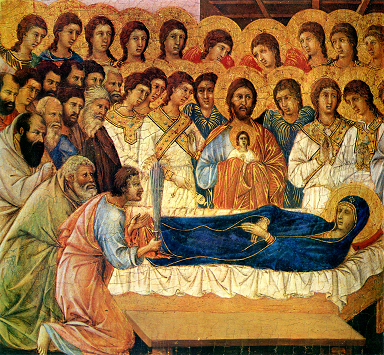
Dormission of Mother of Christ, Mary
I have no further description, at this time

Historical accounts wrote that when he learned that the Mother of Christ, Mary, lived in Jerusalem, he travelled to Jerusalem to meet her. From this meeting he said: "Her appearance, her features, her whole appearance testify that she is indeed Mother of God." In Jerusalem, he also discovered where Mary slept and departed this world to join her Son and her God. Then he wept sorely like the Apostles and other Church leaders torrents of tears and also attended Mary's funeral in Jerusalem. 

After his conversion, Dionysius became the first Bishop of Athens. He is venerated as a saint in the Catholic and the Eastern Orthodox churches. He is the patron saint of Athens and is venerated as the protector of the Judges and the Judiciary. 

Dionysius suffered a Christian martyr's end by burning. His story was preserved by the early Christian historian, Eusebius of Caesarea in his Ecclesiastical history. More on Dionysius the Areopagite


Please visit my other blogs: Art CollectorMythologyMarine ArtPortrait of a Lady, The OrientalistArt of the Nude and The Canals of VeniceMiddle East Artistsand 365 Saints, also visit my Boards on Pinterest

Images are copyright of their respective owners, assignees or others. Some Images may be subject to copyright

I don't own any of these images - credit is always given when due unless it is unknown to me. if I post your images without your permission, please tell me.

I do not sell art, art prints, framed posters or reproductions. Ads are shown only to compensate the hosting expenses.

If you enjoyed this post, please share with friends and family.

Thank you for visiting my blog and also for liking its posts and pages.

Please note that the content of this post primarily consists of articles available from Wikipedia or other free sources online.


03 works, Today, October 2nd, is Saint Theophilus' day, his story illustrated #274

Friedrich August Moritz Retzsch
Faust and Mephisto playing chess
Oil on canvas
29 x 34 cm
I have no further description, at this time

This story is significant as it is the oldest story of a pact with the devil and was an inspiration for the Faust legend. 

Friedrich August Moritz Retzsch (December 9, 1779 - June 11, 1857) was a German painter, draughtsman, and etcher.

Born in the Saxon capital Dresden. he joined the Dresden Academy of Fine Arts in 1798 under Cajetan Toscani and Józef Grassi, later working autodidactically, copying the famous pictures of the Gemäldegalerie, among them a copy of the Sixtinian Madonna. He was made a member of the Academy in 1817 and professor in 1824. The Cotta publishing house commissioned illustrations for Johann Wolfgang Goethe's Faust (26 plates), which made him financially independent. Goethe liked his work, and he illustrated works by other famous authors. He also did oil paintings on classical subjects, and portraits. 

As a winemaker, he was a member of the Saxon wine association from 1799 onwards. Retzsch died in Oberlössnitz/Radebeul. More on Friedrich August Moritz Retzsch

Saint Theophilus the Penitent or Theophilus of Adana (died c. 538 AD) was a cleric in the sixth century Church who is said to have made a deal with the Devil to gain an ecclesiastical position.

Theophilus was the archdeacon of Adana, Cilicia, which is part of modern Turkey. He was unanimously elected to be a bishop, and when out of humility he turned the position down, another man was elected in his stead. 

Unknown artist
Theophilus goes to the necromancer: pays homage to the Devil
PSAUTIER D’INGEBURGE DE DANEMARK (INGEBORG PSALTER)
 Graz: Academic printing and Publishing house, 1985
I have no further description, at this time

When the new bishop, based on malicious and unfounded rumors, unjustly deprived Theophilus of his position as archdeacon, Theophilus regretted his previous stance and sought out a necromancer, who helped him contact Satan. In exchange for his aid, Satan demanded that Theophilus renounce Christ and the Virgin Mary in a contract signed with his own blood. Theophilus complied, and the devil gave him the position as bishop.

Virgin takes back contract, hellmouth; Return of contract
Unknown artist
Theophilus Prays to the Virgin
The Virgin concults with Christ
The Virgin retrieves the contract from the Devil
The Virgin returns the contract to Theophilus
PSAUTIER D’INGEBURGE DE DANEMARK (INGEBORG PSALTER)
 Graz: Academic printing and Publishing house, 1985
I have no further description, at this time

Later, fearful for his soul, Theophilus repented and prayed to the Virgin for forgiveness. After forty days of fasting, the Virgin appeared to him and verbally chastised him. Theophilus begged forgiveness and Mary promised to intercede with God. He then fasted a further thirty days, after which Mary appeared to him again, granted him absolution. However, Satan was unwilling to relinquish his hold over Theophilus, and three days later, Theophilus awoke to find the damning contract on his chest. He then took the contract to the legitimate bishop and confessed all that he had done. The bishop burned the document, and Theophilus died out of sheer joy to be free from the burden of his contract. More on Saint Theophilus


Please visit my other blogs: Art CollectorMythologyMarine ArtPortrait of a Lady, The OrientalistArt of the Nude and The Canals of VeniceMiddle East Artistsand 365 Saints, also visit my Boards on Pinterest

Images are copyright of their respective owners, assignees or others. Some Images may be subject to copyright

I don't own any of these images - credit is always given when due unless it is unknown to me. if I post your images without your permission, please tell me.

I do not sell art, art prints, framed posters or reproductions. Ads are shown only to compensate the hosting expenses.

If you enjoyed this post, please share with friends and family.

Thank you for visiting my blog and also for liking its posts and pages.

Please note that the content of this post primarily consists of articles available from Wikipedia or other free sources online.


Friday, October 2, 2020

07 works, Today, October 1st, is Saint Remigius' day, his story illustrated #273

Master of Saint Giles
The Baptism of Clovis, circa 1500
Oil on panel
Height: 61.5 cm (24.2 in); Width: 45.5 cm (17.9 in)
National Gallery of Art, Washington, D.C

The Master of Saint Giles was a Franco-Flemish painter active, probably in Paris, about 1500, working in a delicate Late Gothic manner, with rendering of textures and light and faithful depictions of actual interiors that show his affinities with Netherlandish painting. It is not clear whether the Master of Saint Giles was a French painter who trained in the Low Countries, or a Netherlander who emigrated to France.

His pseudonym was given him by Max Friedländer, who reconstructed part of the anonymous painter's oeuvre, starting from two panels that were part of the lefthand shutter of an altarpiece, and two further panels, now in Washington, from the same altarpiece. The hand of an assistant can be discerned in the Baptism of Clovis at the National Gallery of Art, Washington. All four panels have, or had, single grisaille figures of saints (Saints Peter, Giles, Denis and an unidentified bishop-saint) in niches, imitating sculpture, on the reverse. The Washington pair, which were in poor condition, have been separated and are lost, although photographs exist. Undoubtedly there were further panels, whose subjects cannot be guessed, as the combination of scenes is original. More on The Master of Saint Giles

Saint Remigius of Rheims (French: Saint Rémi or Saint Rémy), Apostle to the Franks (437–533), was Bishop of Rheims from 459 to 533. During the seventy-four years that he was bishop he was the most influential prelate in Gaul, with the culminating event of his life being the baptism in 496 AD of Clovis, King of the Franks, and over 3000 of his warriors. This led to the conversion of the entire Frankish people to Nicene Christianity, and was a momentous success for the Orthodox Church as well as a seminal event in European history. 

Remigius was born in 437 in northern Gaul, into the highest levels of Gallo-Roman society. He is said to have been the son of Emilius, count of Laon and of Celina, daughter of the Bishop of Soissons, which Clovis had conquered in 486.

Unknown artist
Saint Remigius'Story, last quarter of the 9th century
Picardy Museum in Amiens

Late Carolingian ivory binding, c. 870, with miracles from the life of Saint Remigius. Top: The dying pagan asks Saint Remi for baptism, Centre: the Hand of God fills the two vials, Bottom: the dove of the Holy spirit delivering the Holy Ampulla at the Baptism of Clovis. The plaque manages to cover two versions of the story. More on The plaque 

After studying at Reims for awhile, devoting himself to secular and sacred learning, Remigius withdrew to a small house near Laon, to live in reclusion and prayer. However when a bishop was needed in Rheims, the clergy and people, having noted Remigius for his learning and sanctity, in addition to his high status, carried him off from his hermitage and made him their bishop in his twenty-second year, in 459 AD, though still a layman.

The holy bishop soon became renowned throughout northern Gaul. He converted heretics, brought Arian heretics back to the Orthodox Faith, and cared for the many who suffered at the hands of barbarian marauders. Wherever he went, miracles attended him. He healed the sick, and once, when a town was on fire, threw himself into the flames and quenched them. Birds would come to his table whenever he ate, and he would share his meal with them.

UNKNOWN MASTER, Swiss (active 1490-1510 in northern Switzerland)
St Remigius and the Burning Wheat , c. 1500-05
Oil, gold, and white metal on wood panel, 138 x 78 cm
Metropolitan Museum of Art, New York

This scene from Remigius's legend. Foreseeing a poor harvest, he filled a barn with a store of wheat, only to discover later that a group of drunken peasants set fire to the provisions.

Remigius is known through the legend of the Baptism of the Moribund Pagan, according to which a dying pagan asked for baptism at the hands of Remigius, but when it was found that there was no Oil of the Catechumens or sacred Chrism available for the proper administration of the baptismal ceremony, Remigius ordered two empty vials be placed on an altar and as he prayed before them the two vials miraculously filled respectively with the necessary Oil of the Catechumens and Chrism.

UNKNOWN MASTER, Swiss (active 1490-1510 in northern Switzerland)
Saint Remigius Replenishing the Barrel of Wine, c. 1500-05
Oil, gold, and white metal on wood panel, 138 x 78 cm
Metropolitan Museum of Art, New York

In 482 the young warrior Clovis became leader of the Frankish tribes in that region. Though he was a pagan, he knew and admired St. Remigius, and was married to a Christian, St. Clotilde (June 3). 

Ary Scheffer, (1795–1858) 
Bataille de Tolbiac 496, c. 1836
Oil on canvas
415 × 465 cm (13.6 × 15.2 ft)
Palace of Versailles

Ary Scheffer, (b Dordrecht, 10 Feb. 1795; d Argenteuil, 15 June 1858). Dutch-born painter and lithographer who spent virtually all his career in Paris and became a French citizen in 1850. His work was immensely popular in his lifetime, but is now generally considered sentimental. Early in his career he favoured literary themes (Francesca da Rimini, 1835, Wallace Coll., London, and other versions), but later he turned to mawkishly treated religious subjects (St Augustine and St Monica, 1854, NG, London, and other versions). More on Ary Scheffer

 Joseph Blanc, (French, 1846-1904)
The Battle of Tolbiac, c. 19th century
Oil on canvas
Pantheon in Paris, France.

Paul-Joseph Blanc (25 January 1846, Paris - 5 July 1904, Paris) was a French painter who specialized in scenes from ancient history and mythology.

He studied at the École des Beaux Arts. In 1867, he was awarded the Prix de Rome for painting for his work The Murder of Laius by Œdipus and was named a Professor at the École in 1889. His studio in Montmartre also served as an art school.

In addition to his favorite subjects, he produced many portraits of politicians.

He participated in the decoration of several buildings; among them the Panthéon, where he painted The Vow of Clovis at the Battle of Tolbiac, The Baptism of Clovis and The Triumph of Clovis. His decorative paintings may also be seen at the Opéra-Comique and the Hôtel de Ville. More on Joseph Blanc

Once, when his army faced defeat by the Alemanii, Clovis prayed to "the God of Clotilde and Remigius" and won a great victory. This answer to his prayers convinced him of the truth of the Christian Faith, and he asked St. Remigius to instruct him. Two years later he gathered all his chieftains in Rheims to attend his baptism. The baptism was accompanied by many miracles, seen by all in attendance. Two of the king's sisters and three thousand of his lords and soldiers were baptized at the ceremony. This event is considered the birth of France as a Christian nation.

French School, (16th century)
Scenes from the Life of St. Remigius, c. 1531
Tapestry. Date: 1531
Musee Saint-Remi, Reims, France

In great old age, St Remigius went blind, but miraculously recovered his sight. He reposed in peace at the age of 105, immediately after serving the Divine Liturgy. More on Saint Remigius


Please visit my other blogs: Art CollectorMythologyMarine ArtPortrait of a Lady, The OrientalistArt of the Nude and The Canals of VeniceMiddle East Artistsand 365 Saints, also visit my Boards on Pinterest

Images are copyright of their respective owners, assignees or others. Some Images may be subject to copyright

I don't own any of these images - credit is always given when due unless it is unknown to me. if I post your images without your permission, please tell me.

I do not sell art, art prints, framed posters or reproductions. Ads are shown only to compensate the hosting expenses.

If you enjoyed this post, please share with friends and family.

Thank you for visiting my blog and also for liking its posts and pages.

Please note that the content of this post primarily consists of articles available from Wikipedia or other free sources online.


Thursday, October 1, 2020

10 works, Today, September 30th, is Saint Jerome's day, his story illustrated #272

Leonardo da Vinci
Saint Jerome Praying in the Wilderness,” begun c. 1483
Vatican Museums, Vatican City State

The painting is unfinished, its origins shrouded in mystery—and yet it has been hailed as one of the great masterpieces in the history of art. More on this painting

Leonardo da Vinci, (born April 15, 1452, Anchiano, near Vinci, Republic of Florence — died May 2, 1519, Cloux, France), Italian painter, draftsman, sculptor, architect, and engineer whose genius, perhaps more than that of any other figure, epitomized the Renaissance humanist ideal. His Last Supper (1495–98) and Mona Lisa (c. 1503–19) are among the most widely popular and influential paintings of the Renaissance. His notebooks reveal a spirit of scientific inquiry and a mechanical inventiveness that were centuries ahead of their time.
The unique fame that Leonardo enjoyed in his lifetime and that, filtered by historical criticism, has remained undimmed to the present day rests largely on his unlimited desire for knowledge, which guided all his thinking and behaviour. An artist by disposition and endowment, he considered his eyes to be his main avenue to knowledge; to Leonardo, sight was man’s highest sense because it alone conveyed the facts of experience immediately, correctly, and with certainty. Hence, every phenomenon perceived became an object of knowledge, and knowing how to see became the great theme of his studies. He applied his creativity to every realm in which graphic representation is used: he was a painter, sculptor, architect, and engineer. But he went even beyond that. He used his superb intellect, unusual powers of observation, and mastery of the art of drawing to study nature itself, a line of inquiry that allowed his dual pursuits of art and science to flourish. More Leonardo da Vinci

Saint Jerome (ca. 345-420)
was an early Christian biblical scholar. The official Latin Bible of the Roman Catholic Church, the Vulgate, is largely the product of his labors of translation and revision.

Francisco de Zurbarán, (1598–1664)
The Temptation of St. Jerome, c. 1639
Oil on canvas
235 × 290 cm (92.5 × 114.1 in)
Saint Mary of Guadalupe , in Extremadura, Spain

Francisco de Zurbarán (baptized November 7, 1598 – August 27, 1664) was a Spanish painter. He is known primarily for his religious paintings depicting monks, nuns, and martyrs, and for his still-lifes. Zurbarán gained the nickname Spanish Caravaggio, owing to the forceful, realistic use of chiaroscuro in which he excelled. 

Zurbarán was born in Fuente de Cantos, near Badajoz. In 1617, after training in Seville, he returned to Llerena in his native province. By 1629 he was back in Seville, where he became the city's official painter.

In 1634 he was in Madrid painting mythologies for the Buen Retiro, Philip IV's new palace, perhaps through the intervention of his friend Velázquez. His last years were not so successful and he died in Madrid in poverty. More on Francisco de Zurbarán

Born in territory now in northwest Yugoslavia, Jerome studied rhetoric as a youth at Rome in preparation for a career in law, which he did not pursue. As a student, Jerome engaged in the superficial escapades and sexual experimentation of students in Rome; he indulged himself quite casually but he suffered terrible bouts of guilt afterwards.

The 2 decades from his early 20s were a period of much travel and temporary settlement. After a journey to the German city of Trier, he stopped for a time at Aquileia, in Italy, and there became a member of circle of young Christian intellectuals sharing a common commitment to the ascetic life. He had already formed his two consuming interests: scriptural studies and the pursuit of Christian asceticism. 

Giovanni Bellini, (circa 1430 –1516)
St Jerome Reading in the Countryside, c. 1505
Oil on canvas
Height: 49 cm (19.2 in); Width: 39 cm (15.3 in)
National Gallery of Art,  Washington, D.C

Giovanni Bellini (c. 1430 – 26 November 1516) was an Italian Renaissance painter, probably the best known of the Bellini family of Venetian painters. His father was Jacopo Bellini, his brother was Gentile Bellini (who was more highly regarded than Giovanni during his lifetime, although the reverse is true today), and his brother-in-law was Andrea Mantegna. He was considered to have revolutionized Venetian painting, moving it towards a more sensuous and colouristic style. Through the use of clear, slow-drying oil paints, Giovanni created deep, rich tints and detailed shadings. His sumptuous coloring and fluent, atmospheric landscapes had a great effect on the Venetian painting school, especially on his pupils Giorgione and Titian. More on Giovanni Bellini

In Syria from about 374, for 4 or 5 years he lived as a recluse in the desert. He made his first attempt to learn Hebrew under the guidance of a converted Jew; and he seems to have been in correspondence with Jewish Christians in Antioch. 

Niccolò Antonio Colantonio, (ca. 1420–1460) 
Saint Jerome in His Study, circa 1440-1470
Oil on panel
Height: 125 cm (49.2 in); Width: 151 cm (59.4 in)
National Museum of Capodimonte, Naples, Italy 

Colantonio (born Niccolò Antonio) was an Italian painter, who was the outstanding native figure in the art of Naples in the Early Renaissance.

Details of his life are obscure, though the Neapolitan Renaissance humanist Pietro Summonte (1463–1526) gave brief details in a letter to the Venetian Marcantonio Michiel in 1524. A birth-date of about 1420 is a generic calculation from the date of death. Colantonio was active in Naples between about 1440 and 1460 or later. He was perhaps first patronized by René d'Anjou, who ruled in Naples between 1438 and 1442. His last recorded commission is one by Queen Isabella in 1460, unless he is the Colantonio paid for decorating a room in the Castel Capuano in 1487. However Summonte says that he died young. More on Niccolò Antonio Colantonio

Jerome is often depicted with a lion, in reference to the popular hagiographical belief that Jerome had tamed a lion in the wilderness by healing its paw. The source for the story may actually have been the second century Roman tale of Androcles, or confusion with the exploits of Saint Gerasimus (Jerome in later Latin is "Geronimus"). Hagiographies of Jerome talk of his having spent many years in the Syrian desert, and artists often depict him in a "wilderness", which for West European painters can take the form of a wood.

Unknown artist
Gregory the Theologian
The Kariye Mosque, or the Church of the Holy Saviour,Istanbul, Turkey
I have no further description, at this time

The Kariye Mosque, or the Church of the Holy Saviour in Chora, is a medieval Greek Orthodox church used as a mosque today in the Edirnekapı neighborhood of Istanbul, Turkey.

Finding that life not entirely compatible, he journeyed in 379 to Constantinople, where he was a student of Gregory of Nazianzus; and there also he undertook the translation from Greek into Latin of homilies by Origen, that eminent biblical scholar much admired by Jerome.

Unknown artist
St Damasus I, Pope & Confessor
I have no further description, at this time

For 3 years from 382 Jerome was at Rome, serving as secretary to Pope Damasus. At the Pope's suggestion, he undertook a complete revision of the Latin Gospels of the New Testament, the aim of which was to replace older, varying, and inaccurate versions with a uniform one based on the best available Greek manuscripts. 

Francisco de Zurbarán, (1598–1664)
St. Jerome with St. Paula Romana and her daughter, St. Eustochium, from 1638 until 1640
Oil on canvas
Height: 247 cm (97.2 in); Width: 174 cm (68.5 in)
National Gallery of Art,  Washington, D.C.

Francisco de Zurbarán, see above

In Rome Jerome was surrounded by a circle of well-born and well-educated women, including some from the noblest patrician families, such as the widows Lea, Marcella and Paula, with Paula's daughters Blaesilla and Eustochium.

Lawrence Alma-Tadema
Paula's conversion by Saint Jerome, c. 1898
Wood, oil
50.8 x 112.7
Private collection

Sir Lawrence Alma-Tadema, OM, RA (8 January 1836 – 25 June 1912) was a Dutch painter of special British denizenship.

Born in Dronrijp, the Netherlands, and trained at the Royal Academy of Antwerp, Belgium, he settled in England in 1870 and spent the rest of his life there. A classical-subject painter, he became famous for his depictions of the luxury and decadence of the Roman Empire, with languorous figures set in fabulous marbled interiors or against a backdrop of dazzling blue Mediterranean Sea and sky.

Though admired during his lifetime for his draftsmanship and depictions of Classical antiquity, his work fell into disrepute after his death, and only since the 1960s has it been re-evaluated for its importance within nineteenth-century English art. More on Sir Lawrence Alma-Tadema

The resulting inclination of these women towards the monastic life, away from the indulgent lasciviousness in Rome, and his unsparing criticism of the secular clergy of Rome, brought a growing hostility against him among the Roman clergy and their supporters. 

The death of Damasus in 384 led to Jerome's departure from Rome, and in the company of a group of ascetic enthusiasts he made a pilgrimage to the monastic centers of Palestine and Egypt.

El Greco (Domenikos Theotokopoulos)
Saint Jerome in Penitence, c. 1595 - 1600
Oil on canvas
104.20 x 96.50 cm
 National Galleries of Scotland

Doménikos Theotokópoulos (1541 – 7 April 1614), most widely known as El Greco; Spanish for "The Greek", was a painter, sculptor and architect of the Spanish Renaissance. The nickname "El Greco" refers both to his Greek origin and Spanish citizenship. The artist normally signed his paintings with his full birth name in Greek letters.
 
El Greco was born in Crete, which was at that time part of the Republic of Venice, and the center of Post-Byzantine art. He trained and became a master within that tradition before traveling at age 26 to Venice, as other Greek artists had done. In 1570 he moved to Rome, where he opened a workshop and executed a series of works. During his stay in Italy, El Greco enriched his style with elements of Mannerism and of the Venetian Renaissance. In 1577, he moved to Toledo, Spain, where he lived and worked until his death. In Toledo, El Greco received several major commissions and produced his best-known paintings.
 
El Greco's dramatic and expressionistic style was met with puzzlement by his contemporaries but found appreciation in the 20th century. El Greco is regarded as a precursor of both Expressionism and Cubism, while his personality and works were a source of inspiration for poets and writers. El Greco has been characterized by modern scholars as an artist so individual that he belongs to no conventional school. He is best known for tortuously elongated figures and often fantastic or phantasmagorical pigmentation, marrying Byzantine traditions with those of Western painting. More on El Greco

André Reinoso, Portuguese painter (active v. 1610 to 1641).
Saint Paula instructs his nuns, c. 1650
Mosteiro dos Jerónimos, in Lisbon, Portugal

André Reinoso, Portuguese (active v. 1610 to 1641). Attributes to him are the nineteen panels of the Life of St. Francis Xavier (Lisbon, sacristy of the Church of St. Roch), whose picturesque composition, the abundance of characters and bizarre details, the wealth of color and chiaroscuro evoke the influence of contemporary Spanish workshops. The Church of Mercy in Obidos preserves intact the painted ensemble including the Visitation and Pentecost (1628) at the high altar and the Mount at Calvary and the Pietà (1630) on the side altars. Stylistic affinities also give him a panel of the Saint-Roch church and a series devoted to the Life of Saint Jerome (Lisbon, sacristy of the Jeronimos Church of Belém). More on André Reinoso

From 386 to the end of his life Jerome was settled in Bethlehem. There he presided over a monastery endowed by the wealthy Paula, who herself presided nearby over a sister foundation for women. Jerome's most significant accomplishment in his 34 years at Bethlehem was his translation of the Old Testament from the original Hebrew into Latin. It was an act of scholarly courage, arousing in his lifetime the criticism of many (including Augustine) who were wedded to the traditional Greek Old Testament as the basis for Latin translations. Of much less credit to Jerome in these years was his role in a number of vitriolic controversies; in the most unfortunate of these he aligned himself with implacable foes of that teacher, then dead a century and a half, from whom Jerome had learned so much—Origen. More on Saint Jerome


Please visit my other blogs: Art CollectorMythologyMarine ArtPortrait of a Lady, The OrientalistArt of the Nude and The Canals of VeniceMiddle East Artistsand 365 Saints, also visit my Boards on Pinterest

Images are copyright of their respective owners, assignees or others. Some Images may be subject to copyright

I don't own any of these images - credit is always given when due unless it is unknown to me. if I post your images without your permission, please tell me.

I do not sell art, art prints, framed posters or reproductions. Ads are shown only to compensate the hosting expenses.

If you enjoyed this post, please share with friends and family.

Thank you for visiting my blog and also for liking its posts and pages.

Please note that the content of this post primarily consists of articles available from Wikipedia or other free sources online.