Tuesday, May 26, 2020

07 Works, Today, May 26th is Saint Augustine of Canterbury's day, his story in Paintings #146

Augustine of Canterbury

Saint Augustine of Canterbury, also called Austin, (born Rome?—died May 26, 604/605, Canterbury, Kent, England;) first archbishop of Canterbury and the apostle to England, who founded the Christian church in southern England.


Pope Gregory ang St Augustine 

Augustine was prior of the Benedictine monastery of St. Andrew, Rome, when Pope St. Gregory I the Great chose him to lead an unprecedented mission of about 40 monks to England, which was then largely pagan. They left in June 596, but, arriving in southern Gaul, they were warned of the perils awaiting them and sent Augustine back to Rome. There Gregory encouraged him with letters of commendation (dated July 23, 596), and he set out once more.


Pope Gregory sending St Augustine to convert the people of England to Christianity,
11th-century manuscript
British Library Board

The Italian-born monk and his entourage arrived in the Kingdom of Kent in 597.  


King Ethelbert of Kent and his Christian wife, Bertha, welcomed the missionaries


King Ethelbert of Kent
Hereford Cathedral

King Ethelbert of Kent (reigned circa 597-616) and his Frankish Christian wife, Bertha welcomed them; and gave the missionaries a dwelling place in Canterbury and the old St. Martin’s Church, where he allowed them to preach. 


Edmond Thomas Parris, (British, 1793–1873)Title:
QUEEN BERTHA EDUCATING HER CHILDREN, c.  1857
Oil on panel
17.99 x 13.74 in. (45.7 x 34.9 cm.)
Private collection

Edmund Thomas Parris (3 June 1793 – 27 November 1873) was an English history, portrait, subject, and panorama painter, book illustrator, designer and art restorer. He was appointed history painter to Queen Adelaide, Queen Consort of William IV, and painted Queen Victoria's coronation in 1838 and the Duke of Wellington's funeral in 1852. He supervised the painting of the huge panorama in the London Colosseum in Regent's Park, London, and was the inventor of "Parris's medium".

Parris showed an early talent for art and was placed with a Jewellers to learn enamel-painting and metal-chasing. During his apprenticeship, his leisure time was given to the study of mechanics, which subsequently proved to be of great use to him.

In 1816 he entered the schools of the Royal Academy.

A wholly different class of art, in which Parris gained a great temporary reputation, was the portrayal of female beauty, and he was for some years a fashionable portrait painter. In 1836 and 1838 three sets of plates from his drawings were published. In 1838 he was commissioned to paint a picture of the Queen's coronation. In 1852, he painted the Duke of Wellington's funeral.

Parris was a frequent exhibitor of historical and fancy subjects at the Royal Academy and British Institution from 1816 to the end of his life, and in 1832 received the appointment of historical painter to Queen Adelaide.

At one time Parris carried on a life-drawing school. He invented a medium which, when mixed with oil, produced a dull fresco-like surface; this was widely known as "Parris's Medium." More on Edmund Thomas Parris

Æthelbert's wife, Bertha, is revered in English and Christian history for her role in Æthelbert's conversion. Bertha was a Frankish princess and was already a Christian when she arrived in Kent, a few years before Augustine arrived.

With Aethelberht’s support, their work led to many conversions, including that of the King. In the following autumn Augustine was consecrated bishop of the English by St. Virgilius at Arles.

Thousands of Aethelberht’s subjects were reportedly baptized by Augustine on Christmas Day 597, and he subsequently dispatched two of his monks to Rome with a report of this extraordinary event and a request for further help and advice. They returned in 601 with more missionaries


Saint Augustine

Augustine founded Christ Church, Canterbury, as his cathedral and the monastery of SS. Peter and Paul, which came to rank as the second Benedictine house in all Europe. Canterbury thus was established as the primatial see of England. In 604 he established the episcopal sees of London, consecrating Mellitus as its bishop, and of Rochester, consecrating Justus as its bishop.

At a conference with British bishops, Augustine tried in vain to unify the British (Celtic) churches of North Wales and the churches he was founding. A second conference, his last recorded act, proved equally fruitless. Augustine was buried at SS. Peter and Paul. More on Saint Augustine of Canterbury


Images are copyright of their respective owners, assignees or others. Some Images may be subject to copyright

I don't own any of these images - credit is always given when due unless it is unknown to me. if I post your images without your permission, please tell me.

I do not sell art, art prints, framed posters or reproductions. Ads are shown only to compensate the hosting expenses.

If you enjoyed this post, please share with friends and family.

Thank you for visiting my blog and also for liking its posts and pages.

Please note that the content of this post primarily consists of articles available from Wikipedia or other free sources online.

Monday, May 25, 2020

07 Works, Today, May 25th is Zenobius of Florence' day, his story in Paintings #145

Andrea Orcagna, 14th century
Saint Zenobius
Cathedral of Santa Maria del Fiore, Florence, Italy

Andrea Orcagna, (c. 1320—1368), was a eading Florentine artist of the third quarter of the 14th century, a painter, sculptor, architect, and administrator In 1343/4 he was admitted to the painters' guild in Florence and in 1352 to that of the masons. His only certain work as a painter is the altarpiece of The Redeemer with the Madonna and Saints (1354–7) in the Strozzi Chapel of S. Maria Novella. Colours are resplendent, with lavish use of gold, and the figures are remote and immobile. As a sculptor and architect he is known through one work, the tabernacle in Orsanmichele a highly elaborate ornamental structure housing a painting of the Virgin Enthroned by Bernardo Daddi. Orcagna was capomaestro of Orvieto Cathedral from 1358 to 1362, supervising the mosaic decoration of the façade. He was also an adviser on the construction of Florence Cathedral. During 1368 he fell mortally ill while painting the St Matthew altarpiece (Uffizi, Florence) and this work was finished by his brother Jacopo di Cione (d1398/1400), who worked in his style and continued it to the end of the century. More on Andrea Orcagna

Saint Zenobius (Italian: San Zanobi, Zenobio) (337–417) is venerated as the first bishop of Florence.


Sandro Botticelli, (1445–1510)
Baptism of Saint Zenobius, between 1500 and 1505
Tempera on panel
Height: 66.5 cm (26.1 in); Width: 149.5 cm (58.8 in)
National Gallery, London

Alessandro di Mariano di Vanni Filipepi, known as Sandro Botticelli (1445 1510), was an Italian painter of the Early Renaissance. He belonged to the Florentine School.  Botticelli's posthumous reputation suffered until the late 19th century; since then, his work has been seen to represent the linear grace of Early Renaissance painting.

Botticelli was born in Florence. He was initially trained as a goldsmith. There are very few details of Botticelli's life, but it is known that he became an apprentice when he was about fourteen years old. By 1462 he was apprenticed to Fra Filippo Lippi; many of his early works have been attributed to the elder master, and attributions continue to be uncertain. Influenced also by the monumentality of Masaccio's painting, it was from Lippi that Botticelli learned a more intimate and detailed manner.

By 1470, Botticelli had his own workshop. His work was characterized by a conception of the figure as if seen in low relief, drawn with clear contours, and minimizing strong contrasts of light and shadow which would indicate fully modelled forms.

In the mid-1480s, Botticelli worked on a major fresco cycle for Lorenzo the Magnificent's villa near Volterra; in addition he painted many frescoes in Florentine churches. In 1491 he served on a committee to decide upon a façade for the Cathedral of Florence.


Botticelli never wed, and expressed a strong disliking to the idea of marriage, a prospect he claimed gave him nightmares. More on Sandro Botticelli

Born of a Florentine noble family, Zenobius was educated by his pagan parents. He came under the influence early of the bishop Theodore, and was baptized by him, and succeeded, after much opposition, in bringing his father and mother to Christianity. He embraced the clerical state, and rapidly rose to the position of archdeacon, when his virtues and notable powers as a preacher made him known to Saint Ambrose, at whose instance Pope Damasus I (r. 366–386) called him to Rome, and employed him in various important missions, including a legation to Constantinople. On the death of Damasus he returned to his native city, where he resumed his apostolic labours, and on the death of the bishop of that see, Zenobius, to the great joy of the people, was appointed to succeed him. His deacons are venerated as Saint Eugene and Saint Crescentius. He evangelized Florence and its outskirts completely and combated Arianism.


Sandro Botticelli, (1445–1510)
Three miracles of Saint Zenobius, between 1500 and 1505
Tempera on panel
Height: 66.5 cm (26.1 in); Width: 149.5 cm (58.8 in)
National Gallery, London

According to his biographer and successor in the See of Florence, Antonius, he died in his ninetieth year, in 424; but, as Antonius says that Pope Innocent I (d. 417) was at the time pope, the date is uncertain.


Sandro Botticelli  (1445–1510)
Last Miracle and the Death of Saint Zenobius, circa 1500
Tempera on poplar wood
Height: 66 cm (25.9 in); Width: 182 cm (71.6 in)
Collection
 Dresden, Germany

Extraordinary miracles, including several instances of the restoration of the dead to life, are attributed to him. Zenobius is said to have resurrected several dead people. It is also said that after his death, a dead elm burst into life after his body touched it while being borne to the cathedral for burial.


Domenico Veneziano (c. 1410 – May 15, 1461)
St Zenobius Performs a Miracle, c. 1445
Tempera on wood
28 x 32 cm
Fitzwilliam Museum, Cambridge


Domenico Veneziano (c. 1410 – May 15, 1461) was an Italian painter of the early Renaissance, active mostly in Perugia and Tuscany.He worked at the decorations of the Portinari chapel in the hospital of Santa Maria Nuova in Florence from 1439–1445, and had as his assistants Piero della Francesca and Bicci di Lorenzo. It is certain that whilst employed there he used linseed oil as his medium, since the hospital books of that date make many allusions to this item in his expenses. His latter days were spent in Florence, where he died on May 15, 1461. More on Domenico Veneziano


Benozzo Gozzoli, (1420–1497)
Zenobius raises a dead boy, c. 1461
Gemäldegalerie, Berlin

Benozzo Gozzoli, also called Benozzo di Lese, (born c. 1421, Florence [Italy]—died Oct. 4, 1497, Pistoia), early Italian Renaissance painter whose masterpiece, a fresco cycle in the chapel of the Medici-Riccardi Palace, Florence, reveals a new interest in nature (a careful study of realistic detail in landscape and the costumed figure) and in the representation of human features as definite portraiture.


Gozzoli’s work as a whole has a rather empty facility, but in the latter commission, his “Procession of the Magi” reveals an artist of great decorative talent, with a pronounced gift for landscape and portraiture. By 1463 he was working at San Gimignano on a cycle of 17 scenes from the life of St. Augustine in the choir of Sant’Agostino and on a fresco of St. Sebastian (1464). Between 1469 and 1485 he painted his most extensive commission, a series of 25 frescoes of Old Testament scenes for the Campo Santo (cemetery), Pisa. More on Benozzo Gozzoli

A legend states that a child was once run over by a cart while playing. His mother, a widow, wailed as she brought the dead child to Zenobius' deacon. By means of a prayer, Saint Zenobius revived the child and restored him to his mother.


Davide Ghirlandaio,  Italian, Florence 1452–1525 Florence)
The Burial of Saint Zenobius, ca. 1479
Tempera and gold on wood
6 1/4 x 16 1/4 in. (15.9 x 41.3 cm)
The Metropolitan Museum of Art

According to legend, at the burial of Saint Zenobius a dead tree sprang to life when it was touched by the saint's bier. The baptistery and campanile of the cathedral of Florence provide the setting. Florence appears in the background of the scene where Tobias catches a fish whose innards will heal his father’s blindness.

Davide Ghirlandaio (1452–1525), also known as David Ghirlandaio and as Davide Bigordi, was an Italian painter and mosaicist, active in his native Florence.


His brothers Benedetto Ghirlandaio (1458–1497) and Domenico Ghirlandaio (1449–1494) were both painters, as was his nephew Ridolfo Ghirlandaio (1483–1561). Davide was an assistant to, and then a partner of, his brother, the leading painter Domenico. After Domenico's death, Davide took over the studio and trained Domenico's son Ridolfo. He was active in the mosaic decoration of the Orvieto Cathedral. More on Saint Zenobius

There are grounds for believing that he actually died in 417, on 25 May, on which day the ancient tower where he is supposed to have lived, near the Ponte Vecchio, was annually decorated with flowers. More on Saint Zenobius


Images are copyright of their respective owners, assignees or others. Some Images may be subject to copyright

I don't own any of these images - credit is always given when due unless it is unknown to me. if I post your images without your permission, please tell me.

I do not sell art, art prints, framed posters or reproductions. Ads are shown only to compensate the hosting expenses.

If you enjoyed this post, please share with friends and family.

Thank you for visiting my blog and also for liking its posts and pages.

Please note that the content of this post primarily consists of articles available from Wikipedia or other free sources online.

Sunday, May 24, 2020

08 Works, Today, May 24th is Meletius Stratelates' day, his story in Paintings #144

Unknown artist
Saint Meletius the General
The holy martyr Meletius was a military commander of the Galatia district of Asia Minor during the reign of the Roman emperor Antoninus Pius (138-161). 


Unknown artist
Base of the Column of emperor Antoninus Pius

Unknown artist
Detail: Base of the Column of emperor Antoninus Pius

He was a Christian and he prayed fervently that the Lord would put an end to the pagan error. Terrified by his prayer, the devils inhabiting the pagan temples entered into dogs, which frightened the inhabitants of the district with their howling.


Unknown artist
Man with a dog head, c.1493
Nuremberg Chronical, page XIIr 
Beloit College, Beloit, Wisconsin

Saint Meletius and his soldiers got rid of the mad dogs, and destroyed the temples. He was arrested and brought to trial before the governor Maximian. Since he refused to offer sacrifice to idols, Saint Meletius was tortured and he died confessing his faith in Christ. The tribunes of his regiment, the holy martyrs Stephen and John, were beheaded for their confession of Christ as true God.


Unknown artist
Saint Meletius and his soldiers 

Saint Meletius and his soldiers got rid of the mad dogs, and destroyed the temples. He was arrested and brought to trial before the governor Maximian. Since he refused to offer sacrifice to idols, Saint Meletius was tortured and he died confessing his faith in Christ. The tribunes of his regiment, the holy martyrs Stephen and John, were beheaded for their confession of Christ as true God.

The remaining soldiers of the regiment, also declaring themselves Christians, were beheaded by the sword, together with their wives and children. One thousand, two hundred eighteen men perished, although some historians put the number at 11,000.


Unknown artist
Lives of all saints commemorated on May 24

The holy martyrs Theodore and Faustus were burned along with many others. Among the women and children who suffered are the holy martyrs Marciana, Susanna, Palladia, and the infants Kyriakos and Christian. Saint Callinicus, a former sorcerer, also suffered martyrdom. The names of some of the soldiers, and of the twelve tribunes are known: the holy martyrs Faustus, Festus, Marcellus, Theodore, Meletius, Sergius, Marcellinus, Felix, Photinus, Theodoriscus, Mercurius and Didymus.

The holy martyr Serapion was born in Egypt. He had come to Galatia and witnessed the martyrdom of Saint Meletius and his comrades. Seeing the bravery with which those who believed in Christ died for Him, Saint Serapion also believed, for which he was imprisoned. An angel of God visited Saint Serapion in prison and made him a bishop. More on Meletius Stratelates


Images are copyright of their respective owners, assignees or others. Some Images may be subject to copyright

I don't own any of these images - credit is always given when due unless it is unknown to me. if I post your images without your permission, please tell me.

I do not sell art, art prints, framed posters or reproductions. Ads are shown only to compensate the hosting expenses.

If you enjoyed this post, please share with friends and family.

Thank you for visiting my blog and also for liking its posts and pages.

Please note that the content of this post primarily consists of articles available from Wikipedia or other free sources online.

Saturday, May 23, 2020

08 Works, Today, May 23rd is Saint Mary of Clopas's day, her Story in Paintings #143

Peter Dzyuba
St. Mary of Clopas

Clopas was identified as this Mary's father and the second husband of Saint Anne and the father of "Mary of Clopas", allowing Mary to be identified as the half-sister of Mary, the mother of Jesus. 


Hans Memling  (circa 1433 –1494) 
Triptych of Jan Crabbe, between 1467 and 1470
Oil on oak panel
Height: 78 cm (30.7 in); Width: 63 cm (24.8 in) (central panel)
Vicenza Municipal Art Gallery

 John is standing by the cross of Jesus with his mother and his mother's sister, Mary the wife of Clopas, and Mary Magdalene. 

Hans Memling (c. 1430 – 11 August 1494) was a German painter who moved to Flanders and worked in the tradition of Early Netherlandish painting. He spent some time in the Brussels workshop of Rogier van der Weyden, and after van der Weyden's death in 1464, Memling was made a citizen of Bruges, where he became one of the leading artists, painting both portraits and diptychs for personal devotion and several large religious works, continuing the style he learned in his youth. More on Hans Memling

St. Mary was one of the “three Marys” who followed Jesus, stood at the foot of the Cross when he died, and was the first to hear the news of His Resurrection at the side of His tomb. 


Caravaggio, (1571–1610) 
The Entombment of Christ, circa 1602–1603
Oil on canvas
Height: 300 cm (118.1 in); Width: 203 cm (79.9 in)
Vatican Pinacoteca 

The painting shows Jesus Christ, Nicodemus, John the Apostle, Virgin Mary, Mary Magdalene  and the hysteria of Mary of Clopas in Caravaggio's The Entombment of Christ .


Michelangelo Merisi da Caravaggio (29 September 1571 in Caravaggio – 18 July 1610) was an Italian painter active in Rome, Naples, Malta, and Sicily between 1592 and 1610. His paintings, which combine a realistic observation of the human state, both physical and emotional, with a dramatic use of lighting, had a formative influence on Baroque painting.
Caravaggio trained as a painter in Milan under Simone Peterzano who had himself trained under Titian. In his twenties Caravaggio moved to Rome where there was a demand for paintings to fill the many huge new churches and palazzos being built at the time. It was also a period when the Church was searching for a stylistic alternative to Mannerism in religious. Caravaggio's innovation was a radical naturalism that combined close physical observation with a dramatic use of chiaroscuro which came to be known as tenebrism (the shift from light to dark with little intermediate value).
He gained attention in the art scene of Rome in 1600 with the success of his first public commissions, the Martyrdom of Saint Matthew and Calling of Saint Matthew. Thereafter he never lacked commissions or patrons, yet he handled his success poorly. He was jailed on several occasions, vandalized his own apartment, and ultimately had a death sentence pronounced against him by the Pope after killing a young man, possibly unintentionally, on May 29, 1606. He fled from Rome with a price on his head. He was involved in a brawl in Malta in 1608, and another in Naples in 1609. This encounter left him severely injured. A year later, at the age of 38, he died under mysterious circumstances in Porto Ercole in Tuscany, reportedly from a fever while on his way to Rome to receive a pardon.

Famous while he lived, Caravaggio was forgotten almost immediately after his death, and it was only in the 20th century that his importance to the development of Western art was rediscovered. More on Caravaggio

She was also among the Myrrhbearing women, who on the morning of the Resurrection of Christ went to the tomb of Christ to anoint the body of Jesus, only to discover that He had risen as He foretold. Thus she was among the first witnesses of the Resurrection.

Normally, these honours were paid at the time of the burial and the tomb was then sealed. In the Jesus' case, the anointing didn’t occur at the burial, because any time to do so had already passed, because of the strict observance of the Sabbath, which had begun at the time of the deposition of Christ from the Cross.


The Myrrh-Bearing Women arrive at the empty Tomb

Little else is known of Saint Mary of Cleopas.

According to the local tradition of the island of Zakynthos, the village of Maries, a village named after both Mary Magdalene and Mary of Cleopas, is where Mary Magdalene first preached Christ crucified and risen to the locals while on her way to Rome, accompanied by Mary the wife of Cleopas. 


Mary Magdalene and Mary of Cleopas disembark at Zakynthos

Tradition says their ship dropped anchor at Porto Vromi and Mary Magdalene and Mary of Cleopas came ashore to spread Christ’s gospel. The footprint can still be seen on the rock. Today at Maries, Panagia Mariesotissa is the church of the village, standing below the village and housing an icon with miraculous properties.


Images are copyright of their respective owners, assignees or others. Some Images may be subject to copyright

I don't own any of these images - credit is always given when due unless it is unknown to me. if I post your images without your permission, please tell me.

I do not sell art, art prints, framed posters or reproductions. Ads are shown only to compensate the hosting expenses.

If you enjoyed this post, please share with friends and family.

Thank you for visiting my blog and also for liking its posts and pages.

Please note that the content of this post primarily consists of articles available from Wikipedia or other free sources online.

Friday, May 22, 2020

08 Works, Today, May 22nd is Saint Julia's day, her story in paintings #142

Virginmartyr Julia of Carthage

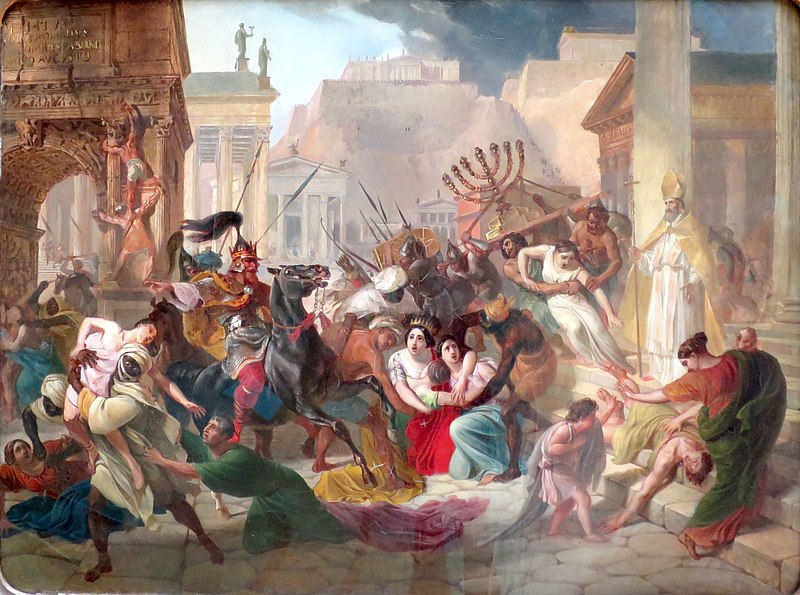
Julia was a Carthaginian girl who was sold as a slave, after Gaiseric captured Carthage in 439; and came into the service of a man named Eusebius. As a young and strong female, Julia brought a good price for the Vandals.

Karl Bryullov, (1799–1852)
Sacking of Rome 455, c. between 1833 and 1836
88x117,9 см.
Tretyakov Gallery, Moscow, Russia

Karl Pavlovich Bryullov, original name Charles Bruleau, Bryullov (born Dec. 12, 1799, St. Petersburg, Russia—died June 11, 1852, Marsciano, near Rome, Papal States), Russian painter who combined technical proficiency and classical academic training with a Romantic spontaneity to produce some of the liveliest examples of Russian art of the period.

Bryullov was descended from French Huguenots, and his father was a sculptor. Bryullov was educated at the St. Petersburg Academy of Fine Arts (1809–21). He studied in Italy from 1823, painting his best-known work, the monumental “Last Day of Pompeii” (1830–33). Much of his continuing reputation rests on his more intimate portraits and his watercolours and travel sketches. More on Karl Bryullov

Unknown artist
Vandal or late Roman,  5th C
Mosaic pavement
Excavated at Bordj-Djedid in 1857, Carthage
British Museum

Even though Eusebius was a pagan he admired so great a virtue in service. When her own duties were done and she was granted the servant's time off, she spent her spare time either in reading or insisting on praying. She grew pale and thin from fasting despite the threats and blandishments of her master, but her mind, intent on Heaven, fed daily on God's words.

Benvenuto Tisi da Garofalo, (c.1481–1559)
A Pagan Sacrifice
Oil on canvas
H 128.3 x W 185.4 cm
The National Gallery, London

Benvenuto Tisi da Garofalo (1481 – September 6, 1559) was a Late-Renaissance-Mannerist Italian painter of the School of Ferrara. Garofalo's career began attached to the court of the Duke d'Este. His early works have been described as "idyllic", but they often conform to the elaborate conceits favored by the artistically refined Ferrarese court. His nickname, Garofalo, may derive from his habit of signing some works with a picture of a carnation.

Tisi is claimed to have apprenticed under Panetti.  In 1495 he worked at Cremona. He may have spent three years (1509–1512), in Rome. This led to a stylized classical style.

Invited to Rome, he worked briefly under Raphael in the decoration of the Stanza della Segnatura. From Rome family affairs recalled him to Ferrara; there Duke Alfonso I commissioned him to execute paintings. Thus the style of Tisi partakes of the Lombard, the Roman and the Venetian modes.

He continued constantly at work until in 1550 blindness overtook him, painting on all feast-days in monasteries for the love of God. He had married at the age forty-eight, and died at Ferrara on the 6th (or 16th) of September 1559, leaving two children. More on Benvenuto Tisi da Garofalo 

Eusebius, a citizen of Syria in Palestine, rowing hard for Gaul with an expensive cargo, anchored at Cap Corse for the night. From a distance he saw that sacrifices were about to be conducted by the pagans and immediately descended with all his people to attend. 

While they were celebrating by becoming intoxicated and Saint Julia was sighing deeply for their error it was announced to Felix by his satellites that there was a girl in the ship who derided the worship of the gods. This "son of the serpent" asked Eusebius, "Why did not all who are with you come down to worship our gods? I heard that there is a girl who derides the names of our gods." Eusebius replied "I was not successful in moving the girl from the superstition of the Christians nor was I able to bring her to our religion by threatening. If she were not necessary because of her most faithful service I would already have had her tortured."


Then Felix Saxo gave him some options: "Either compel her to give offerings to our gods, or give her to me in exchange for whichever four of my handmaidens please you, or for the price that was set for her." Eusebius replied: "If you wanted to give me all your property it would not come to the value of her service."

Felix Saxo was a major, or "magistrate" among the sacrificers, "who happened to be in charge of the place". 

Felix Saxo did not just take the girl by eminent domain as the penalty for disrespecting the rights of Roman citizens was severe, and the girl was the property of Eusebius. He could do as he liked with her. However, disrespecting the state gods was a crime punishable by death, which the magistrate could only overlook at his own risk.

Unknown artist
Saint Julia

Felix Saxo  prepared a banquet, where Eusebius became intoxicated and fell into a deep sleep. Straightway "a raging mob of gentiles" boarded the ship and placed Julia on the shore. Felix said: "Sacrifice to the gods, girl. I will give your master as much as he likes and dissolve the bond of your state." 

Julia replied: "My liberty is the service of Christ, whom I serve every day with a pure mind. As for that error of yours, I not only do not venerate it, I detest it."

Gabriel von Max, (1840–1915)
Saint Julia (also called Crucified Martyress“), c. 1866
Oil on canvas
125×93 cm
Hermitage Museum

Gabriel Cornelius Ritter von Max (ennobled in 1900; 23 August 1840 – 24 November 1915) was a Prague-born Austrian painter, the son of the sculptor Josef Max and Anna Schumann. He studied at the Prague Academy of Arts. His studies included parapsychology, Darwinism, Asiatic philosophy, the ideas of Schopenhauer, and various mystical traditions. He continued his studies at the Viennese Academy of Art. From 1863 to 1867 he studied at the Munich Academy. His first critical success was in 1867 with the painting “Martyr at the Cross”: that painting transformed the “Unglücksmalerei” (dark palette) of Piloty into a religious-mystical symbolism using a psychological rendering of its subject.

He continued to use the dark palette of the Piloty school well into the 1870s, later moving toward a more muted palette, using fewer, clearer colors. From 1869, Gabriel von Max had his studio in Munich. From 1879-1883, Gabriel Max was a professor of Historical Painting at the Munich Academy; he also became a Fellow of The Theosophical Society. In 1900 he was ennobled and became a Ritter. He died in Munich in 1915. More Gabriel von Max

The tribune ordered that she be struck blows to the face. That done, she said that as Christ was struck for her, why should she not be struck for him? Then "the most cruel serpent" ordered that she be "tortured by the hair". Then she was flogged, to which she replied in the same way, that if Christ was flogged and crowned with thorns for her, why should she not endure this diminishment of the hair. 


Hieronymus Bosch, (circa 1450 –1516)
Triptych of the crucified Martyr, circa 1497-1505
Oil on panel
Height: 104 cm (40.9 in); Width: 119 cm (46.8 in)
Doge's Palace, Venice

Hieronymus Bosch (c. 1450 – 9 August 1516) was an Early Flemish painter. His work is known for its fantastic imagery, detailed landscapes, and illustrations of religious concepts and narratives. Within his lifetime his work was collected in the Netherlands, Austria, and Spain, and widely copied, especially his macabre and nightmarish depictions of hell.

Little is known of Bosch's life, though there are some records. He spent most of it in the town of 's-Hertogenbosch, where he was born in his grandfather's house. The roots of his forefathers are in Aachen, in present-day Germany. His pessimistic and fantastical style cast a wide influence on northern art of the 16th century, with Pieter Bruegel the Elder being his best known follower. His paintings have been difficult to translate from a modern point of view; attempts to associate instances of modern sexual imagery with fringe sects or the occult have largely failed. Today he is seen as a hugely individualistic painter with deep insight into humanity's desires and deepest fears. Attribution has been especially difficult; today only about 25 paintings are confidently given to his hand along with 8 drawings. Approximately another half dozen paintings are confidently attributed to his workshop. His most acclaimed works consist of a few triptych altarpieces, the most outstanding of which is The Garden of Earthly Delights. More Hieronymus Bosch

The "serpent", fearful of being indicted for cruelty, hurried the process along by ordering "the handmaiden of Christ" to be placed on the patibulum of a cross. Eusebius was awakened. As he let go the bonds of sleep, the saint, with mind released from the flesh, victress over suffering, took happy flight with the angels to the stars of heaven. More ob Saint Julia


Images are copyright of their respective owners, assignees or others. Some Images may be subject to copyright

I don't own any of these images - credit is always given when due unless it is unknown to me. if I post your images without your permission, please tell me.

I do not sell art, art prints, framed posters or reproductions. Ads are shown only to compensate the hosting expenses.

If you enjoyed this post, please share with friends and family.

Thank you for visiting my blog and also for liking its posts and pages.

Please note that the content of this post primarily consists of articles available from Wikipedia or other free sources online.