Showing posts with label Domenico Ghirlandaio. Show all posts

Saturday, September 5, 2020

10 works, Today, September 5th, is Prophet Zechariah's day, his story illustrated #248

Unknown artist
Zechariah and St. John the Baptist
Georgian fresco
Monastery of the Cross, Jerusalem.

Zechariah is a figure in the New Testament Bible and the Quran. In the Bible, he is the father of John the Baptist, a priest of the sons of Aaron in the Gospel of Luk, and the husband of Elizabeth who is a relative of the Virgin Mary.

During the reign of king Herod, there was a priest named Zechariah whose wife Elizabeth was also of the priestly family of Aaron. Their marriage was still childless, because Elizabeth was "barren", and they were both "well advanced in years".

The duties at the temple in Jerusalem alternated between each of the family lines that had descended from those appointed by king David. During the week when it was the duty of Zechariah's family line to serve at "the temple of the Lord", the lot for performing the incense offering had fallen to Zechariah.

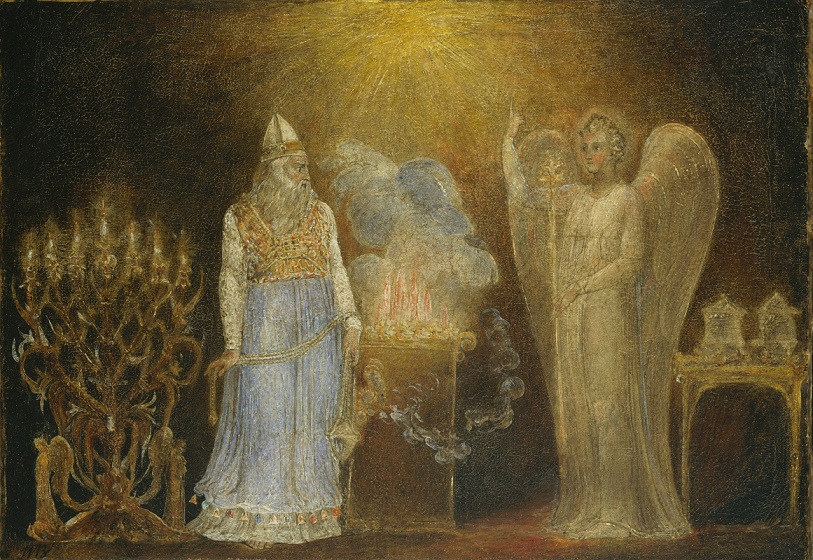
William Blake, (British, London 1757–1827 London)
Archangel Gabriel Appears to Zechariah, c. 1799–1800
Pen and black ink, tempera, and glue size on canvas
10 1/2 x 15 in. (26.7 x 38.1 cm)
he Metropolitan Museum of Art

Blake devoted much of the year 1799–1800 to fifty visionary scenes drawn from the Bible, a commission he received from his principal patron, the government clerk Thomas Butts. About thirty of these works have been identified; it is thought that some have not survived owing to the fragility of the materials. This scene, the earliest in the New Testament narrative cycle, illustrates verses from Luke (I:11–13), in which Gabriel appears to the righteous Zacharias, a high priest of the Jewish Temple in Jerusalem, to announce that Zacharias’s elderly and barren wife will give birth to a son, Saint John the Baptist. More on this work

William Blake (November 28, 1757 - August 12, 1827) was an English poet, painter, and printmaker. Largely unrecognized during his lifetime, Blake's work is now considered seminal in the history of both poetry and the visual arts.


Blake's prophetic poetry has been said to form "what is in proportion to its merits the least read body of poetry in the (English) language". His visual artistry has led one modern critic to proclaim him "far and away the greatest artist Britain has ever produced".


Although he only once travelled any further than a day's walk outside London over the course of his life, his creative vision engendered a diverse and symbolically rich corpus, which embraced 'imagination' as "the body of God", or "Human existence itself". More on William Blake


While Zechariah ministered at the altar of incense, an angel appeared and announced to him that his wife would give birth to a son, whom he was to name John. Citing their advanced age, Zechariah asked with disbelief for a sign whereby he would know the truth of this prophecy. 

Alexander Andreyevich Ivanov
Archangel Gabriel hits Zachariah with silence,  1840 -1850
I have no further description, at this time

Alexander Andreyevich Ivanov (July 16, 1806 – July 15, 1858) was a Russian painter who adhered to the waning tradition of Neoclassicism but found little sympathy with his contemporaries. He was born and died in St. Petersburg. He has been called the master of one work, for it took 20 years to complete his magnum opus The Appearance of Christ Before the People.

Aged 11, he entered the Imperial Academy of Arts and studied at his father's course together with Karl Briullov. For his good achievements he was awarded with two silver medals, in 1824 he received a golden medal for the painting 'Priam Asking Achilles to Return Hector's Body'. In 1827 he was honoured with the Big Gold Medal of the Imperial Academy of Arts for 'Joseph interprets the butler's and the baker's dreams' and was promoted to the XIV grade artists.

In 1830 Ivanov departs to Europe, first in Germany, then to Italy. His first works in Rome were copies of Biblical scenes. In 1834-1835 he finished 'Appearance of Jesus Christ to Maria Magdalena'. The painting had great success both in Rome and St Petersburg. The Russian Imperial Academy of Arts granted Ivanov an honorary academic degree in 1836.

He spent most of his life in Rome where he befriended Gogol and was influenced by the Nazarenes. More on Alexander Andreyevich Ivanov

In reply, the angel identified himself as Gabriel, and added that because of Zechariah's doubt he would be struck dumb and "not able to speak, until the day that these things shall be performed". Consequently, when he went out to the waiting worshippers in the temple's outer courts, he was unable to speak the customary blessing.

After returning to his house in "Hebron, his wife Elizabeth conceived. After Elizabeth completed her fifth month of pregnancy, her relative Mary was visited by the same angel, Gabriel. While still a virgin, 

Walter Rane, (1949)
Mary Is Visited By The Angel Gabriel
I have no further description, at this time

Walter Rane (born 1949) is an American artist who began his career as primarily a book and magazine illustrator but now specializes in religious art.

Rane studied at the Art Center College of Design. He then worked in the New York City area. While in New York City Rane illustrated such works as Meet Kit: An American Girl by Valerie Tripp. He has also illustrated editions of Wallace Stegner's Recapitulation and Ellen Glasgow's In This Our Life. 

In the early 1990s the Church asked him to begin creating works of art on religious themes. Many of his works depict scenes described in the Book of Mormon while others focus on events in the life of Jesus Christ.

Many of his paintings appear in Salt Lake City. Additionally, over 30 unique paintings by Rane can be found in the Church History Museum.

In 2006 Rane was the recipient of the Associate Directors award at the 21st annual Springville Museum of Art Spiritual and Religious Arts Show. A retrospective of Rane's work was held at the Springville Museum of Art in 2013. More on Walter Rane

Gabriel said to her, “Do not be afraid, Mary; you have found favor with God. You will conceive and give birth to a son, and you are to call him Jesus. 'How will this be,' Mary asked the angel, 'since I am a virgin?' The angel answered, 'The Holy Spirit will come on you, and the power of the Most High will overshadow you. So the holy one to be born will be called the Son of God.'" Joseph, whom Mary was betrothed to, found out that she was pregnant, obviously disturbing news. Yet did not want to expose her to public disgrace, he had in mind to divorce her quietly. But after he had considered this, an angel appeared to him in a dream and said, 'Joseph son of David, do not be afraid to take Mary home as your wife, because what is conceived in her is from the Holy Spirit. She will give birth to a son, and you are to give him the name Jesus, because he will save his people from their sins.'  When Joseph woke up, he did what the angel commanded him and took Mary home as his wife."

Unknown artist
The Embrace of Elizabeth and the Virgin Mary, c. 1191
St. George Church, Kurbinovo, North Macedonia
I have no further description, at this time

Mary then traveled to visit her relative Elizabeth, having been told by the angel that Elizabeth was in her sixth month of pregnancy. Mary remained about three months before she returned to her own house. Elizabeth gave birth, and on the eighth day, when their son was to be circumcised according to the commandment, her neighbours and relatives assumed that he was to be named after his father. Elizabeth, however, insisted that his name was to be John; so the family then questioned her husband. 

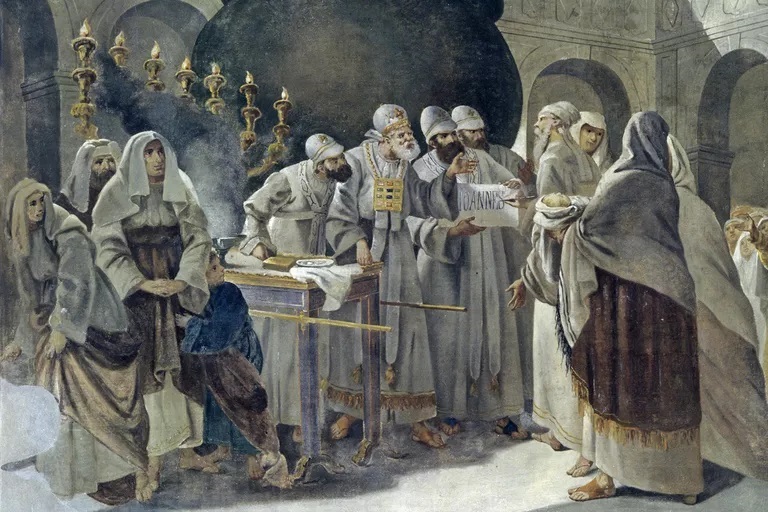
Unknown artist
Zechariah writes, "His name is John."
Mondadori Portfolio/Contributor/Getty Images
I have no further description, at this time

Domenico Ghirlandaio
Zacharias Writes Down the Name of his Son, between 1486 and 1490
Fresco
Width 450 cm
Cappella Tornabuoni, Santa Maria Novella, Florence

Domenico Ghirlandaio (2 June 1448 – 11 January 1494) was an Italian Renaissance painter born in Florence. Ghirlandaio was part of the so-called "third generation" of the Florentine Renaissance, along with Verrocchio, the Pollaiolo brothers and Sandro Botticelli. Ghirlandaio led a large and efficient workshop that included his brothers Davide Ghirlandaio and Benedetto Ghirlandaio, his brother-in-law Bastiano Mainardi from San Gimignano, and later his son Ridolfo Ghirlandaio. Many apprentices passed through Ghirlandaio's workshop, including the famous Michelangelo. Ghirlandaio's particular talent lay in his ability to posit depictions of contemporary life and portraits of contemporary people within the context of religious narratives, bringing him great popularity and many large commissions. More on Domenico Ghirlandaio


As soon as Zechariah had written on a writing table: "His name is John", he regained the power of speech. The child grew up and "waxed strong in spirit", but remained in the deserts of Judæa until he assumed the ministry that was to earn him the name "John the Baptist"

Unknown artist
St. Zachariah and St. Elizabeth with their son, St. John the Baptist
I have no further description, at this time

When King Herod heard from the Magi about the birth of the Messiah, he decided to kill all the infants up to two years old at Bethlehem and the surrounding area, hoping that the new-born Messiah would be among them. More on Prophet Zechariah

Herod knew about John’s unusual birth and he wanted to kill him, fearing that he was the foretold King of the Jews. But Elizabeth hid herself and the infant in the hills. The murderers searched everywhere for John. Elizabeth, when she saw her pursuers, began to implore God for their safety, and immediately the hill opened up and concealed her and the infant from their pursuers.

William Brassey Hole,(1846-1917)
The Murder of Zechariah
I have no further description, at this time

William Brassey Hole RSA (7 November 1846 – 22 October 1917) was an English artist, illustrator, etcher and engraver, known for his industrial, historical and biblical scenes.

He was educated at Edinburgh Academy, then served an apprenticeship as a civil engineer for 5 years, although he really wanted to be an artist.

In 1869, he sailed from Swansea to Genoa, and spent the next 6 months travelling and sketching around Italy. In Rome he made the acquaintance of Keeley Halswelle who gave him practical advice on art. 

On returning to Edinburgh, Hole entered the School of Design, then won admission to the life school of the Royal Scottish Academy, first exhibiting there in 1873; in 1878 he was elected an associate of the Academy. Around this time he took up etching and was accepted into the Royal Society of Painters and Etchers (RE) in 1885; he was already a member of the Royal Scottish Watercolour Society (RSW) from 1884. He eventually became a full member of the Academy (RSA). More on William Brassey Hole


James Tissot
Zacharias Killed Between the Temple and the Altar, c. 1886-1894
Opaque watercolor over graphite on gray wove paper
 7 1/8 x 5 1/2 in. (18.1 x 14 cm)
Brooklyn Museum

Jacques Joseph Tissot (15 October 1836 – 8 August 1902), Anglicized as James Tissot, was a French painter and illustrator. He was a successful painter of Paris society before moving to London in 1871. He became famous as a genre painter of fashionably dressed women shown in various scenes of everyday life. He also painted scenes and characters from the Bible. More on James Tissot


In these tragic days Saint Zachariah was taking his turn at the services in the Temple. Soldiers sent by Herod tried in vain to learn from him the whereabouts of his son. Then, by command of Herod, they murdered this holy prophet, having stabbed him between the temple and the altar. Elizabeth died forty days after her husband, and Saint John, preserved by the Lord, dwelt in the wilderness until the day of his appearance to the nation of Israel. More on Prophet Zechariah


Please visit my other blogs: Art CollectorMythologyMarine ArtPortrait of a Lady, The OrientalistArt of the Nude and The Canals of VeniceMiddle East Artistsand 365 Saints, also visit my Boards on Pinterest

Images are copyright of their respective owners, assignees or others. Some Images may be subject to copyright

I don't own any of these images - credit is always given when due unless it is unknown to me. if I post your images without your permission, please tell me.

I do not sell art, art prints, framed posters or reproductions. Ads are shown only to compensate the hosting expenses.

If you enjoyed this post, please share with friends and family.

Thank you for visiting my blog and also for liking its posts and pages.

Please note that the content of this post primarily consists of articles available from Wikipedia or other free sources online.


Wednesday, June 24, 2020

06 Works, Today, June 24th, is Nativity of Saint John the Baptist's day, his story in Paintings #175

Unknown artist
Ss. Zacharias and Elizabeth
I have no further description of this artwork at this time

The Nativity of John the Baptist is a Christian feast day celebrating the birth of John the Baptist. The Nativity of John the Baptist is a high-ranking liturgical feast, kept in the Roman Catholic, Anglican, Eastern Orthodox and Lutheran churches. The sole biblical account of the birth of John the Baptist comes from the Gospel of Luke.

John's parents, Zechariah and Elizabeth, were without children and both were beyond the age of child-bearing. During Zechariah's rotation to serve in the Temple in Jerusalem, he was chosen by lot to offer incense at the Golden Altar in the Holy Place. 

Domenico Ghirlandaio, (1449–1494) 
Announcement of the angel to San Zaccaria, c. 1480
Tornabuoni frescoes chapel in Florence. 

Domenico Ghirlandaio (2 June 1448 – 11 January 1494) was an Italian Renaissance painter born in Florence. Ghirlandaio was part of the so-called "third generation" of the Florentine Renaissance, along with Verrocchio, the Pollaiolo brothers and Sandro Botticelli. Ghirlandaio led a large and efficient workshop that included his brothers Davide Ghirlandaio and Benedetto Ghirlandaio, his brother-in-law Bastiano Mainardi from San Gimignano, and later his son Ridolfo Ghirlandaio. Many apprentices passed through Ghirlandaio's workshop, including the famous Michelangelo. Ghirlandaio's particular talent lay in his ability to posit depictions of contemporary life and portraits of contemporary people within the context of religious narratives, bringing him great popularity and many large commissions. More on Domenico Ghirlandaio

The Archangel Gabriel appeared to him and announced that he and his wife would give birth to a child, and that they should name him John. However, because Zechariah did not believe the message of Gabriel, he was rendered speechless until the time of John's birth. 

Tintoretto, Jacopo (Jacopo Robusti). 1518-1594
Birth of St John the Baptist, c. 1550's
Oil on canvas
181x266 cm
Hermitage 

Tintoretto; born Jacopo Comin, (October, 1518 – May 31, 1594) was an Italian painter and a notable exponent of the Renaissance school. For his phenomenal energy in painting he was termed Il Furioso. His work is characterized by its muscular figures, dramatic gestures, and bold use of perspective in the Mannerist style, while maintaining color and light typical of the Venetian School.


In his youth, Tintoretto was also known as Jacopo Robusti as his father had defended the gates of Padua in a way that others called robust, against the imperial troops during the War of the League of Cambrai (1509–1516). His real name "Comin" has only recently been discovered by Miguel Falomir, the curator of the Museo del Prado, Madrid, and was made public on the occasion of the retrospective of Tintoretto at the Prado in 2007. More on Tintoretto

Russian icon
Nativity of John the Baptist
I have no further description of this artwork at this time

At that time, his relatives wanted to name the child after his father, and Zechariah wrote, "His name is John", whereupon he recovered his ability to speak. Following Zechariah's obedience to the command of God, he was given the gift of prophecy, and foretold the future ministry of Jesus.

Philippe de Champaigne, (1602–1674)
La Visitation
Oil on canvas
Museo de Arte e Historia de Ginebra

Philippe de Champaigne (26 May 1602 - 12 August 1674) was a Baroque era painter of the French school.

Born in Brussels of a poor family, Champaigne was a pupil of the landscape painter Jacques Fouquières. In 1621 he moved to Paris, where he worked with Nicolas Poussin on the decoration of the Palais du Luxembourg under the direction of Nicolas Duchesne, whose daughter he married. After the death of his protector Duchesne, Champaigne worked for the Queen Mother, Marie de Medicis, and for Richelieu, for whom he decorated the cardinal's palace, the Dome of the Sorbonne church and other buildings. He was a founding member of the Acadèmie Royale de Peinture in 1648.


Later in his life (1640), he came under the influence of Jansenism. After his paralysed daughter was allegedly miraculously cured at the nunnery of Port-Royal, he painted the celebrated but untypical picture Ex-Voto de 1662, now in the Louvre, which represents the artist's daughter with Mother-Superior Cathèrine-Agnès Arnauld. Champaigne produced a very large number of paintings, mainly religious works and portraits. Influenced by Rubens at the beginning of his career, his style later became more austere. He died in Paris. More on Philippe de Champaigne

Unknown artist
Mary then journeyed to visit Elizabeth
I have no further description of this artwork at this time

At the Annunciation, when the angel Gabriel appeared to the Virgin Mary to inform her that she would conceive of the Holy Ghost, he also informed her that Elizabeth, her cousin, was already six months pregnant. Mary then journeyed to visit Elizabeth. Luke's Gospel recounts that the baby "leapt" in Elizabeth's womb at the greeting of Mary. More on The Nativity of John the Baptist


Images are copyright of their respective owners, assignees or others. Some Images may be subject to copyright
I don't own any of these images - credit is always given when due unless it is unknown to me. if I post your images without your permission, please tell me.
I do not sell art, art prints, framed posters or reproductions. Ads are shown only to compensate the hosting expenses.
 If you enjoyed this post, please share with friends and family.
 Thank you for visiting my blog and also for liking its posts and pages.
 Please note that the content of this post primarily consists of articles available from Wikipedia or other free sources online.

Tuesday, March 24, 2020

07 Works, Today, March 24th, is St. Gabriel the Archangel's Day, With Footnotes - #82

Pinturicchio,  (1454–1513)
St. Gabriel the Archangel, c. 1501
Fresco
Collegiate church Santa Maria Maggiore

Pintoricchio or Pinturicchio, whose formal name was Bernardino di Betto, also known as Benetto di Biagio or Sordicchio, c.1454–1513, Umbrian painter whose real name was Bernardino di Betto. A prolific and facile painter, he was influenced by Perugino, with whom he collaborated on the frescoes for the Sistine Chapel. Pinturicchio worked chiefly in Perugia, Rome, and Siena. He decorated the Borgia apartments in the Vatican and several churches in Rome. His most elaborate project was the decoration of the cathedral library in Siena. In the Metropolitan Museum are many panels of mythological scenes from the ceiling of the reception room in the Palazzo del Magnifico in Siena. More on Pinturicchio

Gabriel, in the Abrahamic religions, is an archangel. He was first described in the Hebrew Bible and was subsequently adopted by other traditions.

Follower Francesco Solimena
The Archangel Gabriel appears to the Prophet Daniel
Oil on canvas
110 x 117.5cm (43 5/16 x 46 1/4in) 
Unknown location

Francesco Solimena (October 4, 1657 – April 3, 1747) was a prolific Italian painter of the Baroque era, one of an established family of painters and draughtsmen. He received early training from his father, Angelo Solimena, with whom he executed a Paradise for the cathedral of Nocera and a Vision of St. Cyril of Alexandria for the church of San Domenico at Solofra.


He settled in Naples in 1674, there he worked in the studio of Francesco di Maria and later Giacomo del Po. He apparently had taken the clerical orders, but was patronized early on, and encouraged to become an artist by Cardinal Vincenzo Orsini (later Pope Benedict XIII). By the 1680s, he had independent fresco commissions, and his active studio came to dominate Neapolitan painting from the 1690s through the first four decades of the 18th century. He modeled his art—for he was a highly conventional painter—after the Roman Baroque masters. Solimena painted many frescoes in Naples, altarpieces, celebrations of weddings and courtly occasions, mythological subjects, characteristically chosen for their theatrical drama, and portraits. His settings are suggested with a few details—steps, archways, balustrades, columns—concentrating attention on figures and their draperies, caught in pools and shafts of light. Art historians take pleasure in identifying the models he imitated or adapted in his compositions. His numerous preparatory drawings often mix media, combining pen-and-ink, chalk and watercolor washes. More on Francesco Solimena

In the Hebrew Bible, Gabriel appears to the prophet Daniel to explain his visions. The archangel appears in such other ancient Jewish writings as the Book of Enoch. Alongside archangel Michael, Gabriel is described as the guardian angel of Israel, defending this people against the angels of the other nations.


Domenico Ghirlandaio  (1449–1494)
Announcement of the angel to San Zaccaria , c. 1480
Fresco
330 × 450 cm
Tornabuoni frescoes chapel in Florence. 

Domenico Ghirlandaio (2 June 1448 – 11 January 1494) was an Italian Renaissance painter born in Florence. Ghirlandaio was part of the so-called "third generation" of the Florentine Renaissance, along with Verrocchio, the Pollaiolo brothers and Sandro Botticelli. Ghirlandaio led a large and efficient workshop that included his brothers Davide Ghirlandaio and Benedetto Ghirlandaio, his brother-in-law Bastiano Mainardi from San Gimignano, and later his son Ridolfo Ghirlandaio. Many apprentices passed through Ghirlandaio's workshop, including the famous Michelangelo. Ghirlandaio's particular talent lay in his ability to posit depictions of contemporary life and portraits of contemporary people within the context of religious narratives, bringing him great popularity and many large commissions. More on Domenico Ghirlandaio

El Greco
Anunciación, c.1600; Spain  
Oil on canvas
91 x 66.5 cm
Toledo Museum of Art, Toledo, OH, US

Doménikos Theotokópoulos (1541 – 7 April 1614), most widely known as El Greco; Spanish for "The Greek", was a painter, sculptor and architect of the Spanish Renaissance. The nickname "El Greco" refers both to his Greek origin and Spanish citizenship. The artist normally signed his paintings with his full birth name in Greek letters.

El Greco was born in Crete, which was at that time part of the Republic of Venice, and the center of Post-Byzantine art. He trained and became a master within that tradition before traveling at age 26 to Venice, as other Greek artists had done. In 1570 he moved to Rome, where he opened a workshop and executed a series of works. During his stay in Italy, El Greco enriched his style with elements of Mannerism and of the Venetian Renaissance. In 1577, he moved to Toledo, Spain, where he lived and worked until his death. In Toledo, El Greco received several major commissions and produced his best-known paintings.

El Greco's dramatic and expressionistic style was met with puzzlement by his contemporaries but found appreciation in the 20th century. El Greco is regarded as a precursor of both Expressionism and Cubism, while his personality and works were a source of inspiration for poets and writers. El Greco has been characterized by modern scholars as an artist so individual that he belongs to no conventional school. He is best known for tortuously elongated figures and often fantastic or phantasmagorical pigmentation, marrying Byzantine traditions with those of Western painting. More on El Greco

The Gospel of Luke relates the stories of the Annunciation, in which the angel Gabriel appears to Zechariah and the Virgin Mary, foretelling the births of John the Baptist and Jesus, respectively. Many Christian traditions—including Anglicanism, Eastern Orthodoxy, and Roman Catholicism—revere Gabriel as a saint.


Mohammed receiving his first revelation from the angel Gabriel
Miniature illustration on vellum from the book Jami' al-Tawarikh by Rashid al-Din, published in Tabriz, Persia, 1307 CE 
Edinburgh University Library, Scotland.

Islam regards Gabriel as an archangel sent by God to various prophets, among them Muhammad. The first five verses of the 96th chapter of the Quran, the Clot, is believed by Muslims to have been the first verses revealed by Gabriel to Muhammad.


James E. McConnell, (1903-95)
Noah's ArkNoah's Ark
Gouache on paper

James Edwin McConnell (15 July 1903 - 4 May 1995) was a British book and magazine cover artist best known for Western and historical subjects.

Born in Bedlington, Northumberland, McConnell worked for a local blockmaker before moving to London where he continued in the same trade whilst studying part-time at St. Martin's School. He went freelance in 1933, working through the Partridge Agency with whom he remained until 1953.

McConnell's early freelance work was in advertising and designing book covers. After the Second World War he established himself as one of the leading artists for the burgeoning paperback market. 

McConnell painted over 1,000 covers and frontispiece illustrations. He also contributed to the artwork in the American Roll of Honour, which lies in the American Chapel, St Paul's Cathedral, London.


As he was primarily a paperback cover artist, McConnell has rarely come to the attention of critics, although an exhibition of his Western artwork was held at the Association of Illustrators Gallery in London in 1976. More on James Edwin McConnell

The Latter Day Saints hold that the angel Gabriel is the same individual as the prophet Noah in his mortal ministry.

Melek Taus
Akshardham Temple,  India, Delhi

Yazidis consider Gabriel one of the Seven Mysteries, the heptad to which God entrusted the world and sometimes identified with Melek Taus.

The feast of Saint Gabriel was included by Pope Benedict XV in the General Roman Calendar in 1921, for celebration on 24 March. More on St. Gabriel the Archangel


Please visit my other blogs: Art CollectorMythologyMarine ArtPortrait of a Lady, The OrientalistArt of the Nude and The Canals of VeniceMiddle East Artists365 Saints365 Days, and Biblical Icons, also visit my Boards on Pinterest and my art stores at  deviantart and Aaroko

Images are copyright of their respective owners, assignees or others. Some Images may be subject to copyright

I don't own any of these images - credit is always given when due unless it is unknown to me. if I post your images without your permission, please tell me.

Ads are shown only to compensate the hosting expenses.

If you enjoyed this post, please share with friends and family.

Thank you for visiting my blog and also for liking its posts and pages.

Please note that the content of this post primarily consists of articles available from Wikipedia or other free sources online.

Tuesday, February 12, 2019

06 Works, Today, February 12th, is Julian the Hospitaller's Day, With Footnotes - #43

Domenico Ghirlandaio, (1449–1494)
Detail, Saint Jean l'Hospitalier, c. 1473
Fresco
Church of St. Andrew in San Donnino

Domenico Ghirlandaio (2 June 1448 – 11 January 1494) was an Italian Renaissance painter born in Florence. Ghirlandaio was part of the so-called "third generation" of the Florentine Renaissance, along with Verrocchio, the Pollaiolo brothers and Sandro Botticelli. Ghirlandaio led a large and efficient workshop that included his brothers Davide Ghirlandaio and Benedetto Ghirlandaio, his brother-in-law Bastiano Mainardi from San Gimignano, and later his son Ridolfo Ghirlandaio. Many apprentices passed through Ghirlandaio's workshop, including the famous Michelangelo. Ghirlandaio's particular talent lay in his ability to posit depictions of contemporary life and portraits of contemporary people within the context of religious narratives, bringing him great popularity and many large commissions. More on Domenico Ghirlandaio

Julian the Hospitaller is a Roman Catholic saint.


According to de Varazze, on the night Julian was born, his father, a man of noble blood, saw pagan witches secretly lay a curse on the boy that would make him kill both his parents. His father wanted to get rid of the child, but his mother did not let himt. When he finally found out the reason for her tears, he swore he "would never commit such a sin" and "with great belief in Christ went off full of courage" as far away from his parents as he could. After fifty days of walking he finally reached Galicia where he married a "good woman", said to be a wealthy widow.


Edmond Aman-Jean, (1858-1936)
Saint-Julien the hospitable, c. 1882
Oil on canvas
Height: 360 cm; Width: 270 cm
Museum of Fine Arts of Carcassonne

Edmond Aman-Jean, pseudonym of Amand Edmond Jean, was born in Chevry-Cossigny November 13 , 18581 and died on January 25 , 1936 in Paris , was a painter , writer and art critic French.

Edmond Aman-Jean was a student of Henri Lehmann of the School of Fine Arts in Paris and the classmate of Georges Seurat , with which he shared a workshop. He is also linked with the symbolist painters Alphonse Osbert and Alexandre Séon .

In 1886 he obtained a travel grant and went to Italy to study Italian primitives, which reinforced his taste for the ancients and for the decor. With Seurat, he worked as assistant to the creating the sacred wood of Puvis de Chavannes ( Museum of Fine Arts of Lyon ). Seurat's influence is notably found in Edmond's Sainte Geneviève ( Museum of Fine Arts of Brest )


Albert Besnard had him appointed to the Legion of Honor in 1900. He was promoted to the rank of Commander in 1933. More on Edmond Aman-Jean


Twenty years later, his parents decided to go look for their now thirty-year-old son. When they arrived, they visited the altar of St. James, and "as soon as they came out of the church they met a woman, whom the pilgrims greeted and asked, for Jesus' love, whether she would host them for the night as they were tired." She let them in and told them that her husband, Julian, was out hunting. The mother and father were overjoyed to have found their son, as was Julian's wife. "She took care of them well and had them rest in her and Julian's bed." But the enemy went off seeking Julian and told him: 'I have sour news for you. While you are here, hunting, your wife is in bed embracing another man. There they are right now, still sleeping.'"


"And Julian felt deep sadness and his face drew into a frown. He rode back home, went to his bed and found a man and a woman sleeping in it. He drew his sword and killed them both. As he was leaving he saw his wife sitting among the other women. She told him: 'There are your mother and father resting in your room.' And so Julian knew, and fell into a rage. 'The shrewd enemy lied to me. 'Better had I never been born, for I am cursed.' And his good wife comforted him and said 'Have faith in Christ Almighty, a stream of life and mercy.' After seeking redemption in Rome, Julian built seven hospitals and twenty-five houses. And the poor started flowing to him, to Jesus' Almighty's love."


Tuscan School
Scenes from the Legend of Saint Julian the, ca. 1420/40
Oil and tempera on panel
26.8 x 66 cm.
Private collection

The present panel, most likely part of a predella, depicts scenes from the life of Saint Julian the Hospitaller, patron saint of pilgrims, travellers and innkeepers. According to the Legenda Aurea, Julian is said to have killed his parents by accident, having mistaken them for his wife and her supposed lover. The scene on the right shows the Saint realising his mistake after meeting his wife shortly after. More on this painting


Masolino da Panicale, (1383–1447)
Stories of Saint Julian, part of a predella, from 1425 until 1426
Tempera on wood
Height: 24 cm (9.4 ″); Width: 43 cm (16.9 ″)
Musée Ingres,  Montauban, France

Masolino da Panicale (born 1383, Panicale, near Perugia, Romagna—died probably 1440–47, Florence) was a painter who achieved a compromise between the International Gothic manner and the advanced early Renaissance style of his own day and who owes his prominence in the history of Florentine art not to his innovations but to his lyrical style and his unfailing artistry.

In 1423, Masolino joined the Florentine guild Arte dei Medici e Spezial, which included painters as an independent branch He spent many years traveling, including a trip to Hungary from September 1425 to July 1427. He was selected by Pope Martin V, on the return of the papacy to Rome in 1420, to paint the altarpiece for his family chapel in the Basilica of Santa Maria Maggiore, and later by Cardinal Branda da Castiglione to paint the Saint Catherine Chapel in the Basilica of San Clemente, Rome. In the interim, he collaborated with his younger colleague, Masaccio, to paint the frescoes in the Brancacci Chapel in the Basilica of Santa Maria del Carmine, Florence, which were much admired by fellow artists throughout the fifteenth century. He painted a cycle of 300 famous historical figures in the Orsini Palace in Rome about 1433-4 and also worked in Todi. He spent his later years, after 1435, working for Cardinal Branda Castiglione in Castiglione Olona. More on Masolino da Panicale

"The enemy conspired again to ruin Julian—disguised as a weak pilgrim, he was let in by Julian with the others. At midnight he woke up and made a mess of the house." The following morning Julian saw the damage and swore never to let in anyone else in his home. He was so furious he had everyone leave. 


Antonio della Corna (or Cornia), BORN IN CREMONA
SAINT JULIAN THE HOSPITALLER, BELIEVING TO SURPRISE HIS WIFE AND A LOVER, KILLS HIS PARENTS
Oil on panel
53 by 60 1/8 in.; 134.5 by 152.7 cm.
Private collection

The scene shows Julian the Hospitaller (also known as Julian the Poor) murdering his own parents, whom he has mistakenly taken for his wife in the arms of a lover. Della Corna sets the scene in a 15th-century bedroom: the headboard of the bed is painted with a landscape that is a continuation of the 'actual' view visible through both arched window openings. More on this painting

Antonio della Corna, who lived in the 15th and 16th centuries, was one of the artists called by Lodovico Sforza to decorate the Porta Giovia Palace at Milan in 1490. No dates are known of his birth or death.


Some assign his birthplace to either Cremona or Soncino, and state Andrea Mantegna and Giovanni Bellini as his influences. There are no works by Corna in Cremona or Soncino. The Bignami Collection, near Cassal Maggiore, contains a picture representing a murder taken from the Legend of St. Julian, signed by Antonio in 1478. More on Antonio della Corna

"Jesus went to him, again as a pilgrim, seeking rest. He asked humbly, in the name of God, for shelter. But Julian answered with contempt: 'I shall not let you in. Go away, for the other night I had my home so vandalized that I shall never let you in.' And Christ told him 'Hold my walking-stick, please.' Julian, embarrassed, went to take the stick, and it stuck to his hands. And Julian recognized him at once and said 'He tricked me, the enemy who does not want me to be your faithful servant. But I shall embrace you, I do not care about him; and for your love I shall give shelter to whoever needs.' He knelt and Jesus forgave him, and Julian asked, full of repentance, forgiveness for his wife and parents. More on Saint Jean l'Hospitalier


Taddeo Gaddi, (Italian, Florentine, active by 1334–died 1366)
Saint Julian, c. 1340s
Tempera on wood, gold ground
21 1/4 x 14 1/4 in. (54 x 36.2 

A nobleman of the ninth century, Saint Julian is shown holding the sword with which he accidentally slew his parents. This cut-down but otherwise well-preserved picture is from a triptych for a church in Florence (Santa Maria della Croce al Tempio).

Taddeo Gaddi (c. 1290, Florence – 1366, Florence) was a medieval Italian painter and architect.


He was a member of Giotto's workshop from 1313 to 1337, when his master died. According to Giorgio Vasari, he was considered Giotto's most talented pupil: in 1347 he was placed at the top in a list of Florence's most renowned painters.[citation needed]


His main work is the cycle of Stories of the Virgin in the Baroncelli Chapel of the Basilica of Santa Croce in Florence. Later he perhaps painted the cabinet tiles in the sacristy of the same church. These works show his mastership of Giotto's new style, to which he added a personal experimentation in the architectural backgrounds, such as in the staircase of the Presentation of the Virgin in the Baroncelli Chapel. More on Taddeo Gaddi


Please visit my other blogs: Art CollectorMythologyMarine ArtPortrait of a Lady, The OrientalistArt of the Nude and The Canals of VeniceMiddle East Artists365 Saints and 365 Days, also visit my Boards on Pinterest

Images are copyright of their respective owners, assignees or others. Some Images may be subject to copyright

I don't own any of these images - credit is always given when due unless it is unknown to me. if I post your images without your permission, please tell me.

I do not sell art, art prints, framed posters or reproductions. Ads are shown only to compensate the hosting expenses.

If you enjoyed this post, please share with friends and family.

Thank you for visiting my blog and also for liking its posts and pages.

Please note that the content of this post primarily consists of articles available from Wikipedia or other free sources online.